Categories
Watch

Celebrate the ‘Fall of the Wall’ in Mumbai

Six German documentary films to commemorate the pulling down of the Berlin Wall will be shown in Mumbai this week. Don’t miss.
by The Editors | editor@themetrognome.in

November 9, 1989 is one of the most crucial days in German history – on this day, the world watched in amazement as jubilant crowds gathered on both sides of the Berlin Wall to celebrate the totally unexpected opening of the border crossings between the Eastern and Western parts of the city. A peaceful revolution in East Germany had finally cracked this grim symbol of Cold War and political oppression.

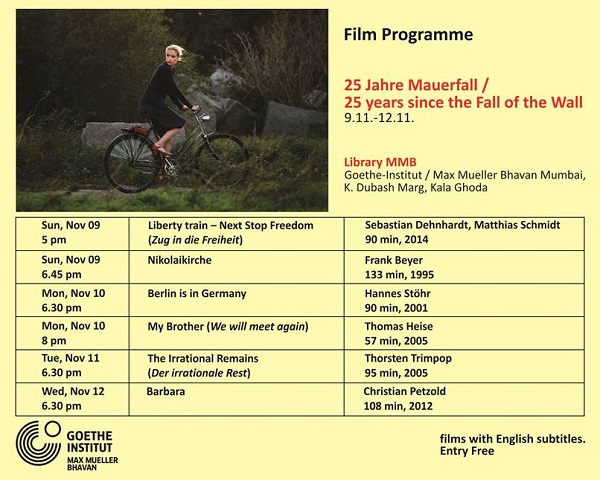
25 years have passed since then. The Goethe Institut Mumbai is commemorating the milestone in Germany’s history with the screenings of six German films starting today, Sunday, November 9 to November 12, 2014. The films are documentaries and feature films. See the schedule as under:

Fall of the Wall schedule

(Picture courtesy thekidswindow.co.uk)

Categories
Do

The st+art of all things awesome

After ‘st+art delhi’, art festival ‘st+art mumbai’ kicks off across multiple locations in city today; two Mumbai artists are part of the Indian artists’ group.
by The Editors | editor@themetrognome.in

We can’t get enough of art in our metros, so any initiative that promotes street art and encourages public participation always gets attention.

‘st+art mumbai’ already started with mural painting in Bandra from November 3, 2014 but officially kicks off from today with the completed mural being presented to the public. From today, November 7, 2014, ‘st+art mumbai’ will kick off across multiple locations in Mumbai, and will go on for a month, till November 30. This is an urban art festival that aims to promote street art on Indian landscape, as well as provide a collaborative platform for street artists from all over the world. The festival will take a whirlwind tour across Bandra, Dharavi, Kala Ghoda, Peddar Road and Versova.

On the anvil are mural paintings, stencil workshops, graffiti workshops, sticker making workshops, and street art walks. See the entire calender of events here.

Participating artists are Akacorleone, Amitabh, Ano, Anpu, Bond, Daan Botlek, Daku, Dome, Gomez, Harsh Kadam, Harsh Raman, Pobel, Ranjit BAP, Seikon, Tika, Tofu, Tona, Tyler, Yantr.

The initiative aims to make the normally ‘exclusive’ art world more accessible to the man on the street – literally. Participating artists will also conduct workshops on stencilling and graffiti, among others. International artists for the initiative include Bond (Germany), Seikon (Poland), Ano (Taiwan).

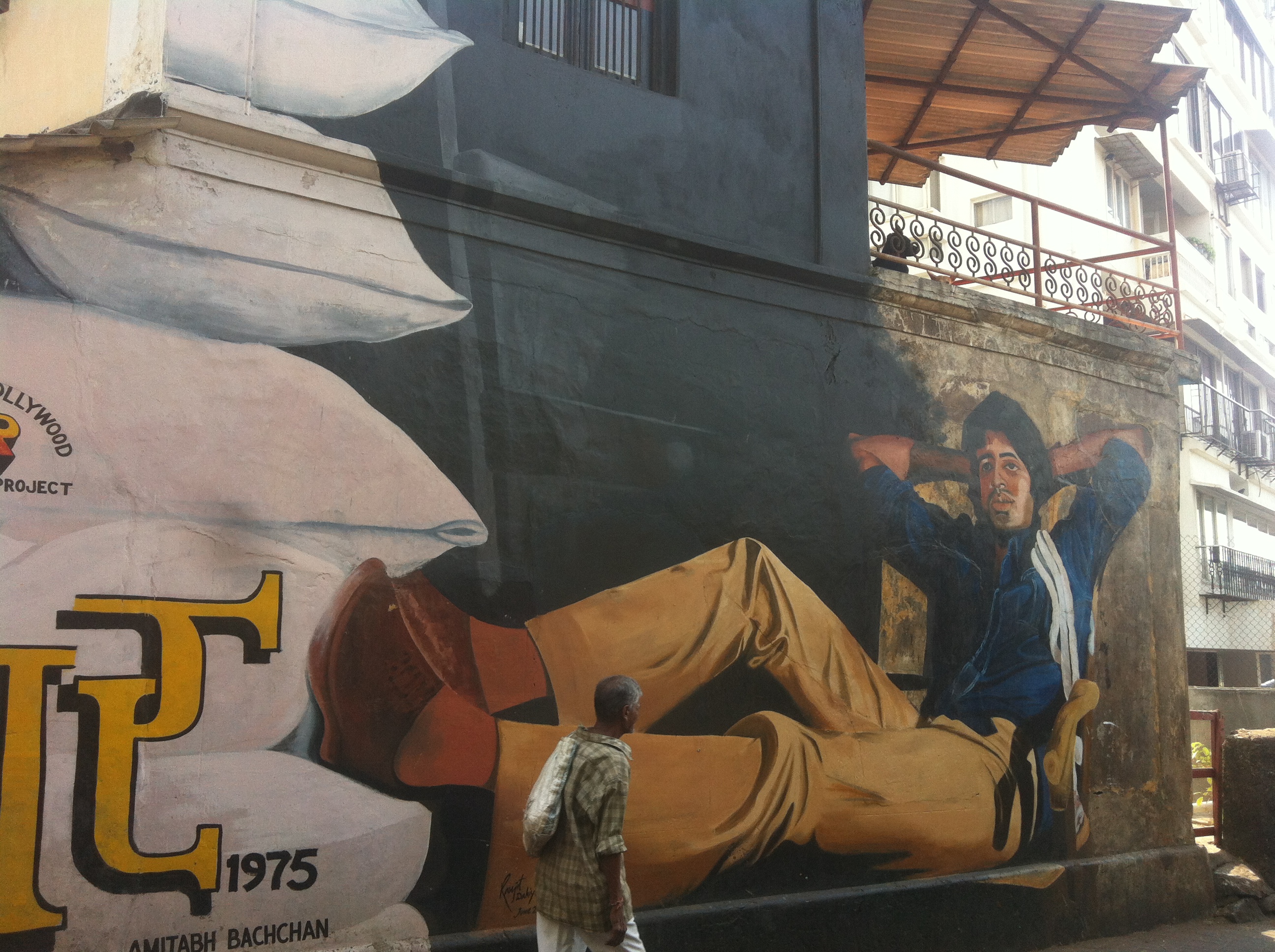
(Featured image is used for representational purpose only. Photograph shows Ranjit Dahiya’s mural of Amitabh Bachchan in Bandra, Mumbai)

Categories
Tech

Review: Samsung Galaxy Alpha

Samsung has upgraded its design and done away with some irritating features, but little else has changed for their newest phone.
by Manik Kakra | @Manik_K on Twitter

If there’s anything in the Android space that’s withstood lots of tests, it has been Samsung’s Galaxy S and Note series. The two series have done exceptionally well in various markets, but now Samsung is thinking differently, and working to improve their phone design and looks. In the last three years or so, the company has been lauded for great phone features and offerings, but it has also been criticised for not thinking over its design and material choices. This is where the Samsung Galaxy Alpha comes in.

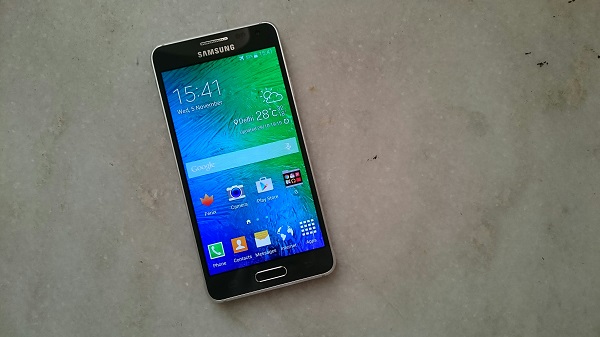
The looks. Samsung’s Galaxy Alpha (SM-G850Y) has a dual chamfered aluminium frame with slightly narrowed edges –a big change in a Samsung smartphone. Samsung has gone with chrome edges quite a few times, but these looked like fake metal and didn’t last long. But as soon as you pick this phone, you will notice how nice the phone feels and how comfortable it is to grip. With its 4.7-inch 720p screen with decent-sized bezels, lightweight profile (115 g), the phone feels compact and is surely not a bulky handset by today’s standard.

The front, other than the screen, sports the speaker grill, Samsung logo, front-facing camera and sensors at the top; and three navigation keys – Menu, Home (physical), Back – at the bottom. The left side panel locates volume rockers (single body that sort of flats towards the middle part); while the right side panel carries the Power/Lock key. Again, if you look at these physical keys, you realise the company has chosen materials thoughtfully. Though it would have been better had these buttons been required to press a little less firmly, they look nice and give just right feedback on pressing.

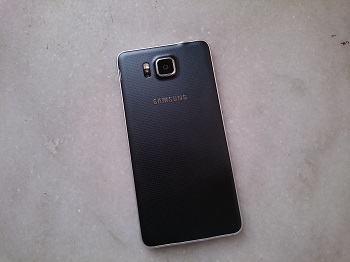
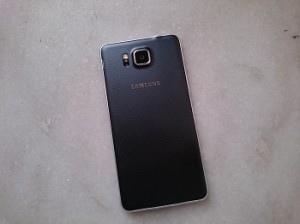
Coming to the back, you see the main camera with the LED flash and heart rate monitor embedded inside, and the Samsung logo and loudspeakers towards the bottom. The back panel is made of a thin plastic sheet, which is probably the only design flaw that could have been handled better. The back sports a patterned design, a bit different from the Note 3 and definitely better to look at on first glance. The 3.5mm headset jack and secondary mic are placed right at the top (where you can also see two plastic cut-outs for antenna purpose); and the microUSB 2.0 has been neatly placed at the bottom

Screen. The 4.7-inch (1280 x 720) Super AMOLED screen is far from being one of the best out there. The S5 has a full HD Super AMOLED, but the Alpha has an HD screen that does a good job for viewing videos, playing games and when used under direct sunlight. The black levels are deep, colours look vibrant and quite saturated (red and green), which you expect from a Samsung AMOLED. But it doesn’t quite show accurate colours. The screen has good viewing angles, and its flaws are not deal breakers.

Audio. The loudspeaker at the bottom is actually fairly loud and mostly clear. If you are okay with its placement and don’t find yourself putting your hand on it unknowingly and muffling sound, it performs well for videos as well as games. In-ear audio quality with the bundled headsets is also decent. It does its job well, giving clear audio for most basic use and handling beats and treble quite well as a default smartphone headset would.

Camera. The phone sports a 12 MP camera (f/2.2) at the back with an LED flash. The native camera app is exactly what we have on the S5 that is simple and smooth to use. Here are a few sample images

As you can see, the phone can take sharp and quite detailed photos. It performs pretty well in good light conditions, but struggles in low light. The camera takes a little with noticeable contrast while to focus in low light (with stabilisation) and clearly isn’t that good in that department. With default settings, though, you can take pretty good shots. There are plenty of modes to choose from, like HDR, Panorama, Selective Focus, which works as well as the S5.The camera can also take ultra HD videos, which can also be edited later.
Battery. The phone houses a 1,860 mAh battery unit. It is not too large by any modern smartphone standard, and it shows in the battery life. I found the phone struggling to go beyond 20 hours of usage. Having said that, with moderate usage, it can give you nearly a day’s use. With a little high brightness level and playing a couple of games, checking Twitter, and Emails, you will find yourself having to charge the phone more than once every 24 hours. With that thin profile, seems like battery life took quite a toll on itself. Connectivity-wise, the phone doesn’t give any troubles. Bluetooth, GPS lock-in, NFC, WiFi perform just as you would expect from a smartphone.

Software and performance. The Indian Galaxy Alpha variant has Samsung’s Exynos 5430 (1.8 GHz quad-core processor + 1.3 GHz quad-core processor and Mali-T628 GPU) coupled with 2 GB of RAM. The phone runs on Android 4.4.4 with TouchWiz UI on top. This is a 32 GB model with around 25.8 GB of usable storage space. Talking about the phone’s software and performance, it is similar to what we saw on the Galaxy S5. The phone can handle heavy webpages, games, closing and resuming apps just fine. But you will find the UI stuttering a little every now and then. One out of five times on pressing the Power/ Lock key to unlock the device, you will see the screen doesn’t light up for three to four seconds while two navigation keys illuminate immediately – a bug. Also, on pressing the Recent apps key, there’s some delay when the recent apps line-up and you can press the app of your choice. It would have been nicer had Samsung done a few subtle changes with its TouchWiz, maybe marking the start of better iconography, fonts and toning down on how heavy TouchWiz feels at times.

The Galaxy Alpha is more about Samsung’s change in design for its upcoming devices and less about this device itself. The phone clearly performs better in the design department compared to other Samsung phones during the last two to three years. With a decent screen, good camera, average battery life, it’s a bit hard to suggest this phone over the S5, but for those looking for a Samsung phone that doesn’t feel tacky and is comfortable to hold, this might be a good option.


Categories
Event

Attend: ‘Museum of Chance’, a photo-book release

Singh’s photographic sequence of her own work ‘Go Away Closer’ is titled ‘Chance’ and opens for public viewing in Mumbai.
by The Editors | editor@themetrognome.in

Dayanita Singh’s Museum of Chance (2014) is a book about how life unfolds, and asks to be recorded and edited, along and off the axis of time. The inscrutably woven photographic sequence of Singh’s Go Away Closer has now grown into a labyrinth of connections and correspondences. The thread through this novel-like web of happenings is that elusive entity called Chance. It is Chance that seems to disperse as well as gather fragments or clusters of experience, creating a form of simultaneity that is realized in the idea and matter of the book, with its interlaced or parallel timelines and patterns of recurrence and return. “While I was in London I dreamed that I was on a boat on the Thames,” Singh writes in the book’s epigraph, “which took me to the Anandmayee Ma ashram in Varanasi. I climbed the stairs and found I had entered the hotel in Devigarh. At a certain time I tried to leave the fort but could not find a door. Finally I climbed out through a window and I was in the moss garden in Kyoto.”

The 88 quadratone images in the book also appear on the front and back covers in random pairs, transforming each copy of the book into a distinct piece of work by the author. ‘’Exhibitions come and go,” Singh says in an interview, “but what remains is the book’’. Each copy of Museum of Chance, therefore, is mass-produced as well as unique because of the random combination of images on its front and back covers and the different colored cloth covers. Moving away from showing editioned prints framed on the wall, Singh makes the book itself the art object, to be valued, looked at and read as such, rather than being regarded as a gathering of photographic reproductions. Infact the Book in its special structure is the work, as were  her silver gelatin prints, and the images inside could be seen as the catalogue of this exhibition of the 88 book covers.

One of the finest photographic artists in the world, Dayanita Singh has always seen herself as a bookmaker working with photography. She has published several mass produced artist books in the course of her career like Go Away Closer (2007), Sent a Letter (2008), Blue Book (2009), Dream Villa (2010), Dayanita Singh (2010), House of Love (2011) and File Room (2013), among others. She has also presented her work in several solo and group exhibitions like Go Away Closer, a solo exhibition at Museum Für Moderne Kunst, Frankfurt (2014); Dayanita Singh, a solo exhibition at the Art Institute, Chicago (2014); A group exhibition in the German Pavilion at the 2013 Venice Biennale; Indian Highway, a touring group exhibition at the Serpentine Gallery, London; Astrup Museum, Oslo (2009); Privacy, a solo exhibition at Hamburger Bahnhof Museum for Contemporary Art, Berlin (2003).

During the opening today, November 6, 2014, Singh will make available the very first of her limited edition of the Book object. She will also individualise them during the opening. The limited edition of the book object, in an edition of 352, costs Rs 9,000 and is only available through her.

It is the same object as you will see on the wall (the book, Museum of Chance, in a specially-made wooden structure to install it on the wall). So in a sense, you can carry part of the exhibition home.

Head to Galerie Max Mueller, Goethe-Institut / Max Mueller Bhavan Mumbai, Kalaghoda, Mumbai on Thursday, November 6, at 6.30 pm. The exhibition is on till December 10, 2014.

Categories
Bombay, bas

What’s wrong with liking ‘Happy New Year’?

What makes us think the ‘masses’ have no brains, and hence deserve ‘certain’ films? Since when did we become such snobs?
Pooja Birwatkarby Dr Pooja Birwatkar

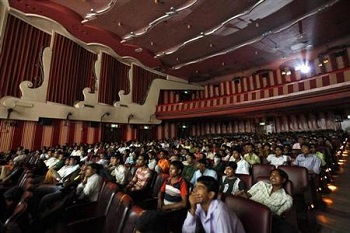
The other day I went to watch a movie, and after a long time I thoroughly enjoyed the new SRK film Happy New Year. Later, as I read the reviews and comments about the film from friends on Facebook and Whatsapp, I received a slight jolt. The reviews trashed the film for being mindless, a total waste of time and okay for people who normally left their brains at home while watching movies. Others said the movie was for the ‘front benchers’, a ‘mass movie’ full of seeti bajao scenes.

In short, Happy New Year is a perfect concoction of all the masalas needed to trigger Indian sentiments – friendship, parental love, patriotism, revenge, hatred, and everything else you can think of.

These reviews and comments prompted me to think: Am I a ‘mass-class’ person? Then I wondered: Wait a minute, what’s so wrong about being the ‘masses’?

I think this Mass v/s Class debate started with people coming to live in the metros, abandoning for ever their lives in villages and small towns for jobs, better lives and more stability. Of course, only those who migrated know the price they have paid for it – nobody can deny that we are lead, or should I say endure, extremely chaotic lives in the cities. Our days are so cluttered and time-bound that we seek escape routes to transform ourselves from the machines we have become to the easygoing humans we would like to be. The intellectual work we do in our offices never offers our poor brains some respite from constant stress and thought, and we Mumbaikars have actually forgotten what it is to ‘Chill maar’.

As adults in a fast-paced, crazy times, we are not alone in losing the ability to focus on the big picture. But we are unable to look for ways to break out of our own shackles. And while most of us may Mass class moviesnot have the chance to walk out of our jobs at this very moment, at least we can relax for one evening and watch a ‘brainless’ movie without having to explain ourselves?

The message I got from Happy New Year was that there are losers who get at least one opportunity to become winners. Isn’t that what we all desire? For one, the film gave me intense sadistic pleasure to know that there are other losers in the world, too. Also, the three hours that I sat through the movie filled me with the hope that losers can achieve what they want, at least once in their lives.

Sure, these movies take us off to a fairytale land where everything’s possible – that, in itself, to detrimental to sane thinking in the real world. But I am sure a lot of us find these movies cathartic and therapeutic to a large extent. Once you step out of the theatre, the real world with all its problems comes back to pounce, but that three hours’ worth of alternate reality was a joy to experience, wasn’t it?

So everyone out there, like me, who once used to be a patron of classy, cerebral films – don’t feel guilty about enjoying masala movies, too. It is totally okay to like mushy romance, gravity-defying action stunts, item songs that make you whistle, intense scenes that make you cry, patriotic scenes that make your heart race. Is your real life filled with so many emotions?

The next time you go to watch a masala movie, go with an open mind. Laugh with everyone in the theatre because everyone, mass or class, is allowed to laugh at the same things. And like the movie said, ‘Keep it simple’. Trust me, life becomes more tolerable once you step out of the theatre.

Dr Pooja Birwatkar is currently pursuing post doctoral research and working in the area of science education. She has been associated with the field of education in the past as a teacher educator, and her area of interest is research in education. 

(Pictures courtesy newsviewslive.com, in.reuters.com. Images used for representational purpose only.)

Categories
Trends

Mumbai walks more than Delhi

Mumbaikars reveal feelings of calmness, better self esteem and improved physical and emotional health due to walking, says a survey.
by The Editors | editor@themetrognome.in

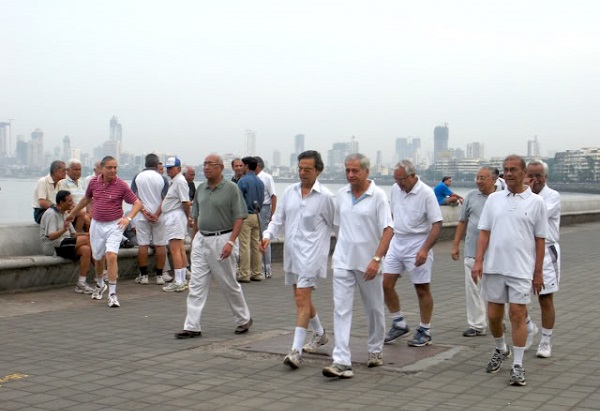
Walking regularly helps people restore their work life balance, makes them calmer, happier and more positive towards life, reveals Max Bupa Walk for Health Survey 2014, a first of its kind study of nearly 1000 walkers in Delhi and Mumbai.

According to the survey, 83 per cent walkers in Delhi and Mumbai experience positive lifestyle changes post walking. 43 per cent walkers in Mumbai and 47 per cent walkers in Delhi feel they have become calmer after taking up walking, while 26 per cent in Mumbai say that their work life balance has improved post walking, as they have started leaving office on time,to walk.

WalkingThe survey reveals that more Mumbaikars also feel that their sleeping habits have improved as a result of walking, and many have experienced an improvement in their self-esteem and confidence. Interestingly, 70 per cent patients suffering from serious heart, respiratory, obesity and bone or joint-related ailments also experienced improvement in their physical, mental and emotional health after walking.

The Max Bupa Walk for Health initiative aims to encourage people to integrate walking into their daily schedule. Buoyed by the participation of more than 40,000 people in the two editions of Max Bupa Walk for Health 2012 and 2013, the third edition of Max Bupa Walk for Health is scheduled for November 9 this year in Delhi and Mumbai.

A significant number of regular walkers say that that they have started avoiding junk food (60 per cent), started waking up early (51 per cent) and have become more inclined towards a healthier lifestyle than before. 1 out of every 3 regular walkers in Mumbai prefer walking over driving short distances. The incidence of walking instead of driving shorterdistancesis also high among cardio (47 per cent) and obese patients (35 per cent).53 per cent patients who walk regularly experienced decrease in stress and 41 per cent said it helped improve their blood pressure levels. Weight loss is also one of the positive after-effects of walking, visible within six months in most patients. On an average, patients reported losing more than four kg through regular walking. Cardio and obesity patients reported an average weight loss of six kg and five kg respectively.

Manasije Mishra, Chief Executive Officer, Max Bupa said, “The findings of the survey reinforce the numerous physical and psychological benefits of walking, including better health, positive lifestyle changes, improvement in eating and sleeping patterns, among many others. It has emerged from the survey that walking is a super pill, prescribed by 96 per cent doctors to people across age groups, including patients suffering from chronic ailments like heart diseases, obesity and asthma.”

Pointing at city wise walking trends, the survey revealed that while Delhi walks more on weekends, Mumbai walks the same distance on weekdays and weekends. However, Mumbai walks longer (45 minutes) than Delhi (34 minutes) at one go.

“The survey shows that companionship makes walking more enjoyable and presence of a companion is a motivator for people across age groups to walk regularly. Over 50 per cent people in Mumbai prefer to walk with their families,”added Anika Agarwal, Head-Marketing, MaxBupa.

Interestingly, the survey also revealed how technology motivates different age groupsand genders to walk more. People in the older age group are more disciplined and focused while walking, however those in the middle and younger age groups like to multitask, engage on social networking sites or apps while walking. Respondents said they listen to music, check emails or talk on the phone as they walk.

(Pictures courtesy arunshanbhag.com, caveviews.blogs.com. Images used for representational purpose only)

Exit mobile version