Categories
Event

Join the discussion: How can US and India make it work together?

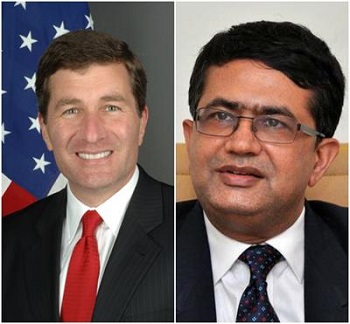
Charles Rivkin, US Assistant Secretary of State and Ashish Chauhan, MD and CEO, Bombay Stock Exchange, will discuss US-Indo ties.
by The Editors | editor@themetrognome.in

This is a discussion you can’t afford to miss, especially if you’re keeping tabs on the growing closeness between the US and India.

Charles Rivkin, Ashish ChauhanThis evening, Charles H Rivkin, US Assistant Secretary of State for Economic and Business Affairs and Ashish Chauhan, MD and CEO of the Bombay Stock Exchange, will jointly discuss how nations can create the ideal conditions to foster greater investment and innovation.

An excerpt about the event released by the US Consulate General, Mumbai, which is hosting the discussion, says, “In the 21st century, the wealth of a nation is often measured in intangible capital such as knowledge, goodwill and intellectual property assets. From the Jaipur foot to water ATMs and backpack Electrocardiogram (ECG) machines, necessity has fuelled India’s innovation sector. As the premium on innovation grows, businesses and governments are looking for ways to best foster innovation and increase global competitiveness. What opportunities can the world’s two largest democracies create through collaboration on innovation? How might India take steps to cultivate an environment which encourages greater innovation and supports more sustainable economic growth? And how would doing so deepen U.S.-India business ties?”

Charles Rivkin has previously served for more than four years as the United States Ambassador to France and Monaco where he led one of America’s largest diplomatic missions. Prior to his Government service, Ambassador Rivkin worked in the media sector for over 20 years where he served as President and CEO of award-winning entertainment companies such as The Jim Henson Company and Wildbrain. In 2013, Ambassador Rivkin was personally awarded the Légion d’honneur with the rank of Commander by French President François Hollande.

Ashish Chauhan is currently the Managing Director and CEO of the Bombay Stock Exchange. He is best known as the father of modern financial derivatives in India. Ashish has been an integral part of the team responsible for setting up the National Stock Exchange where he set up the first commercial satellite network, initial technology platform, the Nifty index and many other such platforms for trading. He has also been responsible for technologically revamping the BSE. His efforts have been lauded through numerous awards, most recently – the Best CEO in the Financial Markets of Asia Pacific by the Asian Banker.

Head to Chhatrapati Shivaji Maharaj Vastu Sangrahalaya, Visitors Annexe, 159-161, MG Road, Fort, Mumbai 400023, today, November 13, at 7 pm. Entry is free but you will need to register at 6.30 pm. 

(Featured image courtesy thehansindia.com)

Categories
Tech

Review: Touchtalent app

This is an app that allows you to showcase your art and connect with, hire other users for professional purposes.
by Manik Kakra | @Manik_K on Twitter

There are quite a few smartphone apps that allow you to share photos, rate them and comment over them, but there are hardly any apps that allow you to actually showcase your creative side and earn from it. Touchtalent is one such app. To put it in a nutshell, Touchtalent is a Web community where people showcase their art. As a user, you can follow many other people that you feel have some worthy content, if or you want to connect with for working alongside.

Touchtalent appTo start with, you can either use your Facebook or Google+ Account, or choose to sign up with your Email ID. From here, you can then upload your photos, graphical art, design, follow others and even message them right there. Plus, there’s an option to hire a person, but I couldn’t really check that, but it probably is there if you want to partner with another person regarding some project that you feel they are good at (looking at their collection).

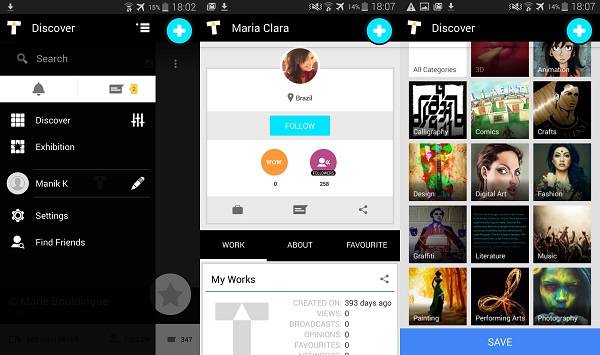
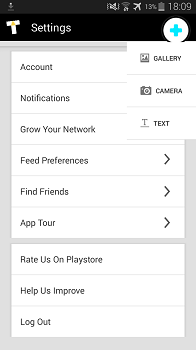
The app (I tried it on Samsung’s Galaxy Alpha, running on Android 4.4) is available for Android and iOS. It works smoothly and looks just as an app that revolves around art should. The App’s UI is simple and user-friendly. The first time you try it, you won’t be confused. As soon as you join in, you’re provided with a link to see other Touchtalent users from your country.  The left pane gives you options like Discover (to see popular users), Exhibition (for special occasions), Settings, your Profile, and the option to add your Social Profile. You can upload a photo from your phone’s Gallery or take a photo from the camera right from the app. Your feeds show you collections of people you will follow, and from there you can visit a user’s Touchtalent Profile, use a picture as your wallpaper, Star it, or share it to another app. Every time a person view your Profile, or follows you or likes it, you get a notification, which you can opt out from the app’s settings if you like.

To wrap it up, Touchtalent is a worthy place to check and explore if you want to showcase your art. The community seems active and something that most users will feel like interacting with.

Categories
Event

Children’s festival kicks off in Thane today

Timed to include Children’s Day on Friday, November 14, the week-long festivities include activities for children of all age groups.
by The Editors | editor@themetrognome.in

Thane has long had a tradition of celebrating Children’s Day on November 14 with gusto, every year. This year, too, with several building societies holding prestigious competitions and private organisations organising activities for children, the situation is no different.

However, Thane has an exciting Children’s Festival lined up starting today, to interest children of all age groups. The Vinod Memorial Welfare Society is organising the week-long festival and will include a variety of activities, such as acts like magic shows to serious sporting competitions.

Says Mukesh Thombre, one of the organisers, “The festival was organised with a view to observing Vinod Thombre’s birthday on November 11, and to also celebrate Children’s Day on November 14. This will be a week-long fiesta with all participants enjoying art and crafts competitions, treasure hunts, essay writing competitions, etc. We are also organising afashion show, and sporting matches for box cricket, badminton and ring football for the older age groups, and there will also be traditional Indian games such as lagori, gilli danda being played.”

Younger age groups can also participate in song and dance competitions and art contests. The festival wraps up on Sunday, November 16.

For details and to register your child for the festival, contact Mukesh Thombre on 9892111999 or Sameer Shetye on 9892126036.

(Image used for representational purpose only)

Categories
Deal with it

‘Swachh Bharat’ is not just a campaign

It has become a trendy new phrase, but maybe we need to take the ‘Swachh Bharat’ campaign beyond mere tokenism. Maybe we should try seriously adopting it.
Pooja Birwatkarby Dr Pooja Birwatkar

‘Swachh Bharat’ is the new ‘in’ thing for the country. When the campaign was launched in October this year, I, like so many others, instantly dismissed it as another campaign which would quickly gather dust as fast as it initially gained momentum. But though it is still in its infancy, the campaign has thus far proved us wrong about its estimated short-lived sustenance.

What is most remarkable about this programme is that it has captured the hearts of the nation’s young the most – in itself, a major achievement. What a way to go, if the future of this country is most enamored by this campaign! The other day, my little son and his six-year-old cousin reprimanded an adult who was about to throw an empty chips packet on the street with the words, “Don’t litter, Modiji ne mana kiya hai.”

So why did this particular campaign strike a chord? Is it merely the charisma of Narendra Modi who launched the campaign? Is it something else? One cannot deny that Modi has been the single most powerful force that has made the campaign what it is. But if you think about it, he merely stated what he have now adopted as a way of life in India. His sentiment that gandagi has crept so deep into our system that we have learnt to live with it to the extent that we condition ourselves to overlook it. Yet, subconsciously, gandagi has always bothered us. Which could explain why the first thing anybody on a first-time trip abroad will say on his or her return is, “People don’t throw garbage on the streets there. Everything was so clean! Yahan aisa nahin hai.”

Let’s talk about our own city – Mumbai, the heart of India, a city famous across the world for both its famous and infamous attributes. But just look at the city and what we have turned it into. Filth in IndiaVehicular traffic, a population bulging at the seams, dearth of greenery, plenty of noise and dirt, garbage strewn all over, filthy beaches, polluted air, numerous diseases, poverty, slums…this is the overall picture of this metropolis.

As we marvel over the huge towers and amenity-laden buildings in Mumbai, just peep at the fringes. The magnificent houses with French windows open to a whole world of garbage, but we are able to miraculously able to look beyond it and focus only on the clouds above. We are all collectively living in a big garbage bin, and then we have the gall to call this indifferent attitude ‘the spirit of Mumbai’. And why are we so proud of this ‘spirit’ anyway, if it makes us immune to these evils of our own doing? We even go a step further and expect the BMC and the Government to clean up after us – after all, we pay taxes, do we not? So cleanliness and hygiene is not our problem.

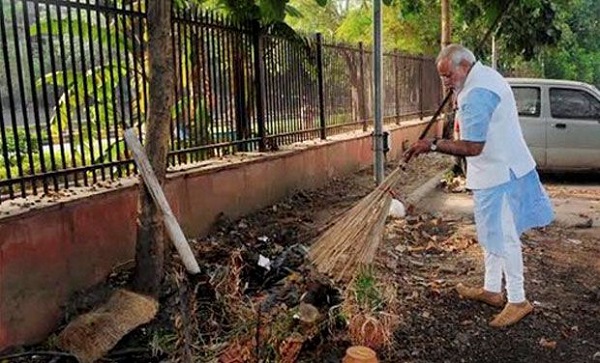
A campaign like ‘Swachh Bharat’ has shaken us. Even more so, because the country’s PM was the first one to pick up a broom. Suddenly, dusting doesn’t look like such a lowly job.

But simply realising the problem is not enough. We have to fuel this campaign at all times. It doesn’t matter if everybody doesn’t participate in it – let’s pledge to first clean our city and not focus simply on our own homes. Mumbai is home to all of us, and it is everybody’s responsibility to ensure its good health.

Dr Pooja Birwatkar is currently pursuing post doctoral research and working in the area of science education. She has been associated with the field of education in the past as a teacher educator, and her area of interest is research in education. 

(Pictures courtesy deccanchronicle.com, www.ndtv.com)

Categories
Achieve

An app to help find missing children

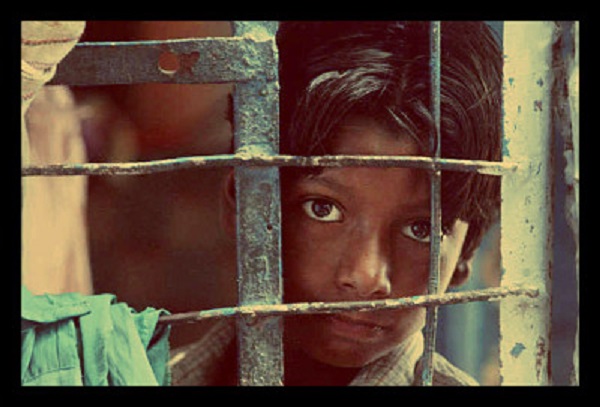
Mumbai techies have developed the app ‘Helping Faceless’ that uses face recognition and data analytics to help trace and return missing children.
by Vrushali Lad | editor@themetrognome.in

It is a burning problem that grows in strength every year. And yet, apart from police detection, there is not much to fall back on when it comes to finding missing children in India.

Except, these Mumbaikars know what can be done – albeit in a long-drawn out process. The app they’ve developed, ‘Helping Faceless’, uses face recognition and data analytics to help trace, and hopefully return, missing children in India.

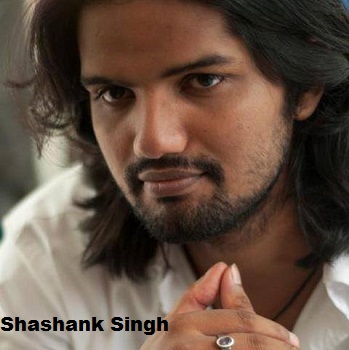
shashank singhSpeaking to The Metrognome, Shashank Singh (29), founder of Helping Faceless, says, “India has a big problem on its hands. Over 1,00,000 children go missing every year all over the country. Of these, most are kidnapped while some run away voluntarily. Many of them land up in begging rings,or are forced into the flesh trade, or end up as labourers in eateries or factories, or as domestic help. What’s more, many instances of missing children are under-reported. Something needs to be done to find these children before they are lost forever.”

What gave him the idea to start the app over a year ago? He pauses for a while, then says, “As a child, I spent some years in UP, in the 90s. When I was about six years old, I was kidnapped for five hours. I have no recollection of the incident, I only know what my parents have told me. It turns out that I was helped by a stranger and returned to my parents.”

That incident, though he has no memory of it, always stayed with him for one fact alone – that a stranger had helped him out from a potentially disastrous situation. “When I came to Mumbai in 2012 and later when I started working on this app, I realised that strangers helping each other was an extremely powerful idea, especially if it was scaled to a level where millions could help each other. My team and I hence developed ‘Helping Faceless’ to help these millions of missing children find their way back home.”

Though he started work on the app alone, today there is a small team in place, with Amol Gupta as co-founder.

How does it work?

The app is simple to use – if you spot a child in distress (either being abused, or working in hostile conditions, etc.), all you have to do is take a picture of the child, and the app auto-relays the picture back to the team’s server. “From here, the photos are referenced with the pictures in our database. When we find a match, we see the details for that missing child and contact partner NGOs and organisations in that place to seek their help in returning the child,” Shashank explains.

However, users are encouraged to talk to the child and build confidence to get details. They are also instructed to give begging children food instead of money. “Even a simple gesture such as giving a child chocolates will help the child speak with you. We encourage users to help the child in any way they can,” he says.

The team works with SOCH (Society Of Children), a TISS organisation which does the back-end work and helps guide the team through the legal steps to follow after a child’s pictures match. “SOCH also helps us figure out potential partner organisations in other cities to coordinate the process. However, each case is different and we have to work as per the requirements,” he says.

Currently, the team has over 60,000 photographs of missing Indian children in its database. “These were sourced from available police records. We are constantly building the database and uploading more pictures and information, while also reaching out to more partners. It’s a long process to begin the journey from tracing a child’s current location and returning the child home, but in a year, we have had success with three children – two from Ludhiana and one in Mumbai. That is a modest number, but the process moves at a glacial speed,” Shashank says.

Also, users must be a little careful about taking pictures of children. “Though there are no laws in India about taking a picture of a child in a public place, provided the child is clothed, we still discourage users from forcefully taking pictures. Also, sometimes it may happen that another person may stop you from taking a picture. Many users have been frightened off,” he says.

What ‘Helping Faceless’ hopes to achieve

“Essentially, we are a business that goes against another business – in this case, we are up against a $36 billion ‘illegal’ business,” Shashank says. “The best way to dismantle a business is to make it unprofitable. Using an app like this, though it seems like a small step, will help us hit back.” He adds that the crux of the app’s ethos lies in the public and police working together to solve these terrible crimes. “The bigger goal is, in four to five years, to have enough data to be able to predict a crime, and data analytics allows us that. The difference between trafficking and crimes of passion is that there is a time lag involved – the trafficked child is taken from spot to spot by public transport normally, there are specific train routes that traffickers use. We can empower the RPF to use the data and intercept the crime in real time,” Shashank explains.

He has shown the app to police officials in some Indian cities, and says that cops are interested in it because the same technology is also useful to catch criminals. “I would say that the same technology can be used to find all missing persons, criminals or not. However, we realise that currently there is a high churn rate among the app’s users. So we are working to make it more community-based and engaging to the user. We have about 3,000 people installing the app per month and signing up, but many of them drop out later on.” The improved app will roll out in two weeks’ time, he says, and so will its iOS version.

Currently, the team has about 30 dedicated volunteers, most of them from Mumbai. “We have found the highest response from Mumbai and Bangalore, while Delhi has the poorest response to the problem,” Shashank says. “Unfortunately, public support is lacking for initiatives like this. People are happy to give money to a child that begs, instead of talking to the child and taking a small step towards helping him or her out.”

‘Helping Faceless’ is available on Google Play Store and on Facebook: /helpingfaceless. 

(Featured image courtesy borgenproject.org. Image is used for representational purpose only)

Categories
Tech

Lenovo launches Vibe X2

Launched at a price of Rs 19,999, the new ‘three layered’ Android smartphone goes on sale on Flipkart today onward.
by Manik Kakra | @Manik_K on Twitter

Lenovo recently launched its brand new mid-range Android smartphone called the Vibe X2. The X2, part of the Vibe series, boasts a 5-inch full HD touchscreen.

Vibe X2_The USP of the phone is its ‘three-layered’ body that consists of three distinct colours to form the phone’s body, which is about 7.3mm thick and weighs 120 grams. Under the hood, there’s a MediaTek MT 6595 SoC (1.7 GHz quad-core + 2 GHz quad-core, Series6 PowerVRGPU) along with 2 GB of RAM. The new Vibe X2 is powered by a 2,300 mAh battery unit, and the company also unveiled a battery accessory, priced at Rs 1,999, (termed it as the X2’s fourth layer) to attach with the device that makes the total capacity 4,600 mAh.

On the back, the phone features a 13 MP (AF) camera; while the front has a 5 MP camera.  There’s 32 GB of on-board storage. The device runs on Android 4.4.2 with Lenovo’s own UI on top. The company says it will update the X2 and Z2 straight to Android 5.0 next year without giving them Android 4.4.4 update in between. Connectivity-wise, there’s 4G (LTE), 3G, Bluetooth 4.0, microUSB 2.0, FM Radio, NFC, WiFi b/g/n/ac, and GPS.

The phone will go on sale exclusively on Flipkart starting today, November 10, at a price of Rs 19,999.

Exit mobile version