Categories
Deal with it

Take note of Indian folk artistes, Bollywood: Santosh Sawant

Noted folk music artist and now film director, Santosh Sawant wants Bollywood to feature more folk music to popularise it.
by The Editors | editor@themetrognome.in

Maharashtra has a rich tradition of folk music but many popular forms of folk music entertainment such as Bharuds, Gondhals, Lavanis, Povadas, Bhaleris, Palanes and Artya have slowly gone off the radar, and are now on their way to extinction. It is a sad state of affairs indeed, that people have forgotten the folk forms peculiar to their home States, as Hindi film music pervades our collective music consciousness.

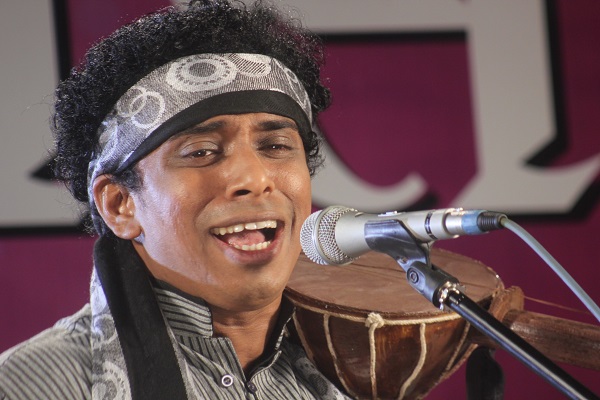
Actor, filmmaker and music composer Santosh Sawant, aka ‘Pawa’ (meaning ‘flute’ in Marathi), wants the new BJP Government in Maharashtra to save folk singers in the State who are struggling for survival. ‘Pawa’ is a gifted folk singer himself, who tried, unsuccessfully, to gain acceptance in Bollywood – owing to his non-mainstream voice. He is known as a foremost exponent of ‘jhamela’, a form of folk song that throws light on the complexities and tragedies of life. “But I persevered and cut an album with the help of T-series in 2010,” he says. “It was called Voice of The Heart. I am now ready to launch my debut Hindi feature film project titled Jhamela which will showcase the life of a folk singer.” The film is inspired by Sawant’s own life and details jhamela as an art form, among other things. “I hope to make folk music more popular through this film. I shall first show it at 45 renowned international film festivals before showcasing it in India,” says Santosh.

Why the spotlight on folk music?

‘Pawa’ is an engineer by qualification who was born in Ratnagiri but who came to Mumbai for higher studies and stayed on. He had a successful career in the machinery exports business, but his love for music often made him restless. “I was born in the idyllic Kolisare in Ratnagiri, which has lush green hills on one side and pristine virgin beaches on the other side. People here were totally disconnected from the modern world, and I grew up in a culture of folk music, folk dances and folk plays which were displayed during the Jalsa, a local fair prevalant in Konkan,” he remembers, adding that his performances at these fairs earned him the ‘Pawa’ nickname.
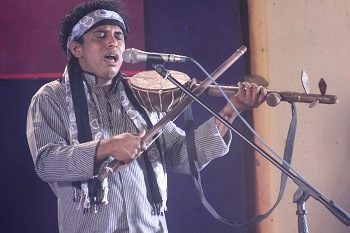
'Pawa' performs on stage (1)He claims he has an acting degree from London, and speaks with bitterness of how Bollywood shunned him because “they didn’t want to take a chance with an actor who dabbled in folk music.” Today, he says he works to further the cause of folk music in India and abroad.

Incidentally, during the recent State Elections, the BJP was said to employ around 200 folk singers to campaign for it. Says ‘Pawa’, “I want the BJP to continue its association with folk singers through scholarships, donations and other forms of support.

“Maharashtra’s zestful folk music has the power to hold the audience spellbound. Folk songs have often formed an important part of Indian movies and some of them are memorable to the day. They are melodious, tug at your heart and often end up having repeat value. While folks songs from different regions have gained mass popularity, it is the original folk singer who somewhere down the line faded into oblivion. Rarely has Bollywood rallied around any folk artiste to give them mass coverage and publicity. I think Bollywood should stop neglecting folk singers.”

At present, folk music is being practiced in the approximately 50 Kala Kendras across Maharashtra, most of them in the Marathwada region. There are around 130 travelling Tamasha troupes that perform seasonally and approximately 15 full-time troupes that perform all through the year. Nearly all of them are fighting for survival.

“The modern film viewer has a warped and skewed notion of folk music as most of it is fed by what various regional and national movie industries are churning out. For example, for the viewer, a Lavani is just another item number adding masala to a movie. To add insult to injury, these dances are performed by mainstream actresses, as no one wants to cast the women who have lived and breathed this dance for centuries,” ‘Pawa’ fumes.

Any takers?

Ask him if anybody’s really interested in folk music these days, and he says, “Of course people are interested, they just need to be exposed to folk music. I have my own band, and we have taken Jhamela all across India and even abroad. We use traditional instruments like harmonium and dholki while staging our folk songs and plays. People love the simplicity associated with our songs which we use to denote the great complexities that human life deals with regularly.”

‘Pawa’ says he hopes his film will find resonance even among the urban viewers. “We need to make our folk music, and our folk artistes, more mainstream,” he says. “It is unfortunate that so many are living in oblivion and poverty.”
Categories
Achieve

Mumbai boy wins State Taekwondo championship

Atharva Samant won two gold medals in the Under 14 category at the recent championship; to represent State in Daman.
by The Editors | editor@themetrognome.in

Taekwondo has several takers in Mumbai, especially amongst youngsters in school. Several prestigious championships always receive a good turnout among students, and the recent Maharashtra State Taekwondo Championships were no different.

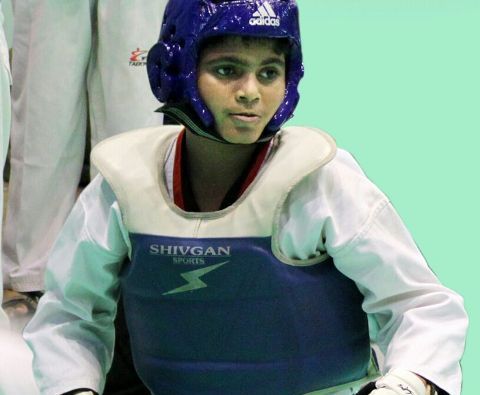
Chembur resident Atharva Samant won two golds in the championship, in Taekwondo Poomsae and Taekwondo Sparring in the Under-14 category. Atharva is a student of Swami Vivekananda School in Chembur, and trains with the suburb-based coach Shrikant Mishra. Prior to these wins, Atharva has also won top honours at championships in the same category, at national meets held in Nerul, Surat and Amritsar.

Atharva will now go on to represent Maharashtra at a national meet in December 2014 to be held at Daman.

Categories
Tech

Review: Sony Xperia Z3

We check out the new smartphone from the feted Sony Xperia series, the Xperia Z3, and come away very much impressed.
by Manik Kakra | @Manik_K on Twitter

Sony’s Xperia Z series of smartphones is known for its good design and decent performance. The company made several improvements going from the original Z to the Z2, and it is expected to do the same with the Z3. Its financial health is far from being in good shape as of the last 18 months or so, and a lot rides on this device (along with a range of other phones) to improve that state of affairs. So, does the Z3 live up to expectations?

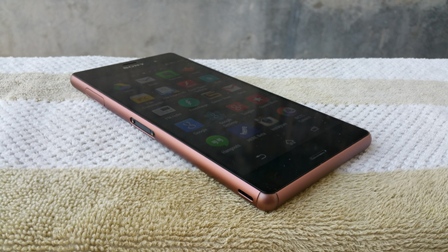
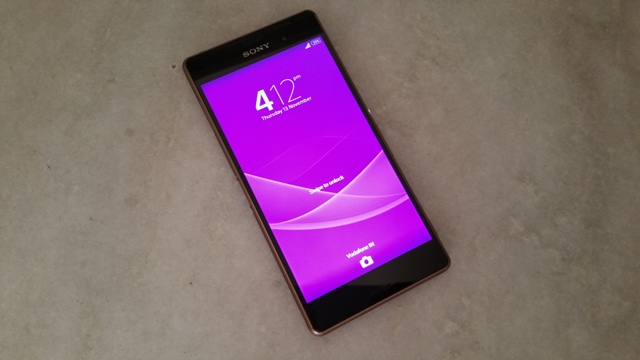
Sony’s Xperia Z3 (D6553) is the company’s latest and best offering. The smartphone follows a similar angular design as its two predecessors, but you will be wrong to say there aren’t any changes made. With rubberised angular edges, slightly rounded (yet flatter than the Z2) sides and overall slim profile, the phone is comfortable for those who are already used to carrying large smartphones. The Z3 also has slimmer bezels than the Z2, meaning more body estate for the screen and less in overall length.

The looks. The front, dominated by the 5.2-inch full HD LCD, has two speaker grills on the screen’s top and bottom, with the Sony logo, sensors and the 2.2 MP front-facing camera and LED light. Coming to the right, you have the microSD card slot and nano SIM card slot housed under a single flap, which still feels flimsy but is slightly better to operate than the Z2’s, and the Power/ Lock key nearer the middle part, Volume keys, which are smooth to touch and protruding just enough to give you good feedback when pressed gently. The dedicated camera key is located just where your right hand (index finger) would be if holding the phone in landscape orientation, with the on-screen navigation keys on your right.

The left side panel locates the microUSB port (under a similar protective flap), magnetic pogo ports for charging the phone using a Sony magnetic dock or for attaching your PS4’s DUALSHOCK Controller to play games. Further down, there is an eyelet for those who still like to carry a thread, a locket, a small cord etc. around their phones these days.

Coming to the back, there’s the 20.7 MP camera on the top left with the LED flash right next to it, NFC and Sony logo toward the middle and the Xperia logo towards the bottom. The whole back panel has got glass on top, meaning fewer scratches, but it’s prone to smudges and fingerprints just like the front. The phone is by no means a compact device, and it probably isn’t meant to be, but there’re a few neat little changes that make it just a bit more comfortable to grip and carry around without losing the Z3’s premium feel and design, and our copper-brown variant stood out just a little more.

Display and screen. The phone boasts of a 5.2-inch TRILUMINOUS LCD. Sony’s Z3 comes with two additional display options – X-Display and Super Vivid mode. With the default mode (third one), the screen is bright, has decent viewing angles and gives nice rich colours for most part. The other two modes aren’t really worth it, especially for watching videos where they just over-sharpen characters and the picture loses out a lot. It has a little better visibility than the Z2, but you will have to really crank up the brightness level to read comfortably. The Z3 has a good screen, but it is still not in the league of the One (M8) and the S5, which, in my opinion, are the best 1080p panels for Android phones today.

Having said, it’s certainly not a deal-breaker and most users should be fine with it for images, Web browsing and even watching videos.

Camera. The Z3 comes with the same 20.7 MP (BSI sensor) camera (f/2.3) we saw on the Z2. Here are a few sample images

The Z3 supports ISO level of up to 12,800, which is higher than that of any other phone today. Users who are comfortable with trying various settings should find it helpful for low-light conditions. The camera app has a lot of editing modes like Background Defocus, AR Effects, HDR, as well as settings like Exposure, ISO, and resolution. Unfortunately, the camera story is similar to the Z2’s which wasn’t very impressive. Images come out quite detailed in good light conditions, but noise seems to be a downside when shooting with the Z3. It performs just okay in low-light conditions. You may find taking photos in 8 MP mode better than any other, and most users will find the overall quality to be just fine. For those interested, the phone can also take full HD videos at 60 FPS and 4K videos.

Connectivity. The Z3’s GPS, 3G, FM radio work fine, though its WiFi does take 1-2 seconds more to get switched on and connect to a known access point than other phones I’ve tried recently. Call quality on the phone is top-notch with no network reception issues or call drops in between during my usage. I still haven’t tried 4G LTE on a device as there’s no network operator offering such a service in Delhi as of now.

Audio quality. In-ear call is loud and clear and so is your voice for the person on the other side. When it comes to audio quality, the Z3 performs well. The front-facing stereo speakers are no match for the One M8’s, they are still not bad and usable for videos and games. The phone supports native FLAC files support, but I couldn’t check how the bundled headsets perform with it as Sony didn’t send us a pair of those.

Battery. It will be safe to say, the Xperia Z3’s most compelling offering is its battery life. More often than not, the phone lasted me more than day with battery level still around the 15 per cent mark. During my usage, I didn’t have to charge it from zero to full more than once a day except for once when the phone was used intensely for watching videos throughout the day. If on moderate usage, the Z3’s 3,100 mAh battery unit may even give you close to one and a half day of usage. And of course, you can stretch it if you use the built-in STAMINA and Ultra STAMINA modes by sacrificing on the phone’s features.

Software and performance. The Xperia Z3 runs on Android 4.4.4 with Sony’s own Xperia UI on top. The Xperia UI is a known entity on Android space and Sony hasn’t much to what it was on the Z2. Sony could have toned down the number of pre-loaded apps and could have made its own services like What’s New clear of the Google Now swipe-up gesture, but they haven’t.

Under the hood, there is a Snapdragon 801 SoC (2.46 GHz quad-core Krait 400 processor, Adreno 330 GPU) coupled with 3 GB of RAM. There’s about 11 GB of available storage space and you can increase it with a microSD card.

It won’t be wrong to say that this is Sony’s best performing Android phone. The Z3 is smooth to operate, doesn’t stutter when switching from one app to another, can handle full HD videos (may miss on audio sync depending on the codec used) and can handle intensive games without dropping many frames. If you have used any of the last two Xperia Z devices, you will feel at home with the Z3’s software. With similar Home screen setup, icons, Menu launcher behaviour and settings, Notification bar and quick toggles, Lockscreen, Sony’s usual set of widgets and Settings, the Z3 has a familiar monochromatic OS that one often associates with Sony’s Android flagships.

The only downside that Sony really needs to cater here is that this phone requires to be attached to a PC to download and install an OS update. It’s not acceptable that a technology company like Sony can’t provide Over-The-Air updates in this day and age. Having said that, the software and performance part is more than satisfactory, and the whole Xperia package on the Z3 remains one of the best when it comes to Android.

Wrapping our review, the Z3 is one of Sony’s best ever devices. With great battery life, good screen, improved design, decent camera and IP68 rating meaning a water-resistant and dust-proof phone, the Z3 is indeed a compelling offering, and if you’re looking for a high-end smartphone, you should definitely check the Z3 out.


Categories
Hum log

Looking for a good masseur? Try a visually challenged one

Qualified masseurs from the Victoria Memorial School for the Blind offer massages for very reasonable rates – and they’re sensational.
by Vrushali Lad | editor@themetrognome.in

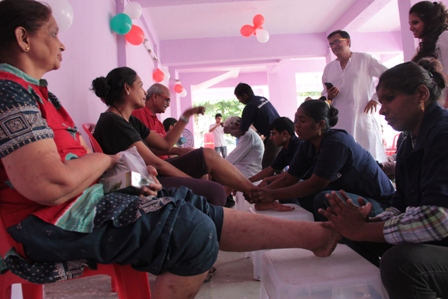
I am a sucker for back massages. Which was why, when I heard there were massages up for grabs for as little as Rs 100 at Borivali, I made my way there at once. There were 11 professional masseurs attending to people who’d asked for foot and head massages. I was the only one in that bunch to ask for a back massage.

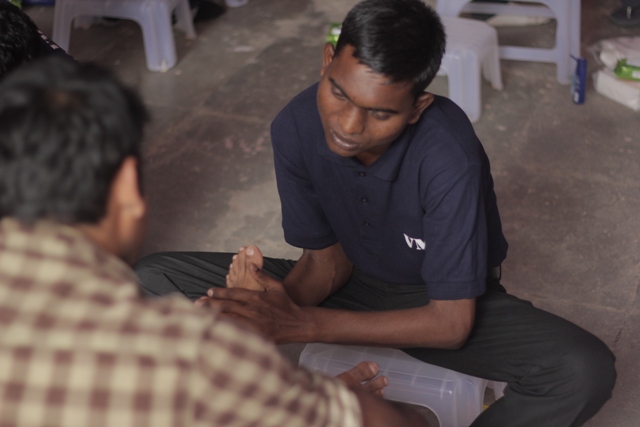
The masseur started by asking my name while kneading my back gently. But a few minutes later, I almost cried out, “AAA, please don’t kill me!” as his thumbs caught the chronically painful points in my lower back. Unperturbed by the way I suddenly stiffened, he said in Marathi, “Roz Suryanamaskar kara. Thoda vajan vadhava. Ani methi kha, tyane farak padel (Do Suryanamaskar every day. Increase your weight. Also eat methi, it will help).”

15 minutes later, it was as if I had never suffered a bad back in my life. I thanked the masseur profusely and asked him his full name. He fixed his sightless eyes in my direction, smiled at me and said, “Rambabu Dhume.”

The event

Rambabu was one of 11 visually challenged masseurs who came to Borivali at the behest of resident Vidhi Mistry, who put together a massage camp in her building premises in association with the Victoria Memorial School for the Blind, Tardeo. Like Rambabu, all the other masseurs are specially trained in giving foot massage, reflexology, neck and head massage, full body massage and facial massage. Students from the school give massages for a living, for extremely modest rates.

Massage eventSpeaking to The Metrognome, Vidhi said, “A few months ago, I had gone to the World Trade Centre to see a friend’s stall. Over there, I came across these visually challenged youngsters giving foot massages for as little as Rs 50 for 15 minutes. I asked for a massage, and it was the best foot massage ever. I promised them that I would organise a camp for them soon.” Coming good on her promise, Vidhi organised the camp and invited about 200 people to attend and avail a massage of their choice for Rs 100. “I’d asked people to donate more, because this money is going to their School and the masseurs.”

Hoping to make at least Rs 50,000 from the camp, Vidhi and her team was stunned to discover that they had made Rs 82,500. “The response was overwhelming. Over 250 people turned up and we extended the event by two hours,” she said.

Massage for a living

During the massage, I got to talking with Rambabu, who told me that he stayed at a hostel in Churchgate and that he travelled anywhere in Mumbai for home visits. “I have a D.Ed from the School,” he said proudly when I asked him how far he had studied massaging. “Along with the practical work, we are also taught to detect why people have certain painful areas and how they can correct them with diet and yoga.” This explained how he had correctly tapped my chronically painful lower back within minutes of massaging me.

Vidhi said that most people did not opt for these “blind masseurs” because they were not confident that they could give a good massage. “They charge very less, too. This is their livelihood, and since most of us get massages anyway, it’s a good idea to hire these people instead,” she said. Rambabu explained that for the home visits, people could specify what kind of massage they wanted and for how long.

Having tried the massage myself, and with my back feeling better than it has in weeks, I’m sure to give the Victoria Memorial School a call for a home visit next.

Want a massage at home? Want to organise a camp employing visually challenged masseurs? Call the Victoria Memorial School to hire a masseur, inquire about charges and other details on 022 23531236. Look up www.vmsb.org for more information.

Categories
Watch

Watch: ‘A streetcar named Desire’

Starring noted actor Gillian Anderson, the Tennessee Williams masterpiece is on today at the NCPA. Don’t miss it for anything.
by The Editors | editor@themetrognome.in

The play received rave reviews in the late 1940s and it won its writer – Tennessee Williams – the Pulitzer Prize for Drama in 1948. A Streetcar Named Desire was also brought to life on Broadway and in a London production by the stars of the day, Marlon Brando and Vivien Liegh, also to high praise.

Mumbai can watch the acclaimed production today at the NCPA. Starring Gillian Anderson, Vanessa Kirby, Ben Foster, Clare Burt and Lachele Carl, the story is of Blanche duBois, a fading but still attractive Southern woman with high-toned pretensions to decorum. As Blanche’s fragile world crumbles, she turns to her sister Stella for solace – but her downward spiral brings her face to face with the brutal, unforgiving Stanley Kowalski, her sister’s husband. Slowly Blanche’s veneer of self-possession begins to slip.

The play is directed by Benedict Andrews.

Head to the NCPA today, November 17, 2014 at 6.30 pm.

(Picture courtesy www.independent.co.uk)

Categories
Learn

Doctors will become teachers for World Diabetes Day

The Indian Diabetic Foundation (IDF) launches nationwide campaign to curb the spread of early onset of diabetes among school children.
by The Editors | editor@themetrognome.in

In probably the largest initiative of its kind, aimed at creating awareness on childhood obesity and diabetes, The Indian Diabetic Federation (IDF) in collaboration with Fortis Raheja Hospital has initiated a nationwide campaign to curb the spread of early development of diabetes among school children.In its initial phase, the campaign would cover city-based schools with diabetologists and nutritionists delivering guest lecture’s in schools on health benefits associated with the intake of healthy breakfast.

Diabetes in Indian childrenThe launch of this nationwide campaign will happen today, November 14, which is World Diabetes Day and is also observed as Children’s Day in India.

“The focus is on motivating children to consume a healthy breakfast. When awareness is inculcated in children, it easily reaches their parents. When children start advising adults on the harmful effects of fast food accumulation, it can easily bring about a solution. Our effort is to create awareness among the students and teachers about the value of nutrition and healthy food, the difference between junk and poisonous food and inculcating the values of consuming homemade food,” said Dr Anil Bhoraskar, Diabetologist, Fortis Raheja Hospital and the Chair Elect of South East Asia – Indian Diabetic Federation.

Dr Bhoraskar added, “Through the series of lectures, we strongly recommend that people should avoid sugar and fats in their daily intake, as it contains high Omega 6 and Omega 3 fatty acids. If people do not take proper breakfast in the morning, they tend to munch more of fatty foods, which are high on salts and detrimental to the body. The disease normally seen in adults because of obesity is now being seen with an increasing frequency in children, particularly Type 2 Diabetes. Today, more number of children below 12 years are susceptible to type 2 Diabetes and the complications worsen post the age of 20 years.”

The IDF hopes that the programme will sensitise children and parents about the serious problem of childhood obesity caused due to the intake of unhealthy breakfast. In an effort to educate parents about feeding their children with healthy breakfast, IDF has decided to distribute booklets on nutrition and its positive effects on their child’s health.

(Pictures courtesy www.niticentral.com, www.thehealthsite.com. Images are used for representational purpose only)

Exit mobile version