Categories
Event

Mumbai, gear up for Barclays Premier League – live!

BPL Live is a free, interactive two-day fan part at MMRDA over the weekend, football legends will interact with fans.
by The Editors | editor@themetrognome.in

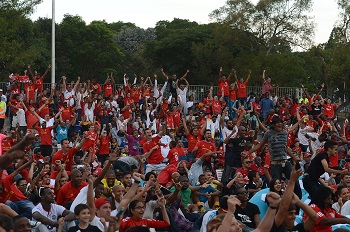
It started in Johannesberg, and the Barclays Premier League Live (BPL Live) is now in Mumbai. The event is hosting its second international fan park over the weekend at MMRDA Grounds, and will offer fans in Mumbai an awesome experience – they can meet legends of the Barclays Premier League, get up close with the iconic Barclays Premier League Trophy and watch live matches broadcast on a giant 380 sq ft screen.

Barclays Premier League Live, a free and interactive experience designed for fans of all ages to enjoy, will be the next best thing to being in the stadium on match day.

What’s more, Robbie Fowler, Peter Schmeichel and Emile Heskey will be in attendance to take part in autograph-signing sessions and interact with fans.

Barclays Premier LiveHere’s what fans can take part in:

– The Live Match Zone – the main arena where fans will watch the live Barclays Premier League matches on a giant screen.

– The Trophy Zone – get up close to the Barclays Premier League Trophy.

– The Club Zone – supporters will be able to learn more about the 20 Barclays Premier League clubs, and through green screen technology, will be able to picture themselves lifting the Barclays Premier League Trophy decorated with the ribbons of their favourite club.

– The Screening Zone – supporters will experience the noise and excitement of a match day before learning all about the winning teams and captains of the Premier League in this exclusive film.

– The Pitch Zone – there will be a mini-football pitch where Barclays Premier League clubs will be conducting skills sessions with local football teams, and there will also be the chance for young fans to have a game of football run by Premier League community coaches.

– The Skills Zone – there are three football skills pods for supporters to test their accuracy, close control and shooting power.

Head to MMRDA Grounds, BKC, between 2.30 pm and 10.30 pm on Saturday, and from 1.00 pm to 9 pm on Sunday. 

Categories
Bombay, bas

Trailing Mumbai’s roadside businesses

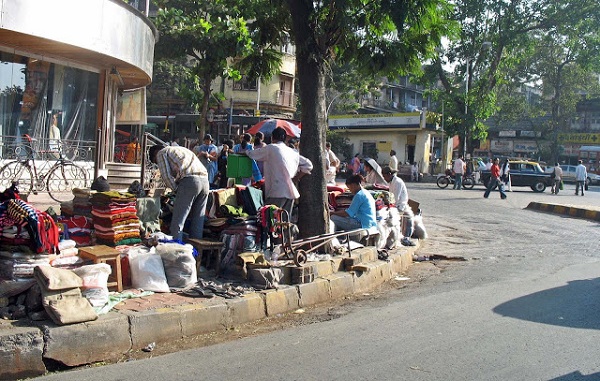
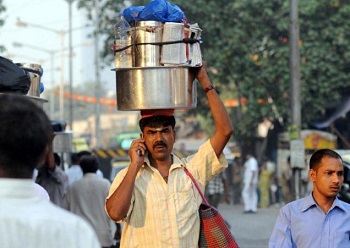
All sorts of entrepreneurs abound in Mumbai – the most ubiquitous are the ones operating their business on the roads.
by Mamta D | @silverlightgal on Twitter

It takes all kinds of people to survive in a city that despite being already overcrowded, attracts migrants in droves by the hour from all over the country. The lure of making it big someday, the hope of feeding a family in a better manner, the irresistible pull of the city that never sleeps – there are varied reasons that bring a migrant to Mumbai. But once here, reality strikes in and strikes really hard. The rose-tinted glasses are cast off in no time and one settles down to the grimy, grueling existence.

One soon learns that nothing in this city comes for free, not even the tiny stretch of pavement where one can plonk a basket or a cart and hawk his or her wares. One learns the hard way that there is something by name of hafta to be paid to the cops to claim even that tiny stretch of pavement. But what if you are so hard up that you can’t even afford to pay the hafta?

Here’s where ingenuity kicks in, and several ‘roadside entrepreneurs’ are born.

Idli seller in MumbaiMurali, who sells idlis on the street corners of Andheri on his impromptu ‘stall’ set up on his bicycle says, “I live in Jogeshwari. I ride several kilometres to come down here because I can find office-going customers looking for cheap breakfasts. For me, this is a good business that brings quick profits. My grandfather owned a shop in the village. He used to cook and serve his customers. Here, in a city like this, owning even a tiny shop is difficult. I cannot afford it at present. I hope to slowly save money from this and eventually buy my own shop some day.”

Other roadside entrepreneurs move on to become ‘permanent’ by establishing a fixed spot on the roadside, even paying the afore-mentioned hafta. But many others function along ‘makeshift’ lines. Thus, the city teems with shoe sellers displaying their wares on a cart with wheels, or the no-frills idli-wada seller who just brings a large aluminium dabba with a stack of paper plates and a rolled up bunch of polythene bags, or the woman with a large container of poha and some Styrofoam bowls.

Savitri cuts a lone figure standing at the corner of the road that leads towards SEEPZ. There’s a small table in front of her and on it are placed two aluminum containers. One contains poha and the other sheera. A stack of paper plates completes the ensemble. A couple of young men head to the table and are soon munching away. “How much is a plate of poha?”, I ask, “10 Rupees” is the reply. And sheera? “15 Rupees.” she holds up a paper plate piled high with sheera enticing me. I take a bite and find it delicious. She lost her husband a couple of years ago and her children are in school. To make ends meet, she started selling food on the road, using the one skill she really knows well – cooking.

How many of these find customers, you wonder. But they do. Middle class office-goers who crave South Indian or Maharashtrian breakfasts but can’t afford the prices of a restaurant roadside stuff that, though sold through such humble means, don’t lack in taste. Likewise, the persons who can’t afford visits to even a small barber salon throng the roadside barber stalls, where they can get a quick haircut or shave for as less as Rs. 20 or Rs. 10.

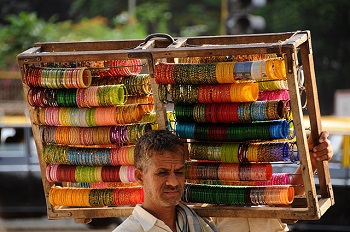
Nasir, who runs a roadside barber shop in Kurla, is in his 60s. He has been in this “business” for decades. He has had several scrapes with the local cops but being the sole bread earner of his largeBangle seller in Mumbai family, he finds a way to resume his trade again. Though these barbers’ cuts are cheap, they are by no means untrendy. These barbers are known to tear out pages from used magazines featuring latest haircuts and see TV to keep themselves up to date with what’s in vogue.

Likewise, in many areas of the city, you will also find roadside ear-cleaners, impromptu dentists, bone-setters, and so on. All these persons operate from the pavements but never lack customers.

Unlike people who can invest good capital into their business, these people start with almost nothing. There’s no one to fund them, no means to pay off loans, and they cannot afford the licenses that would be required to set up proper shops. So they turn into roadside entrepreneurs and hope to fend for their families.

(Pictures courtesy www.stockpicturesforeveryone.com, www.thehindubusinessline.com. Images are used for representational purposes only)

Categories
Do

School students, celebrate Archaeology Day

Three organisations are observing Archaeology Day over two days, starting today, and school students will have a lot to learn.
by The Editors | editor@themetrognome.in

This is one celebration school students in Mumbai should definitely not miss.

The Centre for Extra-Mural Study and the Centre of Archaeology of the University of Mumbai celebrates the Archaeology Day each year on December 10 and 11, along with the India Study Centre (INSTUCEN) Trust, Mumbai. This year too, the same organisations will celebrate this event at the Vidyanagari Campus of the University of Mumbai at the premises of Health Centre Building.

The two days provide a great learning opportunity for school students, since the event will present all facets of an archaeological exhibition. Besides, this year, the organisers are also hosting free study tours to Jogeshwari and Mahakali Cave, in groups, for school children, on December 11.

Archaeology Day Take a look at the activities planned for Archaeology Day 2014, in which students are invited to participate:
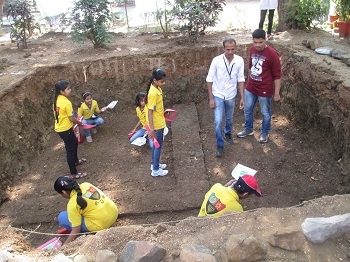
– Mock excavation trench, where students will dig to find buried antiquities, learn about methods and rigours of excavation.

– Types of ancient burials – installations.

– Ancient scripts workshop: Brahmi, Kharoshthi, and Modi.

– Tribal painting: Demonstration and workshop.

– Building Daub house and painting it in Warli style.

-Numismatics – The display of ancient Indian coins and a stall selling coins at affordable rates.

– Stone tools replication workshop where students can see tools from prehistory being recreated in front of their eyes.

– Fossils: Display and preservation techniques, dating methods.

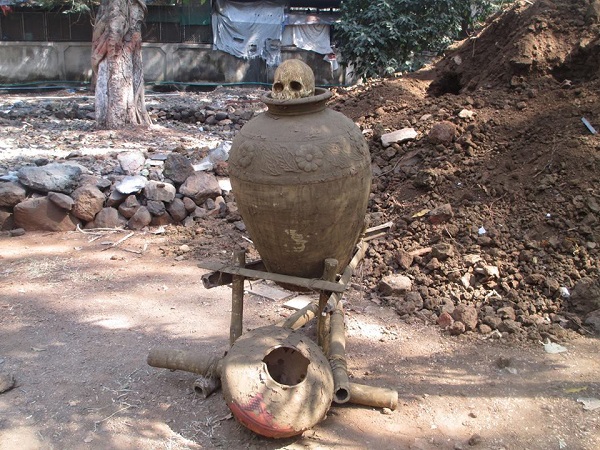
– Pottery workshop, where a live potter will domesticate one of the oldest crafts in our world.

– Sculpting workshop, with a stone sculptor at work to explain style and technique.

Additionally, the excavation at village Chandore by the Centre for Archaeology, CEMS will be the largest single display where the excavator Dr Kurush Dalal will explain the entire process through a display of posters and actual findings. A few private collectors will also be displaying a selected number of artefacts from their collections

The organisers have kept a free study tour for school students to Jogeshwari-Mahakali Caves on December 11, with students being guided by Dr Suraj Pandit and his students. Any school can register its students (Classes 7 to 9) in groups of 45 (accompanied by two teachers).

Do you want to enroll your students or your child for the workshops and study tour? Look up www.extramural.org for details. Entry to the event is free, and the event is open on both days from 11 am to 6 pm.

Categories
Trends

Platinum is every Indian woman’s first choice

Survey conducted across seven metros in India finds that Indian women, especially young ones, prefer platinum jewellery over all others.
by The Editors | editor@themetrognome.in

Women and jewellery share an irreplaceable bond, and more so, when it is platinum jewellery in question.

Moreover, young women today are displaying an increased affinity for jewellery, as indicated by a recent Platinum Guild International research conducted across seven metros in India. Over 250 women were studied to understand the Indian jewellery market and gain further insight on the category.

The result? Platinum appeals to the younger audience between 18 to 35 years, across SEC B+, A, A+, single, engaged, married or living in a metro or mini metro.

Target audience and understanding

The survey was conducted amongst a mini focus group that included women, broadly three different age group at diverse life stages. Each group provided different experiences and the varied interactions reflected in the attitude towards jewellery. Almost all women surveyed felt that ‘jewellery is a woman’s adornment’ and that the practise of including jewellery as a part of your ensemble evolves with the natural progression of life.
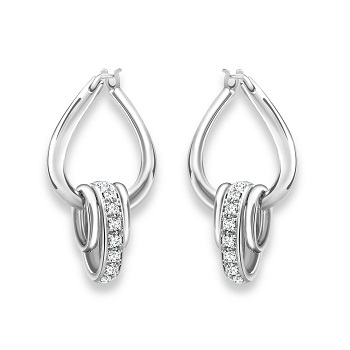
Platinum Jewellery Attitude to jewellery and purchase drivers for platinum

Young unmarried women (16 to 24 years) pursue modernity and express a strong sense of self-identity. They acquire precious jewellery as gifts from parents, grandparents or other members of the family. The occasions to receive jewellery are personal milestones like the 18th birthday, completing school education, college graduation and getting the first job. The younger audience is also more educated, Internet savvy and aware of international trends, seeking options in jewellery metals and designs and willing to try out newer looks and experiment with styles. Design is one of the key criteria of evaluation, as is quality.

Platinum has high affinity for this demographic as it represents her ‘modern’ values. The research states, ‘They see platinum as premium, upper class and exclusive and they consider themselves as ahead of the curve when choosing platinum. The metal is perceived as high quality, modern and very premium. The designs in platinum jewellery too are minimal and understated which appeal to her.’

Young married women (25 to 35 years) aspire to showcase modernity in lifestyle and thinking. They participate in financial decisions to prove their ability to manage the household. ‘While the young married woman has acquired heavy jewellery at her wedding and hence is looking out for delicate designs across social occasions like kitty party, husband’s office party, small family get together to prove her modernity. This was extensively visible amongst women in Delhi. The perceptions of jewellery being an expression of love and commitment is prominent in Chennai, the consumer trend in Ahmedabad is evidently driven by its exemplification of a self-assured modern woman,’ the report states.

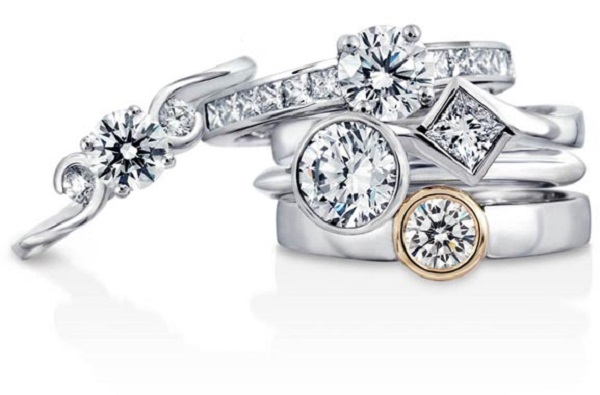
Platinum is seen as a symbol of everlasting love amongst young couples. The consumer mind-set strongly complies that jewellery is an establishing factor of social status and platinum is seen as metal for discerning and true upper class. They aspire for platinum and diamond, light jewellery with modern designs. She perceives platinum as premium, exclusive, modern and international, making her stand out and differentiated from her peers. Platinum love bands, rings or light jewellery is very popular.

The behaviour further evolves amongst older married women (35 to 40 years) as jewellery is now associated as a mark of economic stability for the present and future. In Kolkata, jewellery is acquired and acknowledged as a highly desired asset with a twofold benefit of safeguarding the future of children and self, whereas in Delhi it satisfies the need of attention and approval while one focusses on exhibiting status and confidence. Modernity was the key element to platinum appeal across age groups including this group.

Vaishali Banerjee, Country Manager India, Platinum Guild International said, “As per the survey results, 85 per cent of platinum consumers are in the age group of 15 to 30 years. Today, the young Platinum Jewellery (2)India wants platinum as it is considered a metal that speaks the modern language with its contemporary design form enabling an emotion of pride to the wearer, is established as a symbol of the deepest relationships and is exclusive, unique and expensive which denotes status. Platinum is also perceived as an expression of love, intimacy and commitment; reinforcing the consumer demand for platinum love bands, a footfall driving category that grew at +35 per cent last year. We have also witnessed a growing trend of young brides taking to platinum for their trousseau across key markets in India.”
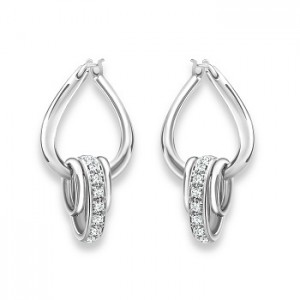
Commenting on the favourable consumer trends for platinum jewellery in India, Suvankar Sen, Director, Senco Gold Jewellery said, “The strong appeal amongst customers for the white metal -platinum is on an upward trend as today people are seeking new designs and platinum offers exclusivity, while maintaining a perfect balance between modern and traditional. The platinum love bands category positioned as an ultimate choice to celebrate love and special occasions has grown significantly last year by 42 per cent. Its strategy is at par with the consumer demand and the sales figures are proof of the progressive growth witnessed in the 2013 and will continue this season as well.”


 

Categories
Event

Financial journalists, this one’s for you

Shriram Sanlam Awards invite entries in financial journalism, will be judged by an eminent panel of editors and corporate personalities.
by The Editors | editor@themetrognome.in

Financial journalists in India need to take note: the Shriram Sanlam Awards for financial journalism is currently inviting entries.

This is the third edition of the Shriram Sanlam Awards for Excellence in Financial Journalism constituted by Shriram Group along with the South Africa-based Sanlam Group (South Africa) in association with the Institute for Financial Management and Research (IFMR), Chennai, in 2012.

Journalists can submit or nominate anything in the purview of financial journalism, ranging from Indian Economic Policy, Macro Economic Issues, Financial Markets including Equity, Debt and Foreign Exchange, Banking and allied services, Sectoral Issues, financial inclusion and financial literacy. There will also be a Life Time Achievement Award, for which recommendations are welcome. This year, the categories of Awards will be decided after receiving nominations. Journalists and editors are free to nominate as many entries or people as they wish. Parameters for the Awards are Insight, Analysis, Depth, Uniqueness, Originality, Comprehensive and Balanced Approach, Level of research, Follow up of story by others leading to wider discussion, and overall impact of the story.

Entries are being accepted up to January 31, 2015.

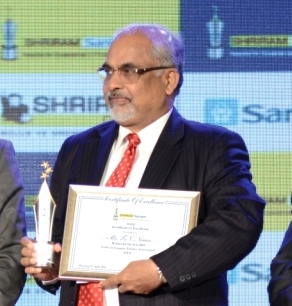
TN NinanOne of India’s most respected media personalities, TN Ninan (in pic on left, Chairman, Business Standard) has been inducted on the jury panel of the Awards for Excellence in Financial Journalism 2014. He was also the recipient of the Lifetime Achievement Award at the 2nd Shriram Sanlam Awards for Excellence in Financial Journalism in the year 2013. He will join a distinguished panel of independent jury members comprising, amongst others, Gopal Srinivasan (Chairman and Managing Director – TVS Capital Ltd.), Srinivasan K Swamy (Chairman and Managing Director, RK Swamy BBDO), Ashu Suyash (CEO, L&T Mutual Fund), Adit Jain (Chairman, IMA Asia) and Swaminathan S Aiyar, Consulting Editor of The Economic Times.

GS Sundararajan, Wholetime Director, Shriram Capital Ltd., said, “This year, the jury has a good mix of corporate personalities and eminent media editors. We are striving to ensure that renowned editors act as mentors to financial and corporate journalists. Financial journalism in the country needs to evolve dynamically as India braces itself for higher goals with challenges therein. These Awards are a step towards inspiring financial journalists to achieve higher levels of professional excellence.”

Look up www.shriramawards.com for rules and nomination form. Entries need to be mailed to awards@shriram.com from official email IDs. The grand finale of the Awards Function will be held in April 2015.

(Featured image courtesy blog.meraevents.com)

Categories
Trends

‘Is this sex product Jain?’

That’s right. Indians are asking for some truly bizarre sex products and experimenting with the sexual experience like never before.
by The Editors | editor@themetrognome.in

Indians are buying intimate products online, and the things they’re asking for sometimes border on the bizarre.

According to a report recently published by an Indian personal products website,ThatsPersonal.com, when it comes to buying sex products online, Indians are anything but shy. However, most women were seen to register purchases in their partners’ names, to maintain their privacy.

SexSaid Samir Saraiya, CEO, ThatsPersonal.com, “We recently conducted a comprehensive quantitative survey on the buying behaviour for intimate products in India, after analysing our sales and website traffic for 18 months. This quirky and fun research is our way of giving society a good laugh. Talking about sex has been a taboo for quite some time in our country, however, people have shed their inhibitions and pre-conceived notions and are ready to explore and experiment.” He added that the site routinely gets some extremely unusual requests and queries about sexual wellness products. “There are queries about certain products being Jain or non-Jain. Then there are questions on how to ‘do it’ for the first time. However, we decided to respect our customers’ privacy and published only the figures for aggregate sales and traffic.”

According to their research, Western India clearly leads the way in buying pleasure products, as the region accounts for 36 per cent of their total sales vis-a-vis only 7 per cent from the Eastern part of the country. North India lags slightly behind at 21 per cent, whereas the South market comprises a large chunk of their market share accounting for 31 per cent of total sales. The research also threw some light on smaller cities, which provide a substantially higher basket value. Surprisingly, a Tier 2 city like Baroda was found to have the maximum women buyers.

Also, age-wise segregation showed that the age groups of 25 to 34 years were the most active buyers. Men were found to be higher spenders and surfers than women.

Lubes and condoms lead the sales, thus emphasising the safe sex message and India’s growing awareness about protected sex. Although the condom remains the most bought and trusted product, Indian men now want to experimenting with other fun stuff like handcuffs, edible lingerie, adult card games (very popular at bachelorette parties), edible body paint and the likes.

As per the research:

– Hyderabad men love to get their hands on handcuffs.

– Gujaratis buy a lot of fun, adult games

– Kerala buys more of latex free condoms.

– South Indian women are maximum buyers of delay gel.

– North Indian men buy a lot of edible lingerie.

(Pictures courtesy www.national-awareness-days.com, www.womendailymagazine.com)

Exit mobile version