Categories
Uncategorized

DIY: Make your own nail polish display stand

Hassled by rows of nail polish bottles that you always end up knocking over? This easy-to-make stand will surely help.
by Ankita Pathak

Most of us have rows and rows of nail polish bottles that take a great deal of arranging. Besides, when we want a colour in the back row, we have to lift each bottle separately to get the required bottle.

But today, this easy DIY nail polish display stand will just make your life easier. Plus, it looks really pretty and is fun to make!

Add your own spin to the three-tier cupcake stand by turning it into a display! Having a rotating fixture is super convenient for larger table top displays, especially for makeup and nail polish holders.  You don’t have to worry about knocking over what’s in front of you and can conveniently view things in the back just by turning the stand.

You will need:

– Rotating kitchen bearing

– 2 square pieces of wood or anything with  a flat surface

– A glue gun

– Glue sticks

– Ruler

– Blade

– Pretty plates in small, medium and large sizes

– Spacers : old glasses or candle holders

The process:

– Have your glue gun heated and ready, starting with the smallest plate first. With the plate upside down, measure and mark the center of the plate with a marker or masking tape.

– Next, mark the circumference of the glass around the center of the plate. This will help center the glass nicely.

– With a hot glue gun, apply glue to the rim of the glass, then quickly put it on the plate before the glue hardens.  This is why you should make markings first to avoid gluing the glass unevenly.

– It’s time to mark the larger plate the same way you did with the plate before. nail-polish-organization

– Place the hot glue onto the open end of your glass and quickly cover it with the plate.

– Use rubbing alcohol to remove the marks you made with your sharpie. If you want your display to be taller, just repeat the earlier steps.

– Take out that bearing and the two flat boards. Next, sandwich the bearing between the boards. Make sure to mount it in the center!

– Ready your glue gun and place glue on all four corners of your bearing. Quickly apply on one board, and repeat with the other piece of wood.

– Now, to mount the base to your display, apply glue to the top surface of your sandwich, then quickly place the whole display you made earlier over  it.

Voila…your stand is ready!

Categories
Event

A match, 11 men and 11 boys

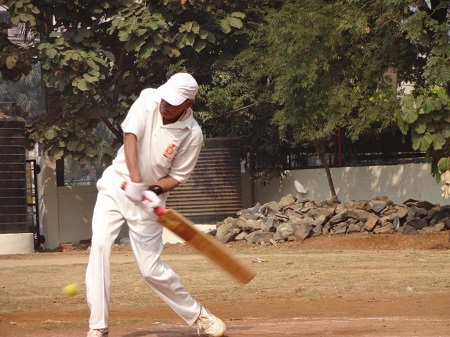
A team of young boys played cricket against a team of senior citizens – and lost! – in Borivli yesterday.
by The Editors | editor@themetrognome.in

At the very start, the younger team of cricketers was quietly advised to “take it easy” on their opponents – after all, the opposition was much advanced in years, with their youngest player 62 years old, and the oldest was 73 years old! But from the first over itself, the seniors showed the youngsters who the boss was, by claiming wickets in quick succession and bowling out the youngsters for 112 runs in 72 overs.

The country’s first ’16 v/s 60′ cricket match was played yesterday, where a team of youngsters (the team’s average age was 20 years) played against a team comprising senior citizens. The event was conceptualised by Silver Innings in partnership with Pushpa Ma Foundation and The Metrognome, and was held on the BMC ground near St Anne’s School, LT Road. The youth team belonged to the Silver Innings Football Club, an organisation that works with senior citizens and their families.


The jubilant seniors’s team won by 7 wickets and with five overs to spare. “We organised this event because we believe that our elders have the wisdom and experience to help and support the youth to bring the required change to create a generation-friendly world,” said Sailesh Mishra of Silver Innings. “We are happy to have organised this innovative programme for intergenerational solidarity. We hope to create awareness and sensitise the youth towards our elders, and what better than sports to develop this idea?” he added. 

(Pictures courtesy Silver Innings)
Categories
Do

Talk: Japan’s post-war avant-garde

Jnanapravah to host ‘Gutai’s World’ a talk by Dr Alexandra Munroe at Fort this evening. Artists and historians, take note.

As part of its ‘Criticism and Theory’ module, Jnanapravaha is hosting a talk titled ‘Gutai’s World: Japan’s postwar avant-garde and the fate of internationalism’ by Dr Alexandra Munroe

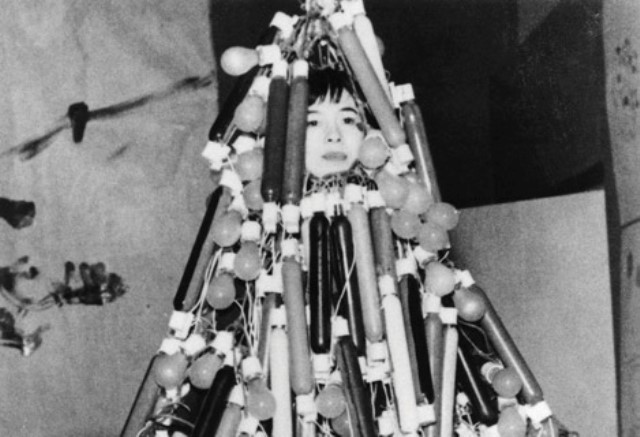
In spring 2013, the Guggenheim Museum presented the first US museum retrospective exhibition ever devoted to Gutai, the most influential artists’ collective and artistic movement in postwar Japan and among the most important international avant-garde movements active anywhere in the world during the 1950s and ‘60s.

Founded by the visionary artist Yoshihara Jiro in 1954, the Gutai group spanned two generations, totalling 59 Japanese artists over its 18-year history. The name ‘Gutai’ literally means ‘concreteness and captures the direct engagement with materials its members championed under Yoshihara’s call to “Do what no one has done before!” and to elicit “the scream of matter itself.”

From its earliest festival-like events, Gutai artists sought to break down the barriers between art, the ordinary public, and everyday life, and continuously took on new artistic challenges using the body in direct action with materials, time and space, nature and technology.

Dr Munroe will discuss Gutai’s extraordinary range of bold and innovative creativity; examine its aesthetic strategies in the cultural, social and political context of postwar Japan, including its relationship with the traditional arts; and will argue for the need to establish Gutai in an expanded, transnational history and critical discourse of modern art.

The talk is at 6.30 pm today, January 23. Head to Jnanapravah, Queen’s Mansion, 3rd floor, G Talwatkar Marg, Fort. Entry is free.

(Compiled by Medha Kulkarni. Picture courtesy Jnanapravah Mumbai)

Categories
Whatay!

10 BEST conductors you’ve met

We all know who really ‘drives’ the BEST buses in Mumbai – their conductors! We’ve even identified 10 different types.
by Andy Reghu | @thereghu on Twitter

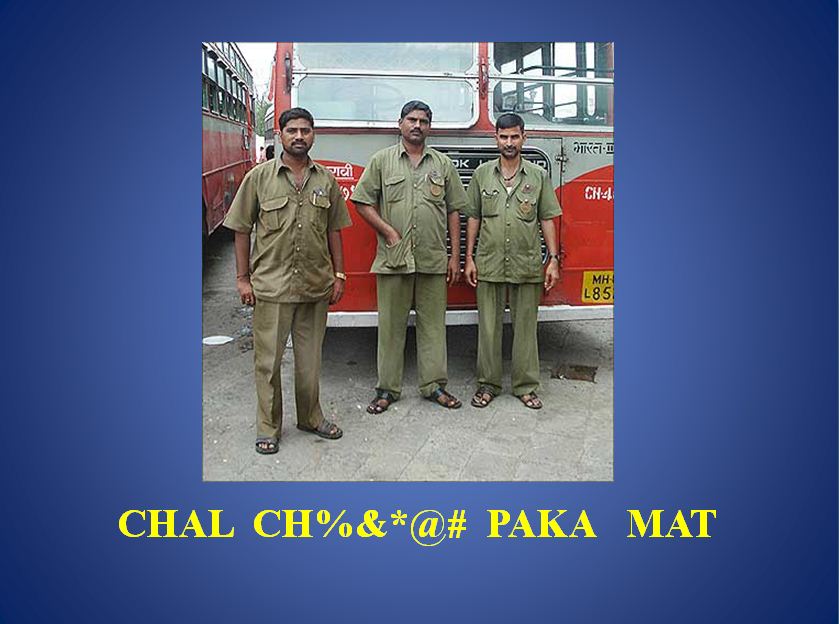
You can’t love them, almost everybody hates them, and nobody can ignore them. Oft-repeated phrases flow from their lips in an unending stream…Chhutta nahin hai, pudhe chala, peechhe khali bus aa raha hai – we’ve all heard these dialogues on our regular bus commutes in Mumbai. After a careful study of these colourful characters – the BEST conductors – I have arrived at 10 categories of conductors that we’ve all met and don’t wish to meet again.

#10) The rude conductor.

He abuses everything and everyone in sight. I doubt if this kind of conductor has ever smiled and said a kind word to anyone, even his own mother. It usually starts with “Chhutta nahin hai, chhutta do!”, builds slowly with, “Bola na chhutta nahin hai, dimaag ka dahi mat karo!” and reaches a crescendo with “Yeh rickshawwala kaisa c#$% hai dekh!” He’s the kind of guy your mother told you to stay away from.

The rude conductor


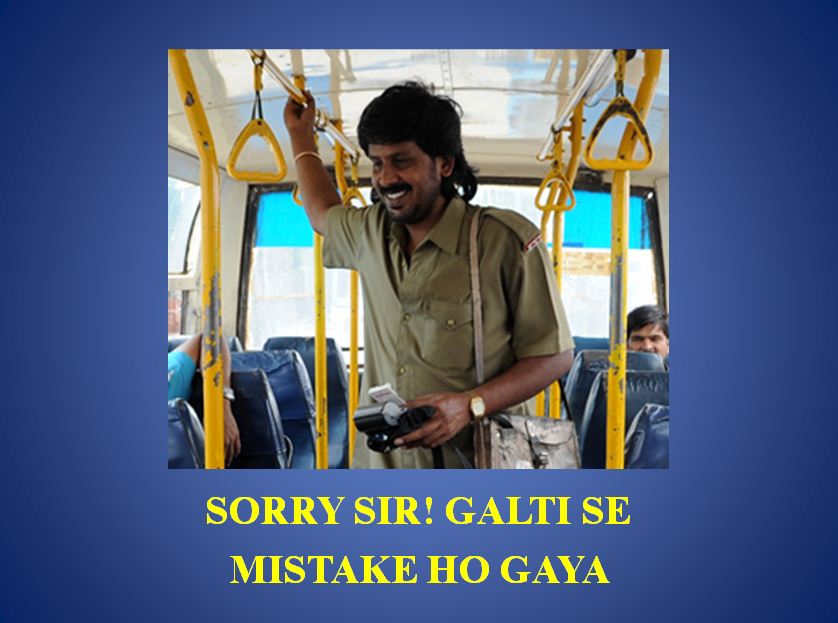
#9) The overly polite conductor.

This one is also to be stayed away from, although for different reasons. He has ‘Atithi devo bhava’ tattooed on his right arm (and possibly his forehead). He is so polite, he makes you sick. And he’s so soft-spoken, he is almost unfit for the job. His most annoying habit is that he apologises even when it’s not his fault.

The overly polite conductor


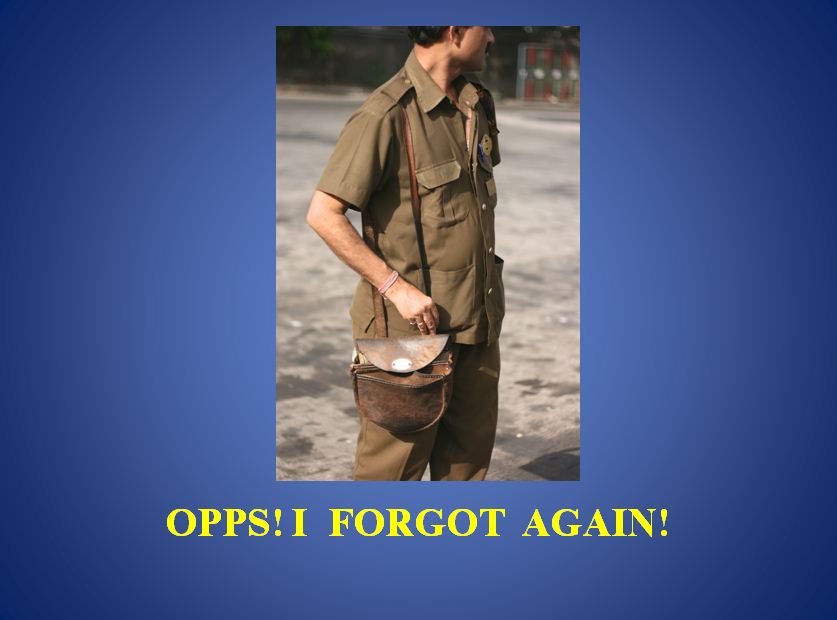
#8) The absent-minded conductor.

This guy takes a Rs 100 note from you and conveniently forgets to return your change –detrimental if you’re a writer, since you’re about to lose half your salary. He reacts with a start when you remind him about your change, but he will always first say, “Diya toh tha tumhara paisa…”

The ignoring conductor


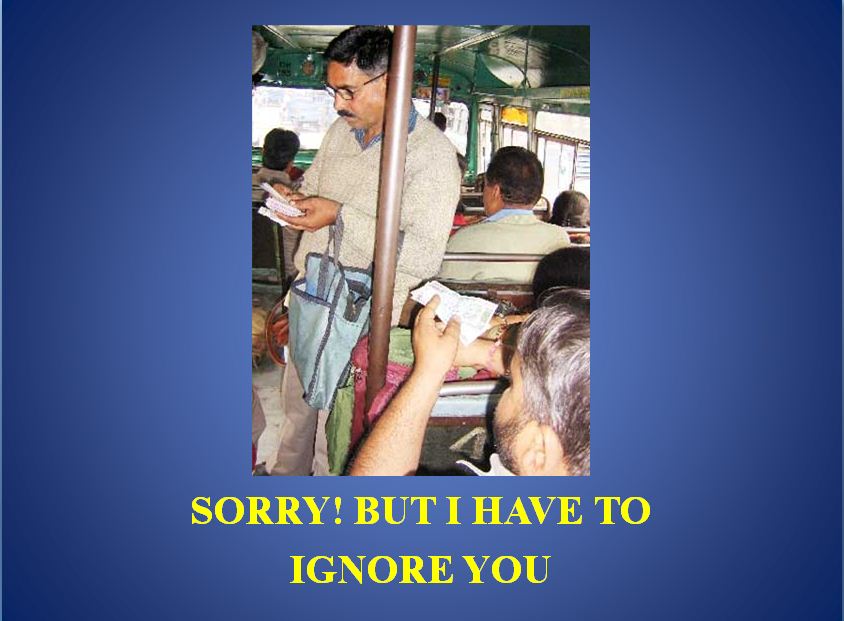
#7) The ignoring conductor.

He’s always too busy to answer your questions, too busy to notice that he hasn’t returned your change, too busy to tell you your stop has arrived, but never too busy to talk to the driver. He reminds you of your always-too-busy-for-you ex-girlfriend, in not-so-pleasant ways.

The ignoring conductor


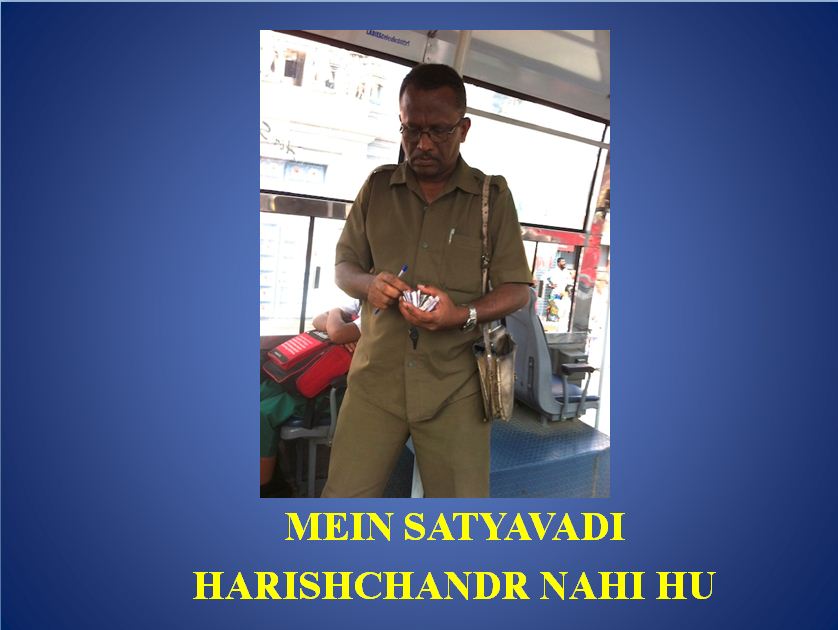
#6) The lying conductor.

This one will raise your hopes in an extremely cruel fashion, mostly by telling you that an empty bus is just around the corner and you would do well to wait a few moments more for it. You believe him and wait, but the promised bus never appears. When it does, it is bursting with passengers, and if you’re having a really bad day, you will encounter another lying conductor in this bus as well.

The lying conductor


#5) The depressed conductor.

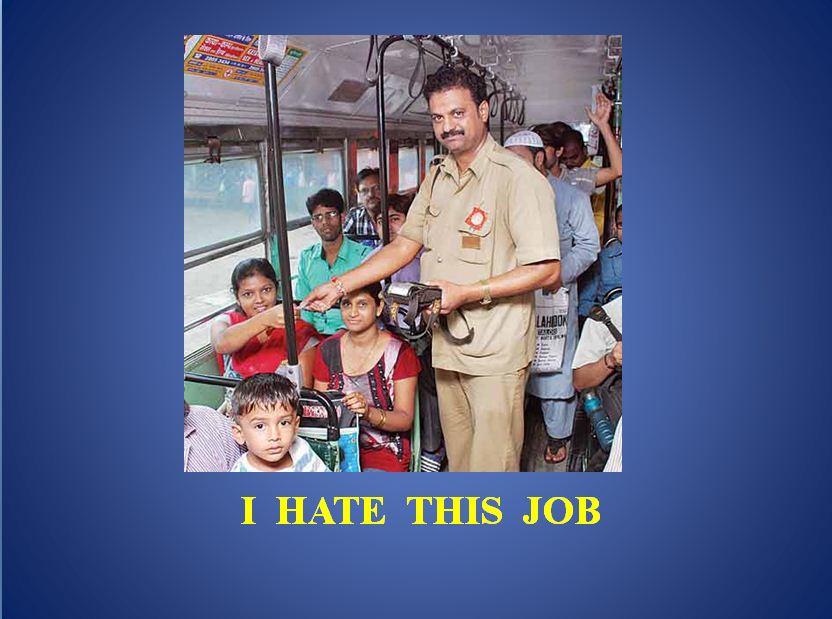
This man has had a very hard life. He has never heard a kind word about himself. His wife has made it a habit to run away with other men. He has never been promoted. The words ‘I want to kill myself’ are etched in every line of his face. He reminds you of your bleakest days. Without saying a word, he can convey how much he hates his job and how much he would rather be a mechanic, but that he became a conductor because “papa chahte the ki main bada hokar conductor banoon…”

The depressed conductor


#4) The over-friendly conductor.

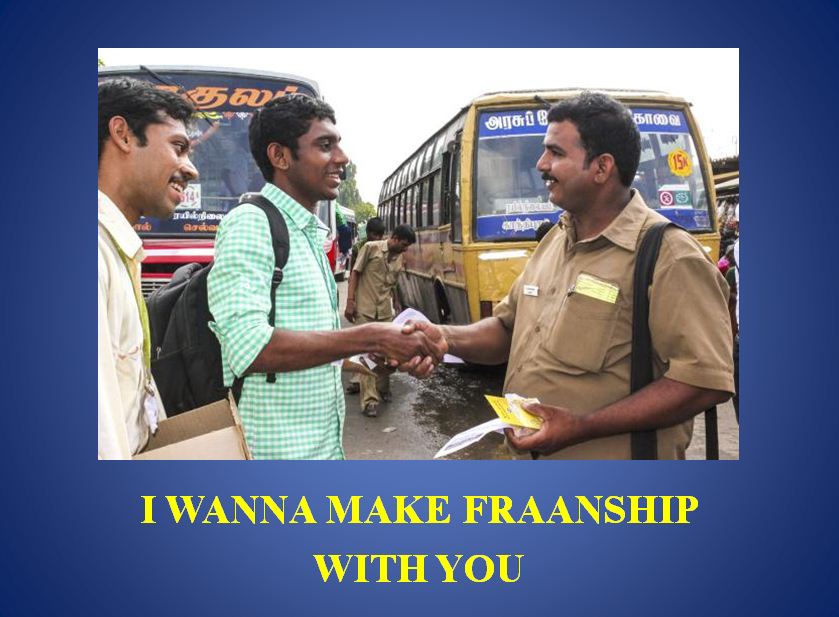
One innocent question from you: “Saki Naka tak kitna?” will make this conductor your friend for life. He will talk to you non-stop. He will ask about your age, your marital status, your family, your pets, their marital status, and so on. His behaviour is extremely annoying to everyone, except for engineers, who of course, are glad that anybody’s speaking to them at all.

The overly friendly conductor


#3) The touchy-feely conductor.

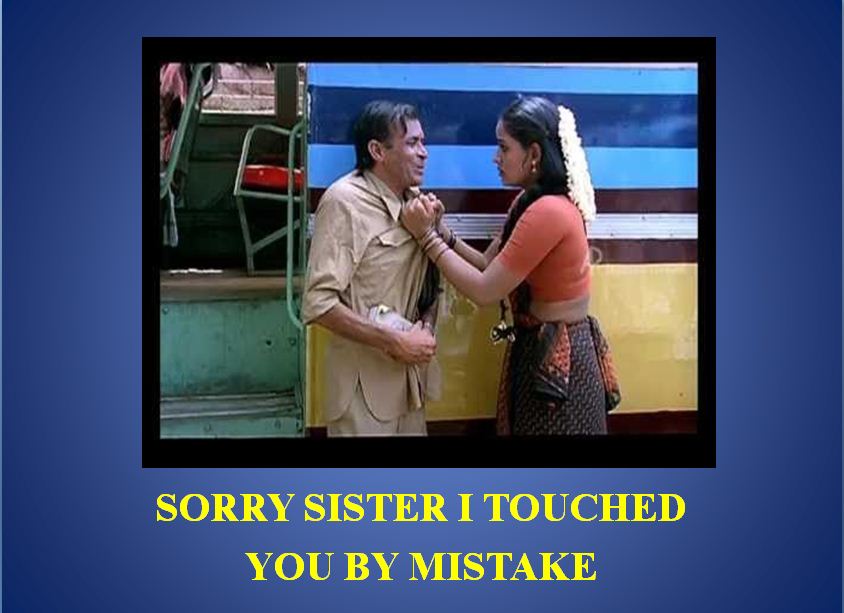
Ladies, you know this type of conductor well. Where just a smile would suffice, he pats you on the back. Where he could just squeeze past you, he will squeeze some part of you. He reminds you of your molester uncle. If you look closely, it might just be your uncle in disguise.

The touchy feely conductor


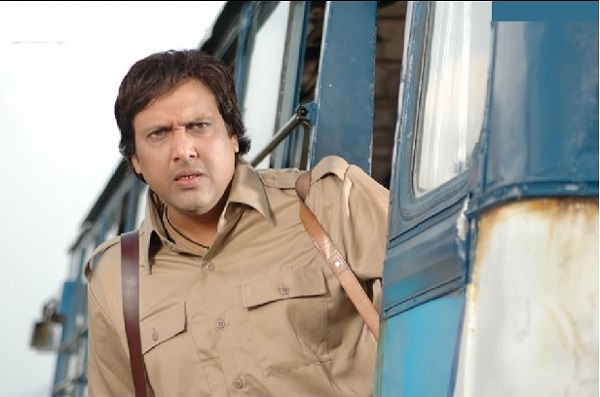
#2) The hero conductor.

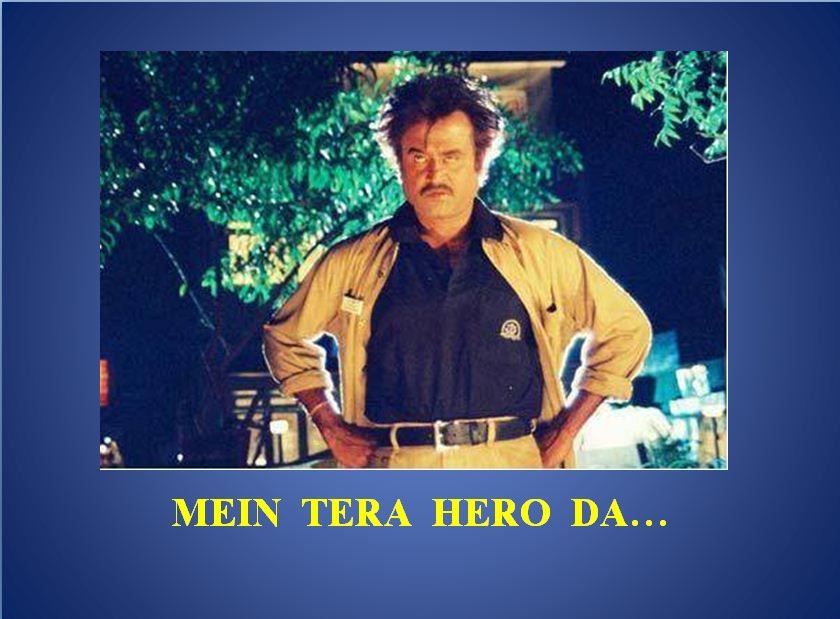
He thinks he is the hero and the baap of the bus. He will seat himself near the entrance of the bus, adjust his hair, see if his shoes (matching his shirt) are still clean, pat his face dry with a special handkerchief, hum constantly, and even use a clever line or two while handing you your ticket. If he wasn’t a BEST conductor, he could be Vivek Oberoi’s understudy. Or Vivek Oberoi himself.

The hero conductor


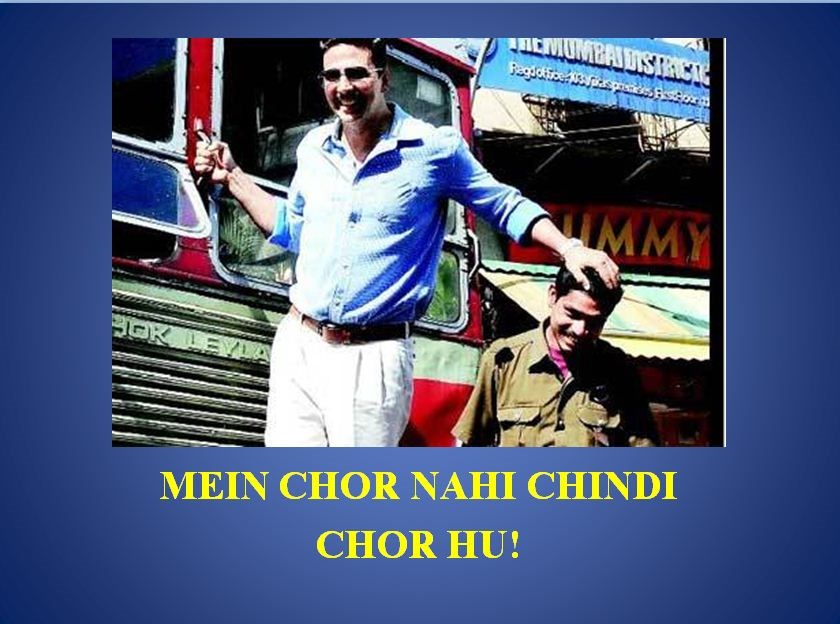
#1) The chindhi chor conductor.

This one takes your money and makes off with the change. Or, he is too lazy to rummage around for coins, so he simply writes the balance amount on the back of your ticket and tells you to collect it from Wadala. When you ask for your money, he gives you a dirty look, as if you asked for his first-born son, or as if he lives in South Mumbai and you’ve just announced that you live in Mira Road. Though he will shake your confidence, be firm and ask for your Rs 2 back.

The chindhi chor conductor


Disclaimer – I love BEST conductors, actually. I was told to write this propagandist, #paidmedia article by the auto union.

Andy Reghu claims to be a writer, a standup comic, a professor and a nuclear biologist. 

(Featured image courtesy jammag.com)

Categories
Tech

Sony launches Vaio Flip

Available in three screen sizes and with prices starting from Rs 94,990, this new device might just take your fancy.
by Manik Kakra

Sony today launched its hybrid Vaio Flip in India. Offered in 13-inch, 14-inch, and 15-inch screen sizes, this hybrid is being touted as a combination of the traditional notebook and tablet form factors. The USP of the Vaio Flip is its swivel screen, which has an additional hinge at the centre to rotate the screen at 180 degrees. So, you can use the device as a complete tablet, swivel the screen back to use as a notebook, or rotate the screen the other way to use it as a screen like a digital photo frame for your need.

Hardware: This Windows 8 device (upgradable to Windows 8.1) comes in various processor options. Its 15-inch model (F15N17) comes loaded with Intel’s fourth generation 1.8 GHz i7 processor, 2 GB nVidia graphics card, and 8 GB of RAM. Then there is one 15-inch and one 14-inch model that come with 1.6 GHz i5 processor and 4 GB of RAM, along with 1 GB nVidia graphics card and Intel 4400 graphics card, respectively.

13Fall_VAIO_Fit_13A_Flip_SAll these models have 1 TB of hybrid storage (SSD + HDD) disks, while the 13-inch (F13N) model, which the company is marketing more as a tablet than laptop, comes with 4 GB RAM, 128 GB SSD and is powered by 1.6 GHz i3 processor. All the models have got 1920 x 1080 HD screens, and have the Windows 8 Home button at the screen’s bottom. The 13-inch model also comes with a dedicated USB 3.0 port that can be used for charging your smartphones and tablets even when your Vaio Flip has been shut down.

Other features: Connectivity-wise, there is Bluetooth, WiFi, HDMI port, USB 3.0 ports. It has an 8 MP rear camera; and a 2 MP front-facing camera.

Price points: Sony is giving its MDR-XB-920 headphones free for every buyer till the end of March 2014, and you can also get an extended warranty for a discounted price for a limited time period.  The F13N1A has been priced at Rs 99,990, and comes in silver and black colours; F14N16 at Rs 94,990, and F15N12 at Rs 1,04,990, and F15N17 for Rs 1,19,990, and come in only silver colour.

Categories
Hum log

‘Horror and mystery fascinate me’

Legendary actor Amjad Khan’s son Shadaab talks about his new innings as a writer, and why he misses his father.
by Vrushali Lad

His father set the silver screen on fire with his very first film, Sholay, in 1975. The creepy Gabbar Singh of Sholay, played to perfection by Amjad Khan, went on to do several different roles, most of them very different from his debut outing.

Several years later, in 1997 his son, Shadaab, ventured into films with Raja Ki Aayegi Baraat (co-starring Rani Mukerji). Naturally, comparisons with his illustrious father followed. However, Shadaab couldn’t make a mark with the few films he did, and he quickly dropped off the radar. He has now surfaced with his first book, Shanti Memorial, a compilation of two chilling novellas set in a home for violent and criminally ill persons.
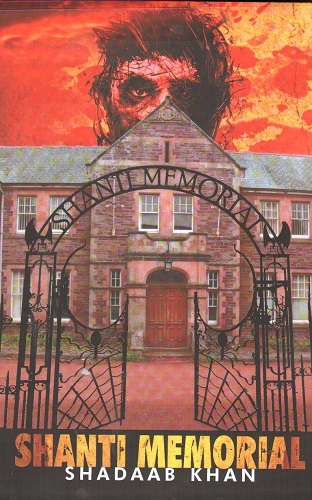
Book Cover of Shanti Memorial - A book by Shadaab KhanWe spoke to him about writing a book, his choice of subject, his father, and why he isn’t in films at the moment. Excerpts from the interview:

You started with films, specifically with acting. Why did you decide to take the jump to writing?

Just because I am writing doesn’t mean I have left acting. I have been writing from an early age of eight years, it just took me a little while to get the confidence to put my work out into publishing. The only reason I haven’t been acting is because good work hasn’t come my way, so I took a back seat. If I get a story that I like, I am open to it. There will always be a balance between my writing and acting, both will be carried on simultaneously.

Do you plan to act in any more films soon?

If I get a good offer to act, I am open to it – there will always be a balance between my writing and acting.

Your book Shanti Memorial is an unexpected book, not something a new novelist would usually write. How did you hit upon this story?

What fascinates me are the human mind, its psychology, paranormal psychology, clinical psychology, horror and particularly the genre of mystery. I don’t remember reading classics, I would rather pick up a mythology book and get immersed. The stories I have written even during my childhood, have always been different from the rest. The reason I wrote Shanti Memorial, is because horror is one of my favourite genres and I wanted to write that genre. But I am not limiting myself and will soon explore writing on other genres too.

What kind of research went into the writing of Shanti Memorial?

Research was really what I have been reading all these years since childhood – thrillers, mystery, mythology, horror, paranormal and clinical psychology. I love horror and murder mystery genres. The idea to write Shanti Memorial is purely based on my interest and love for these two genres.

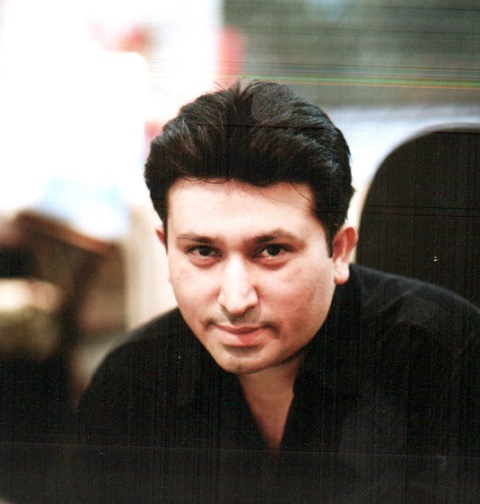
Being the son of the late actor Amjad Khan, and the grandson of legendary actor Jayant, comparisons must be an everyday thing for you. What are your thoughts on this?Shabaad Khan
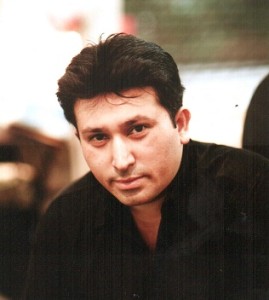
I can only say that I feel honoured to be compared to my dad and granddad. In fact, my maternal grandfather was Akhtar ul Iman, a very famous writer who wrote films like Ittefaq and Waqt. I guess I picked up writing from him. Comparisons can affect you only when you are not content with what you are doing in life. For me, writing has been a passion and I am happy how things are shaping up.

Can you describe the influence your father has had on you as an actor and a human being?

My father always encouraged me throughout my childhood and teenage years. Both my parents acknowledged my love for writing at an early age. Although I was aware of my father’s stardom, for me he was just my father who corrected me when I was wrong and encouraged my good qualities. I lost him at an early age of 18. I miss him and I wish he was here to read my book.

Did you always want to be an actor or did you have other career goals?

Entering the industry as an actor was the most viable option as the industry knew my father. As a person I do not plan too much ahead and take things as they come each day.

What was the turning point in your life that made you think, ‘I should write a book’…?

There was no such turning point as I developed my love for reading and writing at an early age. Reading bizarre psychological thrillers, horror, mystery, mythology, clinical thrillers have always interested me.

Do you plan to direct films in the future? What are the kind of stories you are most drawn to?

It’s a bit too early. But when it happens you will be the first to know.

Do you think you would consider writing a sequel to Shanti Memorial?

It is too early to comment right now. It all depends on the response I get from my readers.

What’s next for Shadaab Khan?

Definitely another book. I am currently exploring a couple of ideas, and very soon I will know which one to proceed with.


Exit mobile version