Categories
Soft Coroner

Women’s Day in a man’s world

Prashant Shankarnarayan wonders if Women’s Day is to be celebrated or observed, and either way, seriously, what’s the fuss about?
prashant@themetrognome.in
The situation – An email regarding Women’s Day sent by my office’s HR department.

The observation: Two days ago, I heard a woman in my office shriek in excitement. Then a few more women followed in unison. Our HR team had sent a ‘Women’s day special’ email, mentioning that all the female employees can shop till they drop on Women’s Day and can buy stuff equivalent to their respective net salaries.

Some women reacted as if they had been crowned Miss Universe. The men started complaining even as some of their female colleagues rejoiced; and then there were many like us who knew this just can’t be true. It took a while for them to realise that it was a prank. Few women, who were literally dancing in bliss moments ago, were seething in rage even as the HR head (a woman) tried to explain that it was ‘just a joke’. Well, I feel that’s what Women’s Day has been reduced to – just a joke!

To start with, are we supposed to celebrate Women’s Day or observe it? If we are supposed to celebrate it, then we in India have been celebrating womanhood for thousands of years. So what’s the big fuss about? If it is supposed to be observed as a day where we contemplate and resolve to better the status of women, then why haven’t we succeeded in simply making life better for women despite celebrating womanhood for thousands of years?

Yes, it is easy to say that present-day women have it better than the ones who existed in the past. But is it enough? Is it enough that they go to work and parties? That they can choose their careers and partners? That they can enter traditionally male domains like defense and airlines? That they have access to contraception and can choose the number of children they want to bear? Is that why we earmark a particular day on the calendar as Women’s Day?

Then why is it that even today any random guy can rape an innocent girl without an iota of fear in his heart? Simple, because in the deepest patriarchal recesses of our hearts, many of us still don’t treat them as equals.

How else does one justify the rape of a foreign national at her own home in Bandra by a small-time crook? How could one rape a girl in a moving bus? How does one explain the rape of a woman in India every 20 minutes? And where does a Woman’s Day stand in response to this barbarism?

We are hypocrites. Our age-old adage starts with ‘Mata’, then proceeds to ‘Pita, Guru and Deivam’; incidentally our favourite expletive too starts with ‘madar@#$!’ The same race that has worshipped man and woman as equal in the form of Ardhanarishwara have pushed many a woman in her late husband’s funeral pyre. Many of us ogle shamelessly at other woman but believe in covering up our wife in a burqa or a ghoonghat. The Indian woman is the Goddess who needs to be appeased and at the same time the sacrificial lamb that gets  butchered. Similarly many men pay lip service to Women’s Day only because they know that the remaining 364 days belong to them.

I wait for the day when we won’t need a particular day to celebrate womanhood because that is the true measure of equality. Till then we have nothing to be proud of because it is just a Women’s Day in a Man’s World.

Prashant Shankarnarayan is a mediaperson who is constantly on the lookout for content and auto rickshaws in Mumbai. The Soft Coroner attempts to dissect situations that look innocuous at the surface but reveal uncomfortable complexities after a thorough post mortem.

(Picture courtesy charteredbanker.com)
Categories
Event

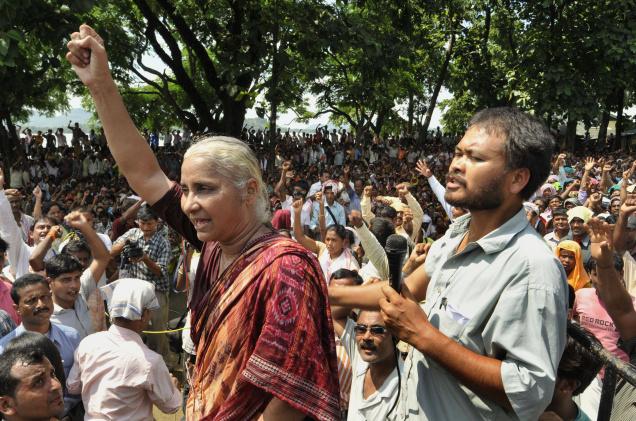
Medha Patkar arrested from Golibar Maidan

Activist arrested from Khar site where slum dwellers are being evicted all day. Protesters allege that cops have thrashed them.
by National Alliance of People’s Movements

In a series of illegal actions against the urban poor in Mumbai, the city Police today came down heavily on Medha Patkar and a group of people resisitng the illegal evictions at Golibar, Khar (East). Other active local residents including Prerna Gaikwad, Ajit and 20 men and women have also been arrested this afternoon. Those protesting have been beaten up very badly by the police and goons on behalf of Shivalik Builders, in the presence of MHADA engineers and officials. The latest information is that at least 10 houses have been demolished at Golibar.

A posse of police vehicles and JCB machines are still at the place and the demolition drive is still on.

The bulldozers at Golibar, a 50-year-old slum, are once again out to demolish and evict the slum dwellers who have been fighting corruption and a land grab by Shivalik Ventures, in which the 2G Spectrum scam-ridden Unitech has a stake. In the past, the slum dwellers have repeatedly opposed and exposed the illegal acts of the private developers who are all out to grab the land. It was only after the expose that the Chief Minister of Maharashtra scrapped the two 3K projects.

Even now, as usual, no notice has been served on the people before the demolitions. The Bombay High Court had directed that the residents must be relocated to a good transit camp that is in a completely livable condition, and also directed that individual agreements with the residents must be registered. However, without following this directive of the High Court, the demolitions are continuing in a totally illegal maner. It is also significant to note that as recently as on January 18, the CEO of the Slum Rehabilitation Authority (SRA), Nirmal Deshmukh, ordered a halt to the demolitions, but the same has started once again, with MHADA’s intervention.”

Update: The NAPM has demanded the immediate release of all detainees, and immediate action on the police personnel involved in the demolition drive. Another demand is for action against Shivalik Builders for several alleged illegalities and encroachments on the land by the firm.

(Picture courtesy thehindu.com. Image is a file pic)

Categories
Event

Boman brings the house down for street children

Noted actor entertained a packed Shanmukhananda Auditorium recently, then tweeted to garner support for the cause. All this, for free.

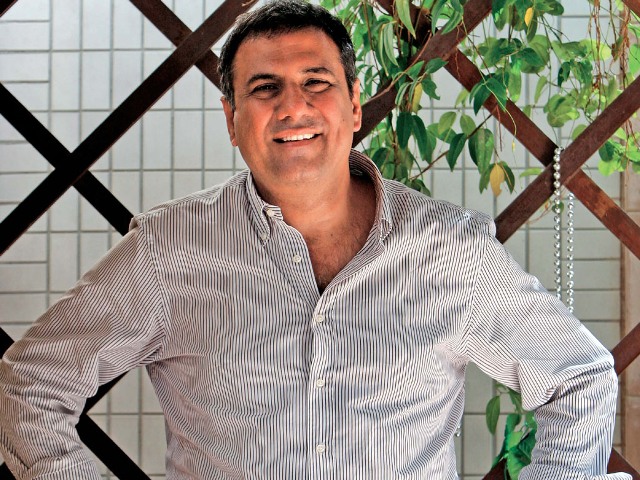
On Saturday, March 2, Shelter Don Bosco, an institution that looks after street children in the city, celebrated their silver jubilee, and Bollywood actor Boman Irani made it an affair to remember for the packed-to-capacity audience at Shanmukhananda Auditorium.

He brought the house down with his antics and music, and in the end had each of the audience members on their feet, applauding him as he sang ‘We Are The World’, mimicking all the voices in the legendary song, right from Lionel Richie to Willie Nelson, and from Tina Turner to Michael Jackson. Singer Manasi Scott accompanied him on the song.

What’s more, the event’s organisers claim that the actor was up early the next morning, tweeting to urge his Twitter followers to help out the Institute. And by the end of the day, he had a sizeable assurance of help pouring in. The actor reportedly did not charge a fee for making the appearance, and has been associated with the organisation’s events for the last 10 years.

The evening began with Manasi Scott and Chrisann Misquitta on the grand piano with their rendition of ‘Fever’ and an improvised ‘Imagine’. Then came the Monsorate Brothers with ‘Effie’ and they simply had the audience rooted to their seats with hit numbers from 1920 till the 80s, before ending with RD Burman classics. Manasi and her band performed to ‘Skyfall’, ‘Titanium’ and ‘Iktara’. She brought the curtains down on her performance with ‘Mama Mia!’

The entire event was conceptualised and executed by Light Infotainment. Speaking on the occasion, Martin D’Souza of Light Infotainment said, “We wanted to give something to everyone who watched the show. We knew the audience would range from eight to 80 years.”

(Picture courtesy indya.com)

Categories
Overdose

Pedestrian pains

Jatin Sharma recently bought a new car, and he has lost respect for pedestrians already. Read on to know why.

When you buy a new car, you want to respect pedestrians. Mostly because you were one of them before you got your mean machine.

I recently got a new car. In my new-found love for pedestrians hoofing it while I drove by in style, I stopped at every signal, and when I would see them waiting to cross, I would drive to the side of the road and apply the brakes – only to realise that they were not always equally considerate towards me. They would keep crossing one after the other, and others would just jump out after seeing me stop for others. It was almost like it was a race to see who would cross in my front of my car first.

Another time, all the cars were whizzing by and no one was letting the pedestrians cross. My new good-driver soul made me stop. But instead of being thankful, everyone while passing started throwing abuses at me. They vented their frustration at having waited a long while, on me. Me, the guy who had stopped and let them cross. All of them looked at me in anger, also pulling a lot of faces.

This is a good time to insert a quote from Lawrence S Harris: ‘Are we taking drunken drivers off the road to turn them into drunken pedestrians?’ 

I  admit  that I just Googled this quote and I have no idea who Lawrence S Harris is and when he quoted this. But I am putting it out here because it is apt to what I’m about to say next.

Yes, pedestrians have every right to curse, abuse and torment the drivers in our country.  It has been observed that our country lacks basic discipline and respect for traffic rules. Whether it is lane-cutting or rash driving or the, ‘Yeh rasta mere baap ka hai‘ attitude of a driver, our traffic situation is clearly based upon the law of the jungle. Whoever is bigger and powerful rules the roost. It’s that law of nature where the smaller car is bullied by the bigger car, or the bigger bus, or the biggest truck.

But the law of the jungle falls flat when it comes to the pedestrian. Jaywalking is the pedestrian’s favourite pastime and the moment someone is going to hit them, they will not look for logic or the fault of their actions, it directly becomes the question: “Yeh carwale /H@#$zaade samajhte kya hain khud ko?”

Pedestrians labour under the delusion that averting accidents is just a driver’s responsibility. Pedestrians in our country like to jump over dividers and even land on the bonnet of a passing car suddenly. Every time it happens, I wait for at least one of these clowns to jump out with a bugle in hand and yell, “SURPRISE!”. Most pedestrians don’t even realise that the person inside the vehicle is manoevering a machine that is at least 100 times his weight, and he needs to stop it mechanically in order to avoid a disaster.

And if the driver goes wrong even by a whisker, the world and its mother rushes out to bash him up without asking whose fault it was. Our country has so many rules and regulations for drivers, but when it comes to pedestrians, there’s nothing, so we can just hope that each of us is a brilliant driver who can handle any situation. The driver can’t speak on the phone while driving and can’t be drunk behind the wheel and he/she needs to have a seat belt on, but the pedestrian can be drunk and on merrily talking on the phone and can basically get away with anything. 

And there are some pedestrians who make you talk to the hand. Literally. These are what I like to call the Ichchadhari Traffic Police; the moment they want to cross the road, they stroll across it with a hand raised. This species of pedestrian is deaf to honking cars and do not even acknowledge the driver of the car that has braked suddenly to avoid knocking him down. 

I’ve recently learnt that cars and pedestrians contribute to the traffic nuisance in our city in equal measure. Drivers are at fault several times, but pedestrians too need to be a little lenient towards drivers. They need to realise that a guy handling a vehicle must be under tremendous pressure. The pedestrian should try and avert small mistakes, too. He should not pretend to be a hero, leaping across the dividers and catching drivers off guard. 

We are a country that lacks basic infrastructure and courtesy when it comes to traffic rules. But then, the onus is on the people of the country to formulate those rules in order to make road usage beneficial for everyone. A country changes by the attitude of its people. But somehow, when people come out on the roads, either behind the wheel or on their feet, they instantly enter into a competition to see who reaches his/her destination first. 

There is no need to be in a perpetual road race. If we all become considerate about each other on the roads, the day will be come when even in India, drivers would love to stop their car and let the pedestrian cross the road. For now, if the drivers do that, they are only sitting waiting for people to stop crossing the road and let him pass, since the light turned green ages ago.

Jatin Sharma is a media professional who doesn’t want to grow up, because if he grows up, he will be like everyone else.

(Picture courtesy blogs.seattleweekly.com)

Categories
Deal with it

Mumbai Police HQ on terrorists’ list?

Are terrorists planning on doing the dirty with the Mumbai Police Commissioner’s office? Our Police chief seems to think so.

The Mumbai Police anticipates trouble.

As per a directive issued to his men by Mumbai Police Commissioner Dr Satyapal Singh, there may be a threat to the Mumbai Police Headquarters located near Crawford Market, south Mumbai. “All vehicles arriving at the HQ must be asked to slow down even before they approach the main gate, and once at the gate, they must be thoroughly screened,” his missive says.

The directive comes on the heels of the recent serial blasts at Hyderabad on February 21. Following the blasts, Delhi and Mumbai were immediately put on high alert by security agencies. However, the Mumbai Police HQ has surely received a specific threat, which has prompted this action.

This move is aimed at vehicles loitering outside the HQ as well.

Meanwhile, a non-bailable warrant (NBW) has been issued against Indian Mujahideen (IM) founder Yasin Bhatkal – IM is believed to be behind the Hyderabad blasts. A Delhi court issued the NBW today against Bhatkal and nine other operatives of the IM.

(Picture courtesy mumbailocal.net)

Categories
Trends

The city of carcentricity – Part II

Trupti Amritwar Vaitla explains how we all are paying for road infrastructure that caters to a small proportion of people.

Read Part I of the series here.

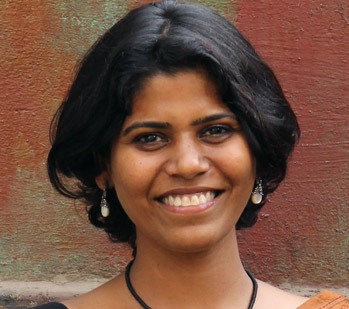
Yesterday, we featured Part I of Nidhi Qazi‘s interview with Trupti Vaitla (see pic on left), Chief of Operations at Mumbai Environment and Social Network (MESN), and also the head of Rachana Sansad’s Urban Design Cell. In the concluding part of the ‘City of carcentricity’ series today, Trupti explains how the majority pay for a small proportion of users’ car infrastructure by way of taxes and more.

Nidhi: Why this car-centric approach? Whom does this approach benefit and how?

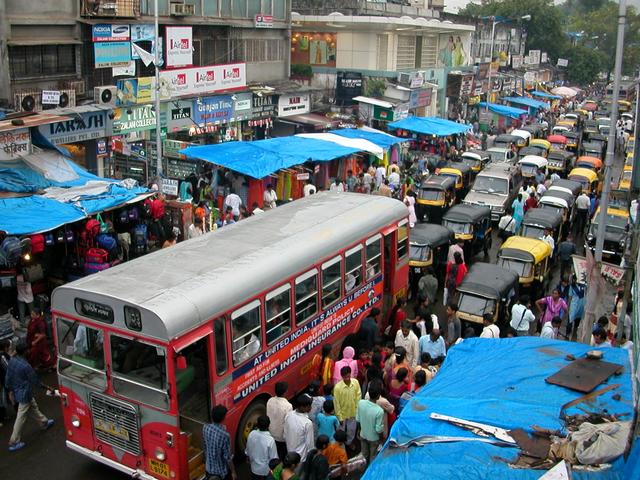
Trupti: The projects in the city are car-centric as cars are a big business for many, like the car manufacturing industry, the road infrastructure industry and many car-related service industries. There is also a belief that car industry provides employment to a large number of people, and so, going against it is as good as going against the employment of working class.

We have a big impact of American lifestyle, where people live in sparse suburbs and are totally dependent on cars for mobility. For us, this model means ‘being developed’ and we are imitating them blindly in our cities which are dense, compact and actually ideal for mass transit. America is now seriously rethinking its car-centric ways which have proved unsustainable.

Our politicians, policy makers, bureaucrats and other authorities, are all car users, and view the entire situation from that lens and believe that owning a car is progressive and getting car infrastructure is the motorist’s right.

Big infrastructure projects like highways, freeways, sea links and flyovers which require huge investments, and are justified seeing the congestion on the road, but what causes that congestion never gets highlighted either by politicians, authorities or even by media.

N: How much does the government spend on the public transport system?

T: While in Mumbai, public transport carries 70 per cent passenger trips (down from 80 per cent about a decade back), the expenditure by users of public transport is less than 6 per cent. On the other hand, users spend more than 70 per cent on private transport which caters to barely 12 to 15 per cent of trips.

All the Western and Central railway suburban stations and tracks were completed by 1925, and since then, there was very little investment in upgradation till 2004 except in Navi Mumbai stations after Mankhurd. During the last 10 years, due to MUTP 1 (Mumbai Urban Transport Project) and MUTP 2 there was an investment of about Rs 2,000 crore for replacing the old tracks, coaches and extension of platform.

Recently some investment up to Rs 4,000 crore is made for the metro and monorails. Also 1,000 new buses more were bought under JNNURM, where half were in lieu of grant and the rest were bought by the Municipal Corporation. Of these, 600 were to replace the old buses and only 400 were added to the existing fleet. There is no investment in any kind of bus system to improve its efficiency. About Rs 8 to Rs 10,000 crore were spent on highways, the Sea Link and flyovers within Mumbai in the past 10 years.

N: Can you give us a comparison between the taxes paid by buses and car-users? Why is there a difference? What are the solutions?

T: Depending on the cost of the vehicle, the private vehicles have to pay a lumpsum one time tax of 7 to 14 per cent  for an individual and 14 per cent to 20 per cent for a company-owned vehicle for a lifetime. A bus has to pay tax annually and on per seat basis, depending on the type of vehicle (like basic, luxury, and AC bus). It is estimated that buses, considering a life of seven to eight years, pay 25 to 30 per cent tax i.e. two to three times higher than the private cars ! Also buses have to pay sales tax of 3 per cent on the sale of the tickets.

We also have a street tax which is based on the property value at 15 per cent  and not on the vehicle value or size. If we have pro-public transport policy, then why, under our tax regime, do buses pay much more than private vehicles? Why don’t we have taxation or road user fees that are designed to restrain private vehicle ownership and tilt in favour of buses? Also why can’t we charge nearer the real and total cost of parking spaces? Such rationalisation is easy and will make a great difference in favour of public transport usage.

It’s a Catch-22 situation, where it is unrealistic to expect migration from private transport to pay heavy charges and expect people to travel in the poor public transport. At the same time, it is not possible to wait for public transport to improve to restrain the growing numbers of private vehicles.

The basic rule is that mass transit can improve mobility, but it cannot solve congestion. Congestion can be solved only by a restraint on private vehicles and provision of good public transport. Both measures need to happen simultaneously to achieve a sustainable mobility. Instead of time consuming options like the metro rail to improve mass transit, this city needs solutions like improving the buses with dedicated lanes or BRTs, which are time and money efficient ways but which need vision, will and discipline.

Organising the existing intermediate public transport fleets like autos and taxies with dial system and shared routes to optimise its use and provide effective last mile connectivity.

Besides, we should focus on improving information and ticketing systems for better utilisation of public transport.

(Featured image courtesy purveshg.blogspot.com. Trupti’s pic courtesy bmwguggenheimlab.org)

Exit mobile version