Categories
Guest writer

Rise. Dance. And don’t stop talking!

A Mumbaikar has a V-Day message for the women who are battered by men, and for men who abuse women.

payal tiwariby Payal Tiwari

A few months ago

The phone was ringing at 3:00 am. Your sobs woke me up. He raised his hand on you! It sounded unbelievable to me…How could he? I know him so well…He’s so good to women, to you, to me, to everyone! This is unacceptable. I know you were bruised that night. I was too ill equipped to handle the situation, too scared to get you away from that house. You kept crying…I silently heard you cry.

A few weeks ago

We all met at our favourite café for Sunday brunch. I was so excited to meet you, we hadn’t met since you moved in with your boyfriend. He is so caring in his own way, it’s always fun being around you two. And I am knocked out of my senses when you tell me what you two have been going through these past weeks. My head throbs with shock as I hear you open up to me. How could you have survived alone in that house? How does he not acknowledge it as violence? Why do you not walk out of it each time wordlessly?

A few days ago

I have been in love with your ways of defying structures; we’ve all grown to theoretically understand various facets of feminism and practicing it in every way of our existence. Our conversations reinforce various facts and I register how prevalent and widespread domestic violence is in intimate relationships. We talk endlessly of love, power, and violence. I dissolve into thoughts and images of how he physically abused you after giving up on the ‘discussion’ he was having with you!  I feel a surge of confidence to hear that you decided to move on…Passing the stage of passive onlooker, who hopes that this was the last time, and he is so apologetic about it!

Today

Over drinks and food, you have opened up about all those girls in your college who occasionally got a beating or two under the garb of their partners being ‘possessive’. I remember you once telling me: “I like to be with a ‘manly’ boy and well. . .These things come with baggage!”

Domestic violence is endemic in nature! From marriage to live-in-relationships, domestic violence in various forms (emotional, physical, financial, and sexual) is extremely violence against womenprevalent in intimate relationships. Abusers are not peculiarly crooked-looking men who beat their wives to pulp, they can be the most loving and caring partners who resort to violence after a bad day or might not consider any other way of conflict resolution but to raise their hand.

But no incident is ‘provocative’ enough to invite someone to raise their hand. No ‘mistake’ is big enough to justify an episode of violence. ‘Just one slap’ IS domestic violence. That ‘one slap’ is also capable of ruining someone’s self confidence to such an extent that they start showing withdrawal symptoms.

Will we forever maintain silence around this issue, because it happened just once and we are sure he “won’t do it again?” Each day I get more concerned about violence against women. Because it is happening every day, every minute! Where do we go from here? Do we wait till this violence ends or do something about it? What can we do about it? Is this only a ‘women’s issue’ and does not affect men at all? Is the definition of violence restricted to only ‘physical battering’? No. It is not only a women’s issue because men also get affected by violence.  Violence spreads because of sexist attitudes that form a part of a certain culture that perpetrates rape and violence against women. This violence is of various degrees and moves beyond physical battering. It includes verbal thrashing (constant taunting, comparisons, constantly finding faults etc.) as well.

Eve Ensler, the writer of The Vagina Monologues suggests that one billion women across the world stand up together on February 14, 2014 and dance just like that they did last year. This year we stand up for justice for those who have been fighting for it.  Let our dance be symbolic, and let’s unite against violence on women! There are many ways of celebrating, many ways to unite…  Let this fabulously festive way be our language to acknowledge the violence that women face very often!

We need stories, we need dialogues, we need conversations, and I am angry that we choose to ignore these incidences. I blame the parents, friends, colleagues and relatives of these men who are violent towards women. When will we have the conversation with these abusive men? If he did it once, he could do it again… 

I want us to talk unabashedly, as loud as we can. And together we need to talk. I want men, women, members of the LGBT community, everyone to come together and dance till the violence against women ends. I want to scream and shout till the violence against women ends! And in order to stop this violence from occurring we need to dance, fight, yell and talk… As hard as we can and as much as we can!

Payal Tiwari is a researcher on gender issues, and is based out of Navy Nagar, Mumbai. She holds a master’s degree in Women’s Studies from Tata Institute of Social Sciences (TISS). A fervent animal lover and a staunch feminist, she loves to travel, drink chai and read.

(Pictures courtesy ibnlive.in.com, faridabad.haryanapolice.gov.in)
Categories
Deal with it

Commuter groups demand better travel for Mumbaikars

Two organisations based in Mumbai observed Commuters Protest Day against the Railways’ apathy towards Mumbai commuters’ woes and long-standing demands.
by Nidhi Qazi

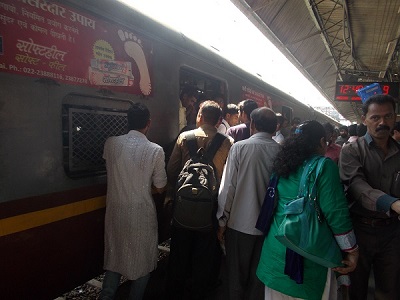
Yesterday, a young boy in his 20s fell on the space between up and down tracks at Chembur station, from a CST-bound train on Harbour Line after hitting an electricity pole. He was then rushed to Sion Hospital.

crowdsWhy did he fall? “Because he was standing on the footboard, teasing passengers on the platforms and did not see the pole and thus got hit by it,” said a constable at Chembur station. He further added, “In the 10 months that I have been stationed here, I have constantly been hearing about such incidents. On an average, two to four people die like this every week. Most of these people are young, between 16 to 25 years of age. And they hail from three main areas – Mankhurd, Govandi and Kurla. The young boys from these areas are famous for their antics.”

The fact that a lot of young people can be spotted doing antics on the moving train or atop it may be worrisome, but it is equally important to see beyond the issue and question why they do it. Is it something they do just for fun or really, is it because they have no space inside the compartments, and are forced to stand (or rather hang) by the footboard?

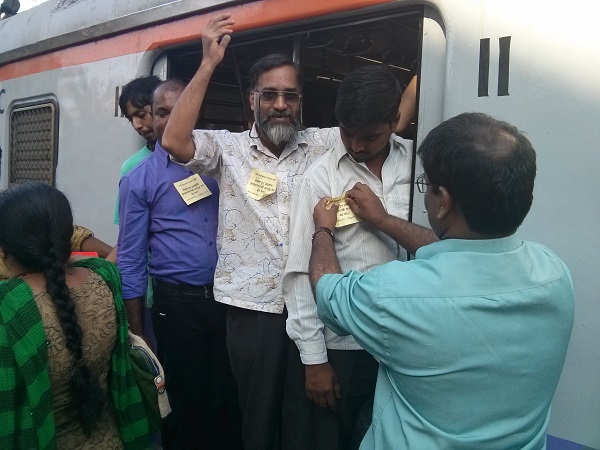
Yesterday’s incident may not be a new occurrence by any means, but it was still significant as it happened on a day that was being observed as Commuters’ Protest Day – an initiative of the Democratic Youth Federation of India (DYFI) and Pravaas Adhikar Andolan Samiti (PAAS) covering 111 suburban stations in Mumbai’s Western, Central and Harbour lines.

As Preethy Sekhar, Maharashtra Secretary of DYFI put it, “We stationed our volunteers at various stations on all the three lines who distributed badges to the commuters. These badges are a symbol of protest against the ill conditions commuters face daily. Peak-hour trains are overcrowded three or four times the carrying capacity. Passengers fall off from running trains and fall on the tracks while trying to board. Death and loss of limbs have become daily occurrences.”

The two organisations laid out a list of demands: 

– Increase the number of services on war-footing in all the suburban routes. Procure new rakes for giving relief to commuters.

– All local trains on Western, Central, Harbour and Thane-Vashi routes must have 15 coaches.

– All platforms at all stations must be extended to suit 15 coach trains.

– Start suburban train services (EMU) in Dahanu Road-Vasai-Diva-Panvel route.

– Stop the practice of late-running of trains. Resolve problems in signalling system and deploy sufficient number of running staff.

– Bring about comprehensive commuter safety measures.

– Conduct survey of platform heights urgently at all stations and make adjustments wherever necessary.

– Avoid the danger of stampedes; build adequate number of foot over bridges and subways.

– Provide 24 hours ambulance service at all railway stations.

– Conduct safety audits of all railway stations and adopt accident prevention measures.

– Provide necessary passenger amenities at all railways stations.

– Ensure women’s safety in local trains. All ladies coaches must remain reserved for all 24 hours.

– Police personnel must be deployed in ladies coaches without fail.

– Railway board must conduct an immediate assessment of all projects for Mumbai suburban sector and implement all proposals on war-footing.

The organisations will follow up with the Railways on these demands.

(Pictures courtesy Nidhi Qazi and Sadiq Basha)

Categories
Guest writer

Mumbai’s children – in want of playing spaces

A space-starved city’s biggest casualty is the lack of playing spaces for children – but where should our children play?
by Dr Pooja Birwatkar

As a young girl, the dreams of my future were like most other people’s – a happy life, a good husband, a good job, of course money, a nice house and lovely kids playing in my garden. But wait. Did I say “A garden of my own?”

This was the only part of my dream which was not fulfilled. Why? Because I got married and moved to Mumbai.

In a city of dreams where many dreams succeed and many crash, my hopes of a garden came crashing down after I moved to Mumbai. I never knew the worth of a garden till I became the mother of an energetic, always-running-and-jumping child. My building, like most other buildings, is starved of open space. The builder has minted money by making flats on the ground floor, too. The leftover space serves as a parking lot for a few privileged flat owners who have bought the parking space (though it is not meant to be sold). Anyway, a garden is non-existent in the premises and the only ‘play area’left is the space between parked cars.

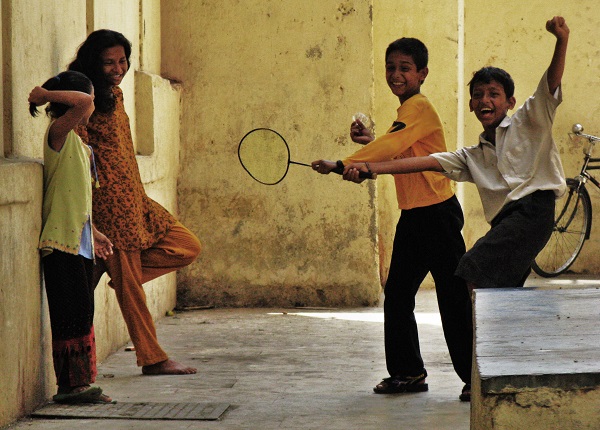
Thanks to Mumbai traffic and busy office hours, most people return home late and that means their empty parking lots are utilised for cricket, badminton, running, etc. My five-year-old son and other children of all sizes and ages compete with each other every evening to catch the best available space. The mothers of the little ones huddle in one corner, chatting and gossiping. But amidst all these chatting sessions, our eyes are forever trained on the entrance gate to spot a car entering the building. As soon as a car shows up, there are shouts of “Car aa rahi hai, bacchon, side pe ho jao!”. Chaos follows, with children running in all possible directions, some even towards the car, followed by their anxious mothers.

The poor driver of the car is, by now, conscious of all eyes on him/her. The kids are happy if the car is not about to park in their playing space. If it does, then the car owner is parking spacemade to feel guilty as the children drag their feet, pick up their bottles and playthings with a “Why you came early today?” look on their faces. The car gets parked and the playing resumes, only to be interrupted again by another car entering the building.

Meanwhile, a daily feature of play time in the building is the falling down and hurting themselves of at least two children every day. This is no joking matter – the children fall on hard floor and sometimes seriously injure themselves. Every day, I carry a silent prayer in my heart for my child as he plays. Come rainy season, the children are robbed even of the parking space ‘play area’. After the rains subside, the moss-covered floors make even walking impossible.

The solution to all this is go to a nearby garden. But alas! When I go there, I realise many people know of this solution already. The gardens are crowded and unkempt. Most of the swings, slides are rusted and broken with sharp edges. Besides, going and coming back from the gardens means getting stuck in traffic and for parents who come home from long hours at work, this can be very frustrating. Some buildings do boast of a play area, garden and other such amenities, but the cost of living and maintenance issues make them unaffordable for the middle class.

But despite all these limitations, the children still enjoy their limited play space and make the most of their play time, and for that, I really salute them. Parents are often heard lamenting about the space crunch problem and give the usual excuse that their children watch TV as there is nothing else for them to do. We have to understand that limitations would be there, but they can also be suitably overcome if one wants to. Since nothing can be much done in terms of infrastructural changes to overcome this space problem, what best can be done is to employ some smart strategies for play time:

– Parents can make groups and organise play activities for younger children.

– Groups can take turns to supervise the children while other parents can use the time to run errands.

– Parents can take turns to ferry the children to the nearest park or ground. This can be done on Saturday and Sunday mornings and other school holidays.

– Plan for play time so that it does not coincide with people returning from office and using the parking lot.

– Invest in creative indoor games for rainy days. Puppet shows, activities, story sessions, dramatics can all be planned for children for summer vacations and the rainy season.

It is important for children to play with each other as apart from recreation and fun, it also trains them for social interactions and is an essential part of the growing years. And though I gave up the ‘Ghar, ghar ke aage garden, garden mein grass aur usme khelte bachche,’ dream for my own children, I dream it now for my grandchildren. And now you must excuse me as I see a car approaching and I must warn the children who are playing kho kho.

Dr Pooja Birwatkar is currently pursuing post doctoral research and working in the area of science education. She has been associated with the field of education in the past as a teacher educator, and her area of interest is research in education. 

(Pictures courtesy www.ndtv.com, letsjapan.wordpress.com)

Categories
Deal with it

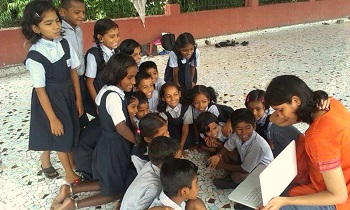
Apni Shala: Where children see life

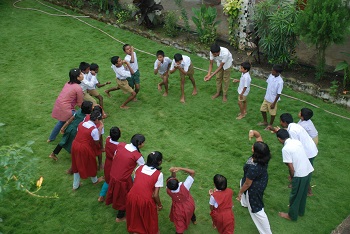
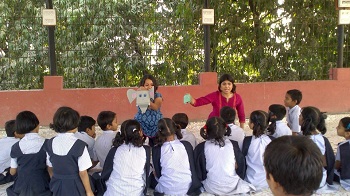
A city-based start-up works with children of BMC schools to impart important, essential life skills through games, stories and drama.
by Nidhi Qazi

That life skills are important, we all know. We can proudly look back at our schooling and say, yes, we did have a platform to show our potential. But wait – do all of us get a chance to see our life skills at work in school? Did all of us get a chance to really know ourselves? If these questions disturb you, read on.

Eleven-year-old Nilesh studies in a BMC school. His classmates stay away from him. There was a time when he didn’t talk in class, was withdrawn and showed physical aggression towards his classmates. His father is an alcoholic, while his mother passed away. Being the eldest child, he has to take care of the rest of his siblings. Then ‘Apni Shala’ happened to him.

A start-up, ‘Apni Shala’ started working with Nilesh’s school since January 2013. Since then, Nilesh is a changed boy. He participates in class, his self-esteem has improved and his classmates are much closer to him.

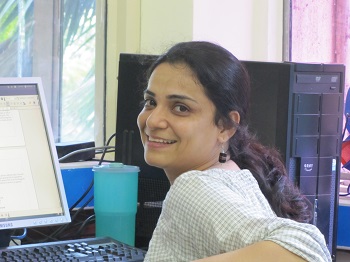
More such stories of children and their problems, is what Apni Shala aims to address. A team of three – Amrita Nair, Anukriti Goyal and Swetha Ranganathan, all passionate about education and all three being alumni of TISS, Mumbai – came together and formed Apni Shala in 2011. Initially, the team started with the idea of setting up a library and building skills through stories, when they realised the potential of other potent media such as games and drama. “Our project was to set up libraries and we did that. But once we did the need assessment, schools expressed a need for Life Skills Education (LSE). And thus, we have now started providing the same to the schools we work with,” says Anukriti, who looks after finances and fund-raising for the start-up.

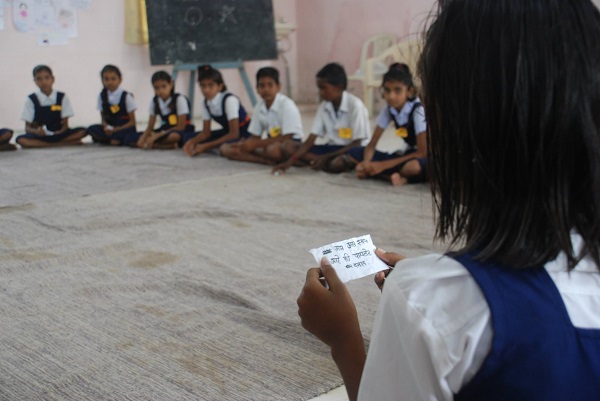
Apni Shala’s LSE programme has modules based on various life-skills prescribed by the WHO, such as making responsible decisions, teamwork and co-operation, solving problems, understanding emotions etc. These modules are facilitated by all three team members; even while each of them looks at separate aspects of the programme like design, content, fund-raising, strategy, communications etc.With the LSE programme running in three BMC schools and three community centres, Apni Shala works in Sion, Chembur, Oshiwara, Colaba, Worli and Reay Road. Their team also consists of an advisory board of curriculum consultants, psychologists and experts. They get funded through various grants.

Why Apni Shala?

Why do we need life-skills building in the first place? “In theory, life skills help build positive attitude. And thus, when we take it to practice, the skills learnt can be used in behaviour. So, we are aiming to provide an environment where a child can get better skills to face situations. Thus, LSE becomes important as more skills in a child’s environment can have a better and positive impact on his or her life,” says Swetha, who looks after communications, monitoring and evaluation of the programme.The need for LSE also stems from the fact that mainstream education overlooks the need for children to express and enjoy learning. Take the story of Sunita, who studies in a BMC school and who lives in a hostel, away from her parents. “Sunita was always disinterested in our programme, she was also shy and would not participate. But now she has become so expressive and enjoys drama,” says Swetha.

She adds, “Yes, some of the schools do give a platform, but kids from many schools do not gain enough experience and exposure. These schools do not teach much about these life-skills. And thus, we want LSE to be incorporated well in pedagogy. Even though there are separate books now on life-skills, how much of it being used in schools really?” 

The challenges

As a start-up, they are looking for more manpower, on all three fronts – administration, front-end and organisation.

Also, one session in a week for one school is a frequency that worries the team. “Although something is better than nothing, we still have to make our programme spread over a week rather than just a weekly one,” says Swetha. This becomes a challenge as “many of the schools do not consider the programme as ‘academic’ and thus it becomes a challenge to convince them.”

The team also feels that it becomes challenging to quantify the impact made by the programme, in front of funders. “To what extent can we quantify? Moreover, our assessment is based on observations. We try being as objective in our observations as we can, “ says Swetha.

In the pipeline…

Though the LSE programme is their core offering, Apni Shala plans to get into training teachers for facilitating life-skills and delivering the same through the existing modules.

They have also launched merchandise comprising bags, mugs and diaries which have quotes on life skills printed on them, and Do-It-Yourself (DIY) kits for children. “Besides fund-raising, these products are aimed at creating awareness among the general public about life skills and their relevance in the lives of children,” says Anukriti.

While they are based in Mumbai, Apni Shala is also looking for collaboration in remote areas. It recently conducted a life skills workshop in Anandwan School, Chandrapur district in Maharashtra.

To understand the impact of their work better, Apni Shala is also thinking of ways to engage with the parents of the kids, to get a better sense of their work.

Apni Shala will conduct a workshop on ‘Interactive theatre’ for children at the Kala Ghoda Festival on February 7 from 5.30 to 7 pm at The Museum Gardens. To volunteer, share ideas or give expertise on building the start-up, visithttp://www.apnishala.org or call them at +91 8454822690.

(Pictures courtesy Apni Shala)

Categories
Wellness

Surprising causes of stress

Did you know that the things that make you happy can also give you stress? Read on to know more.
by Sharad Panjwani

‘Stress’ is, in the simplest terms, a short-term elevation or depression in our mood caused by a change in our environment. These changes can be good or bad. However, prolonged stress gives rise to depression or behavioural changes.

Normally, we associate stress with negative situations and people. A bad appraisal, an unfriendly group of co-workers, an argumentative spouse, your child’s continued bad grades – all of these are causes of stress, and we associate the term ‘stress’ only with negative or unpleasant events in our lives. However, even seemingly ‘good’ factors in our lives can cause stress! We’re just not aware of them.

Says psychologist Dr Charul Shahani, “Anything that causes a change in our environment can give us stress. Even something as innocuous as a close relative visiting us can cause enormous amounts of stress – however, in this case, our feelings of happiness override any panic or fear we may experience. The stress in seemingly ‘happy’ situations spurs us on to work better or faster. However, in some cases, people might experience a breakdown – like when they are organising a party for friends, or going on a blind date.”

These are some hidden sources of stress:

Families: Though this is largely dependent on a particular situation, our families do cause us stress without us realising it. A simple argument over who gets to watch which TV programme, or if the family should take an outing to a certain restaurant, can cause varying amounts of stress. Apart from these, some irritating habits of our family members cause stress on a daily level.

Pets: Our pets largely give us huge amounts of joy, but dealing with them can also be stressful. Says vet Varun Chugh, “We learn to identify our pets’ behaviours, their personalities and what they prefer to eat, how they like to play, what annoys them, and so on. Keeping a track of all of these can be stressful, especially if the pet suddenly changes some behaviours. Your dog barking at night or your cat mewing as if in pain – these can cause stress. People who have young children in their homes as well as pets experience double the amounts of stress because they are handling different personalities at the same time. This stress can translate into fatigue, irritation and lack of sleep.”

Food: Science has established that different foods can have varying effects on our moods. Apart from taste, the temperature, smell and fragrance of food and drink that we consume have a huge bearing on our mood. People who skip their breakfasts are obvious contenders for stress in this category, but so are people who are non-finicky in their food choices! While we assume that people who ‘eat whatever is put on their plates’ are easy-going , no-fuss individuals, these same people can feel stress if their habitual eating discipline prompts them to consume stuff they don’t like. An example of this would be finishing off food at a party despite bad cooking, so that the hostess is not upset.

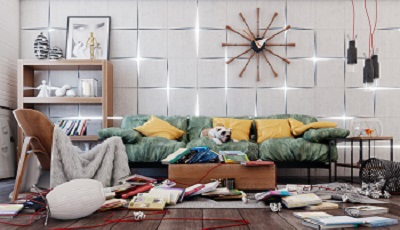
Messy room or workspace: Some of us are naturally messy – we dump our stuff all over the place but we know where to find it. However, studies show that the bigger the mess, messy roomthe bigger the stress in remembering and finding our things later. This happens even if we know exactly where we’ve put them. So when our elders ask us to tidy up, it is for this reason alone – to minimise our own stress.

Gossipy neighbours or co-workers: Though all of us enjoy listening to or sharing gossip with our neighbours and colleagues at work, there is an unspoken fear all of us face – are people talking about me, too? Besides this, we also experience stress when we hear really bad news about somebody else, or some shocking fact about an acquaintance.

Working after office hours: It’s true that the ‘9 to 5’ concept of a working day doesn’t hold true for most of us, with many offices working well past 10 hours on most days. However, we are conditioned to treat our time out of the office (after work hours or on weekends) as ‘me-time’, and admit or not, all of us do have some tasks that we put off for ‘when we are free after work’. Naturally, the idea of having to work when we should be stocking up the fridge or going on a movie date as planned or even catching up on sleep causes stress.

The colours of our walls: Studies have shown that the colours we surround ourselves with have a direct bearing on our emotional well-being. People who work in spotless white workplaces or offices that have zero tolerance for eating at the desktop, report experiencing slight panic or pressure to be on their best behaviour, without having been told to do so. Similarly, homes or offices with walls painted in warm colours cause negative feelings. On the other end of the scale, dull colours such as grey or navy blue cause lethargy. It is a good idea to have a pop of colour in the surroundings with the walls painted in pastel shades. Offices with windows overlooking trees and activity are best.

Routine health checkups: Says Dr Shahani, “We go for checkups to rule out any abnormality, but a visit to the doctor, however routine, is always a cause for stress. Every human being has the fear of a hidden illness being detected. The friendliest doctor can, unintentionally, cause a lot of stress. However, this stress is released the moment we get a clean bill of health.”

(Pictures courtesy nicholasferguson.org, www.thismamacooks.com, www.deviantart.com) 

Categories
Beauty

Your cosmetics could be harming you

How often do you check your cosmetics’ expiry dates? If you haven’t checked, you are putting your skin at risk.
by Deepa Mistry

One out of 10 women take notice of dates and use makeup products accordingly, while the rest are putting their skin at risk by using old cosmetics for several years, even though they begin to smell or get discoloured. Most women forget that cosmetics cannot be used forever. If you don’t keep track of when you purchased and started using certain types of makeup and skin care products, you could develop breakouts or have an allergic reaction.

Expired makeup and skin care products need to be thrown out after a certain period of time. Remember, the expiry date of a product begins the moment you open it but some products have a printed from-and-till dates because not all products have organic contents. Natural and organic products containing fewer or no preservatives have a shorter shelf life and therefore produce higher levels of bacteria.

Many ingredients in makeup can go bad and some can get contaminated by bacteria and other organisms that enter your pores or touch your skin. This can cause a host of skin and health problems. It’s always a good idea to keep a tab on your makeup products and see if anything has been unopened for a long time or has a peculiar and unfamiliar smell. Products such as mascara, lipstick, foundation, face creams, and blush acquire a funny smell past their expiry date. In most cases, areas around the eyes are affected first because they have the most sensitive skin.

caution expired cosmeticsSome of the effects of using out-of-date makeup and skin care products that have expired include the following:

– Skin infections

– Patches of acne

– Frequent breakouts and blemishes

– Excessively dry skin

– Skin discoloration

– Rashes

– Allergic skin reaction

– Eye infections

1. If you are facing any of the above problems, then it’s time for some cleansing. An important tip when it comes to your beauty hygiene routine is to wash your makeup brushes regularly and thoroughly, or you will continue to contaminate your skin and other products that require brushes.

2. Avoid sharing brushes and lip products with others. Usually at weddings, parties or even a ladies washroom, women share lipsticks and lip balms with unknown women. Avoid doing this. The other person might be suffering from skin problems, so don’t invite skin troubles.

3. So many times, we come across branded cosmetics that are sold on the streets and trains, but don’t get lured into buying them. There is a huge variety of cosmetic brands available in the market – don’t fall for the names you have never bought or heard of only because they are cheaper! Cosmetics and skin care products are such that need to be carefully bought and from genuine sellers only. We advise you to invest in cosmetic that’s branded and well reputed, bought only from a genuine store like in malls or stand-alone cosmetic stores.

Branded cosmetics are very expensive but the damage caused by cheaper quality or expired ones can damage your skin for life. If you can’t decide what brands or where to buy makeup from, consult a makeup or skin expert and only buy cosmetics as per skin type. Remember that not all cosmetics suit every skin.

Facial skin is the most sensitive in our body, pamper it but with love and special care!

(Pictures courtesy perfectmakeups.com, www.carbonated.tv)

Exit mobile version