Categories
Event

Don’t miss: Zakir Hussain speaks about his music

The tabla maestro will talk about his musical journey and how he became a legend; will take place at the NCPA.
by The Editors | editor@themetrognome.in

Behind the success of any maestro, there are ideas and ideologies, which can indeed inspire others. And what better way to be inspired, than to hear about a legend’s path to success from the legend himself?

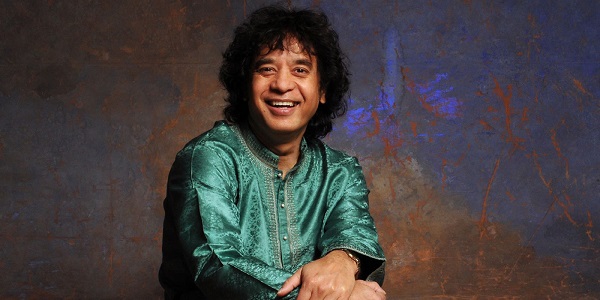
In a special interactive session, legendary tabla virtuoso Zakir Hussain will reminisce about his musical journey including his training, struggles, career and musical artistry, at the NCPA. Engaging the maestro in dialogue will be Arvind Parikh, the eminent sitar exponent. 

Entry to the event is free but on a first-come-first-seated basis. NCPA members will get preferential seating until 6.15 pm.

(Pictures courtesy www.deghelt-productions.com)

Categories
Places

Cambodian surprise

A Mumbaikar goes off the beaten path to Cambodia, and comes away impressed by its friendly people and overall beauty.
by Sujata Garimella

Who hasn’t been fascinated by the exquisitely wild temples in Lara Croft: The Tomb Raider? Cambodia captured the world’s imagination with that movie. Angelina Jolie did more for making the country known than any other person not only via the movie but also by her high-profile adoption of a Cambodian boy (Maddox) around that time. Having got on to the international consciousness, Cambodia got a further fillip with the United Nations and their work with landmine victims/survivors in the country. This was publicity, albeit of the unsavoury kind – but hey, no news is bad news. Between these two, Cambodia became a beacon for the adventure-hungry and the sympathy-pourers and soon became the world’s most visited ‘off-beat’ destination.

My fascination with Cambodia started a few decades earlier, with the cover of a Reader’s Digest Travel book. The cover had a huge stone structure of a face facing four directions. Having noted that this was in Cambodia, the country piqued my interest. Over the years, other tidbits flowed into my consciousness: Angkor Wat in Cambodia was a Hindu Temple; Angkor Wat is the largest Hindu Temple complex and monument in the world; Angkor Wat is not only the largest Hindu Temple complex and monument, it is also the largest religious complex and monument in the world. Yes, most of the nuggets had to do with Angkor Wat but what was even more curious was: how did Hinduism find its way to such a distant land without war or occupation?

A visit to Cambodia was on the top of my bucket list, for sure. When this happened, it was probably the most exciting trip of my life. Since I was travelling with my mother, I went there not as a traveller but as a tourist i.e. it was not a backpacking-adventure-exploration kind of trip, but a planned, comfortable one.

Getting there

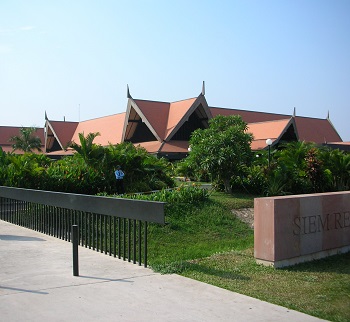
Siem Reap AirportDisembarking at Siam Reap, where Angkor Wat is, was thrilling. It helped that the airport was built in a quaint fashion instead of the normal tall steel-and-glass buildings (see pic on left). It is also at the airport that I got to know that Cambodia offers visa on arrival. (Since these rules keep changing it is best to recheck before you visit and always safer to travel with a visa from your home country.)

Checking into the hotel was pain-free and the Cambodians were refreshingly friendly. With tourism being the mainstay of the economy of Siam Reap, most people speak English and are very welcoming of tourists. The downside of any place existing on tourism (whether Cambodia or Egypt) is the expectation and tacit demand for tips. Be prepared and be ready. While you can exchange dollars for the local currency (Riel) at the airport, Cambodians always quote prices in dollars to tourists. In fact, they shy away from accepting their local currency from tourists.

Discovering the place

There was only half a day left after check-in and negotiation with a tourist guide-cum-driver for hiring the car for the entire duration of the stay so visiting the temples was out for that day. On probing, the driver mentioned a floating village that we could visit. At a cost of $30 dollars (a rip-off because I have since learnt that this is available for $15) we were set. Reaching the embarkation point, we were given a huge boat. The boatman also doubled as a guide and we set off in a narrow waterway.

The ‘lake’ was a narrow-gauge waterway; the water, brown and dirty. The boatman pointed out a floating school and a floating basketball court. Just when we were laughing at ourselves and the ‘floating village’ that we were passing by the water opened up into a vast, seemingly endless water body – the Tonle Sap Great Lake Basin. It was a breathtaking sight. Tonle Sap is the largest freshwater lake in Southeast Asia. The boatman claimed that this lake was fed by rivers from three countries. While this may not be entirely true, it is a fact that its upstream drainage basin spans five countries. He pointed out a notional line in the water (like our Mac Mohan Line with China) stating that from that point it was Vietnam.

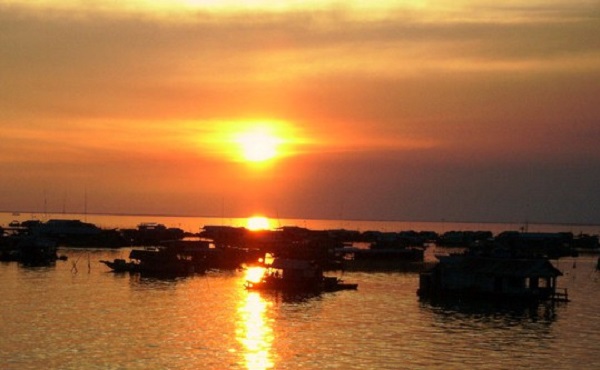
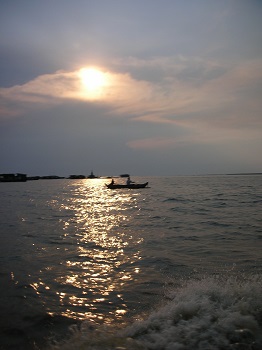
We glided through a village in the water complete with houses, stores, a restaurant and a church in speechless wonder. The villagers used coracles or large plastic and aluminium Floating Village_bowls as their medium of transport. Since we were there in the evening, we were treated to a wonderful sunset, too. On the return journey, the narrow waterway didn’t seem as dirty anymore – the human mind surely is wonderful!

Disembarking brought another surprise. Three or four people swarmed around us with saucer-pictures of us. They took our pictures between the time we got off and to the point we set off, chose the ones that were most clear and printed them on the saucers by the time we came back. Since this was a novelty to me, after some hard bargaining, I bought all three for about $4.

While Angkor Wat, Bayon and the outstanding temple of the tree are spectacular, a trip to Siam Reap would be incomplete without a visit to Tonle Sap – it is a hidden jewel.

Have you recently taken a trip to a place you always dreamed of going to? Tell us about it at editor@themetrognome.in.

(Pictures courtesy Sujata Garimella)

Categories
Do

Have you made a short film? This contest is for you.

The Vasundhara Short Films Competition 2014, initiated by the MPCB, invites films made on environmental themes after January 1, 2012.
by The Editors | editor@themetrognome.in

With our natural resources depleting daily and the environment facing increasing threat from man, it is time that awareness is created far and wide about environmental issues. And what better way to create awareness than to make a short film about it?

The Maharashtra Pollution Control Board (MPCB) has recently announced the Vasundhara Short Films Competition 2014 for all documentary and other filmmakers. This competition will allow filmmakers to shoot and submit short films made on a variety of environmental issues. As per a release from the MPCB, “Any short film or documentary on any environment related theme, made after January 1, 2012 in Marathi, Hindi or English language (or a silent film) is eligible for participation in this competition.” The MPCB has directed that the submitted entries should largely focus on nature and wildlife, environment and conservation issues, or nature and people.

The entries should be made on DVD PAL, and participants must also send a synopsys of the film, the film’s trailer, director’s bio data, and still photographs (digital preferred) from each production for promotion of the film.

Entries are to be submitted to The Member Secretary, MPCB, Kalpataru Point, 3rd Floor, Near Cinemax, Sion Circle, Mumbai 400022 before August 19, 2014, 5 pm.

Rules for application and conditions for the contest are posted at www.mpcb.gov.in.

For details, contact Sanjay Bhuskute on +91- 9869440185 or Raviraj Gandhe on +91- 9820378448.

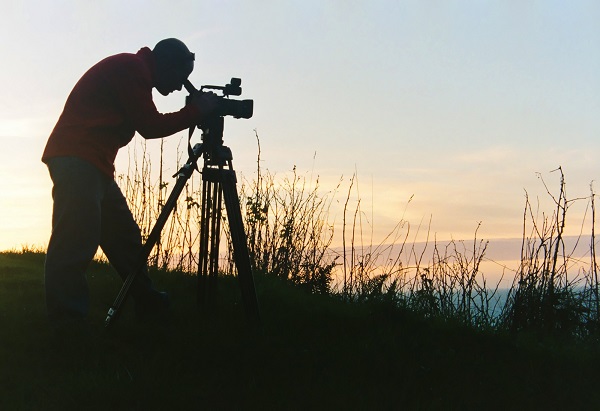
(Picture courtesy www.thefilmmakersworkshop.com)

Categories
Tech

Review: HTC One (M8)

Has HTC lost its mojo? It would appear that its newest phone might bring the company back in the reckoning.
by Manik Kakra | @Manik_K on Twitter

The smartphone race is a hard one to win and retain in today’s day and age. Companies need to bring up something new or improved to the table and make sure they don’t miss out on support for their customers, otherwise they’re going to switch quicker than you can act. HTC’s recent story has been a bit like this. The company, known for their differentiated Android devices, seems to have lost its mojo for the last 18 months or so. It has produced several good phones, but just hasn’t quite been able to do what it takes. With the One (M8), HTC tries to capture more and deliver better. And does it succeed in doing so? Let’s try and find out.

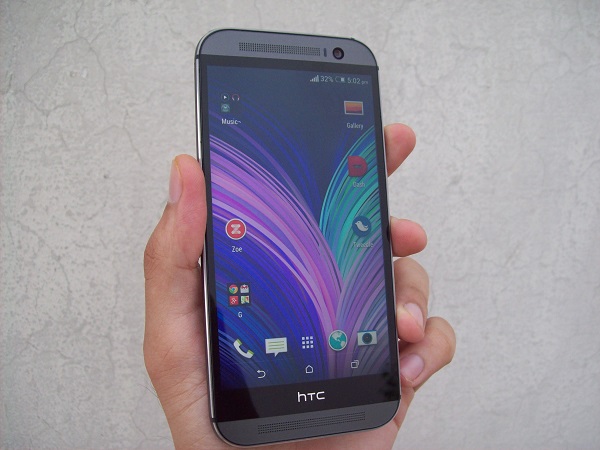
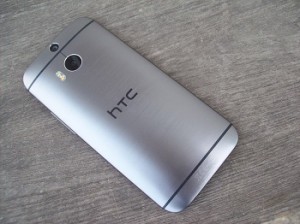
HTC’s One (M8), as the moniker suggests, is the successor to the One (M7). HTC continues to drive its ‘One’ series, which should probably help them identify better and longer with the buyer. In addition to that, HTC hasn’t changed too much when it comes to design ad form factor of its new flagship device. The One (M8) sports an aluminum unibody, claimed to be about 80 per cent of the whole body by the company, with a little usage of plastic here and there.

As soon as you hold the phone, you will notice its curved back and round edges, which fit quite nicely into your palm and it is similar in front design to the One (M7). The device feels very nice to hold and has a premium feel to it, but you might find it hard to grip it at times as it is still a bit slippery, especially while sliding it out of your pocket.
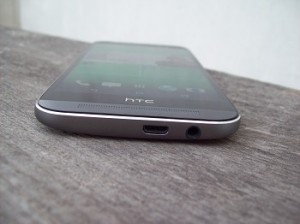
Dominated by the 5-inch full HD S LCD 3 panel, you get the popular BoomSound loudspeakers grilled very nicely on top and bottom of the screen while the front-facing camera, and sensors are placed on their usual places. The LED notification light is hidden inside the top front speaker, and now, in a bit of a change from their previous flagship, the HTC logo in imprinted right on a strip between the screen and the rest of the bottom part of the body.

This space reserved on the outside just for the logo, may not be liked by many because you lose out on space and it makes the device bigger, but on the internal side, there are a lot of components and screws in place, which, HTC, says, is the reason they had to give some space to this plastic strip.

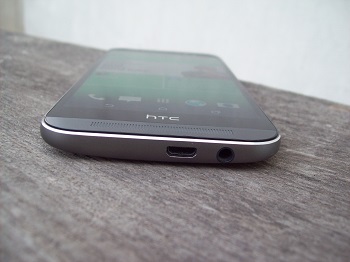
On the top, you get the Power/Lock button and the Infrared port, both are placed on a plastic black strip. On the bottom, you have the 3.5mm headset jack and the microUSB port. On the right, there’s microSD card slot and volume rockers, which gives a nice clicke-ty feedback when pressed. The nano SIM card slot is placed on the left side panel.

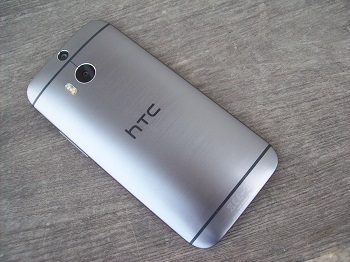
On the back, there are now two camera sensors (more on that later), and a dual LED flash, bifurcated by a thin plastic strip, which is used to ensure there are no network reception issues. The HTC logo is bang in the middle, with another plastic strip toward the bottom half.

Screen

HTC is known for their great display panels, and the One (M8) doesn’t disappoint, either. The 5-inch (1920 x 1080) S LCD 3 panel, with Gorilla Glass 3 on top, is fantastic to work on. Colours look rich, images appear sharp, detailed and viewing angles are also good. While watching full HD videos or reading text, you’ll realise how well HTC has put the screen in place. It is certainly one of the best phone screens out there, and one of the best things about this device.

Audio quality on phones is mainly pertained to their in-ear sound and in-call voice, as the loudspeakers are usually not that great to listen to. But HTC decided with its M7 that it needs to bring more and delivered with the M7’s speakers. The case is similar with the M8. These BoomSound dual front-facing stereo speakers are loud, crisp and clear. It is quite surprising that nobody after more than a year has been able to give HTC’s speakers any tough competition. The more you try them – whether for videos, games music or podcasts – the more you’ll see how much of a difference having a good pair of loudspeakers on your phone can make, and for good.

The in-ear quality is pretty good and not much to complain about. I didn’t counter any network reception throughout my usage and found call quality to be top notch.

Camera

HTC has again used what it calls ‘Ultrapixel’ technology for its camera. This time, we have dual sensors on the back, which are done to capture better depth for an image, so that you100_5088 could change the focus in an image as and when you like in your photo. As a result, you miss out on the OIS functionality and are still getting a 4 MP ‘Ultrapixel’ F/2.0 (and 2 microns) sensor. Here are a few sample images.
As you can see, more or less, the pictures look nice and you can use the camera in low-light conditions, too. You may get some noisy images in low-light, but they’re decent for your phone. To get consistent and clearer pictures, you may want to tone down the sharpness level from settings, though. Zoe, which are short video clips (also available in Gallery), can also be made, but I couldn’t find any dedicated Zoe-sharing service like there was the last time. As far as UFocus is concerned, it works half the times because it requires favourable conditions. The camera UI is even better and quite intuitive to work with. Credit to HTC for making it simpler without missing out on needed setting options. Oh, and the 5 MP front-facing camera is actually good, giving good detailed shots in decent light conditions.

Battery

The phone carries a 2,600 mAh non-accessible battery unit. I found the battery life to be average. I was expecting it to be a bit more than what it usually got, which was around 18 hours on an average, and you could stretch it by using the power-saving mode or the Extreme Power-saving mode, which only allows you to make and receive calls, messages, check the native Email client or alarm, can give you several days of standby time. The phone supports QuickCharge 2.0 (can be seen on a few devices now), but you don’t get the supported data cable and charger in the box.

The HTC One (M8) runs on Android 4.4.2 (4.4.4 should be out soon) with HTC’s proprietary Sense 6 on top. Under the hood, there is a Snapdragon 801 (MSm8974) SoC (2.5 GHz quad-core processor, Adreno 330 GPU), along with 2 GB of RAM. The phone performs very well and is smooth to work on. I didn’t come across any frame rate drops, lags or app crashes to complain about. The Sense Ui seems to have been tweaked and made a bit lighter on the inside. It feels a bit more colourful, and more cohesive to work around.

If there one OEM skin I would have to pick, it would still be HTC’s Sense. Having said that, it is far from being flawless. BlinkFeed continues to exist and sits as the leftward-most Home screen. You can now add a lot more content to it. HTC has also equipped the device to make “double tap to wake” work and work well. Swipe left to get to the last Home screen; swipe right to arrive straight to BlinkFeed; when in portrait mode, click the volume rocker to open the camera app directly. It’s neat and works well, but I wish I had been given the option to double tap on any Home screen to lock it.

HTC sense TV has also been updated and it now supports Indian channels. It does help to have an extension of your smartphone as a TV remote, especially if it displays some relevant content. FitBit is now supported natively in Sense UI; it gives you a proper count of your calorie burn, steps taken, run, etc., but do keep an eye on the app and service hogging battery. More or less, these are the main changes in the Sense UI, and you will find yourself at home if you’ve used Sense 5.5 or even 5 last. The phone comes in only the 16 GB (11.8 GB available) variant for the Indian market, and you can expand it up to 128 GB using a microSD card, plus, the user gets 50 GB of free storage on Google Drive for two years.

All in all, the HTC One (M8) seems to deliver in a lot of areas. HTC seems to know what its potential users want – except for may be that camera in place – like sporting a microSd card slot or providing a different style of Dot View case or making exceptionally great speakers on the front. This is a serious contender to be the best smartphone out there, as there aren’t too many places you could put your finger on and say I expected much better. Apart from an average battery life and a camera that needs some tweaking to be done, you get a great full HD screen, premium material on the phone, and a smooth software that doesn’t isn’t a letdown, the phone has got a lot going for it, and it may just be what HTC needs to be back among the top phone manufacturers.

Categories
Enough said

Does anybody remember the Sachar Committee Report?

Has anything changed for the country’s largest minority group? Meanwhile, the word ‘rape’ has achieved disturbing dimensions among the country’s politicians.
Humra Quraishiby Humra Quraishi

Maharashtra is currently rocked by the news of reservations for Muslims and Marathas. The issue brought to my mind another incident, specifically a report, that created more than its fair share of ripples seven years ago – the Sachar Committee Report.

Headed by Justice Rajinder Sachar and his team, the Report focussed on the current situation of the largest minority community in the country – the Mussalmaans of Hindustan. I still recall the words of the well-known economist and one of the prominent members of this fact-finding team, Dr Abu Saleh Sharief, who had said that in many urban and rural locales, the Muslims are in a more disadvantaged and discriminated position that even the SC and ST communities.

The Report had highlighted the dismal living conditions of Indian Muslims, their issues of housing, drinking water and electricity connections, primary and higher education, Government and private jobs, small industrial ventures, farming and agriculture status, etc.

The question is: what did the Government of the time do? Did it take note of these findings, did it act upon them? More to the point, has anything changed?

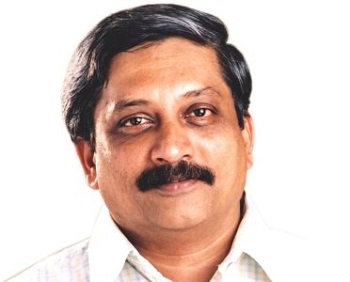
Meanwhile, the word ‘rape’ is being bandied about those in power in the most shameless ways possible. Whether it is Goa’s Chief Minister Manohar Parrikar (in pic on right)Manohar Parrikar dismissing the enormity of rape as against setting up one’s own enterprise, or a key member of the Mamata Banerjee Government, who seems to prefer rape as a weapon of choice against those who cross him, the word ‘rape’ is being used by these men as if it is an everyday affair!

And these men get away with spewing as much venom as they can, as long as they tender a nicely-worded apology. Since there is no real punishment, what is to stop these men, and several more, from using the word ‘rape’ in the crudest of ways imaginable?

And for those who are not in the know, the Kashmir Valley has been rocked with a new form of violence – from street dogs.

It turns out that dog bite cases now account for 1 per cent of all trauma cases in the Valley’s only tertiary hospital. As per a study conducted by the Department of Plastic Reconstructive Surgery, Sher-e-Kashmir Institute of Medical Sciences (SKIMS), Soura, “People fom rural areas were attacked more by the dogs than urban people as 65.5 per cent of patients were from the rural background.

“Also, the face was the most commonly affected part of the body, especially among children. In older age groups, limbs were the mostly attacked part. Most of these dog bite cases have been unprovoked. As many as 96.1 per cent of the patients had between one and five injuries all over their body.”

Humra Quraishi is a senior political journalist based in Gurgaon. She is the author of Kashmir: The Untold Story and co-author of Simply Khushwant.


Categories
Event

Attend: Photography exhibition by students

Bharati Vidyapeeth School of Photography presents ‘Albus Atrum – 14’, an exhibition of photographs by its second batch of students.
by The Editors | editor@themetrognome.in

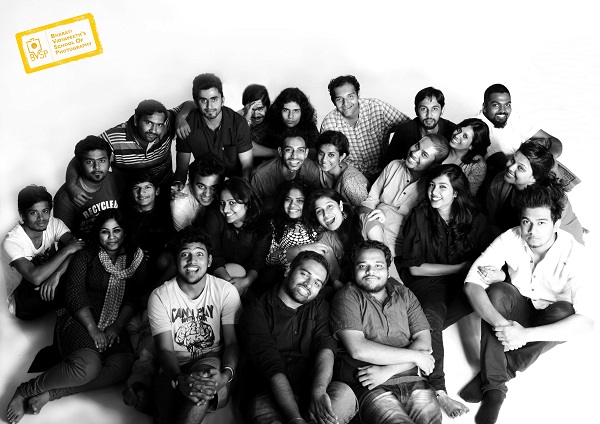
Photography as a subject fascinates most of us, but some take their passion for the subject to quite another level. Ask the students of Bharati Vidyapeeth School of Photography (BVSoP) – the second batch of the institution is putting up a three-day exhibition starting today, July 4, 2014.

Titled ‘Albus Atrum – 14’, this is BVSoP’s second photography exhibition, and was put together using 150 images from its second batch of students that graduated from the school’s Diploma Programme in 2014. The exhibition will be on till July 6, 2014 and prominent personalities like Bharat Dabholkar, Avinash Gowarikar, Subhash Awchat, and Sudarshan Shetty, will inaugurate the exhibition.

The photographs on display span disciplines like fashion, portraiture, still life, food and beverage, automobiles, travel and people, among others. Says celebrity photographer Avinash Gowarikar, “I am very happy to be closely associated with BVSoP for the last one year. The students have really worked hard at gathering knowledge and expertise required to be good photographers. I wish them the very best for this exhibition.”

Head to Tao Art Gallery, Worli, from July 4 to 6, 2014.
Exit mobile version