Categories
Watch

NGO children perform for live audiences

NCPA’s outreach initiative for NGO-supported children in Mumbai will feature various kids’ stage performances in front of a live audience.
by The Editors | editor@themetrognome.in

It is always a joy to see young children performing songs, dances and other acts. Today, you will get the chance to see a lot of great shows put up by children, at the NCPA.

This multi-genre,  multilingual event will feature performances by young children from different NGOs based in Mumbai. As a part of the NCPA’s outreach initiatives, these talented performers will get the opportunity to perform on a professional stage in front of a live audience. The event includes a range of wide performances from group singing, a puppet show featuring the Panchatantra tales, a Judo pyramid and dance performances in the styles of Bollywood, folk music, Odissi and Gotipua depicting the Dashavataar from Geet Govinda.

Talent from NGOs such as the Bal Jeevan Trust, Apun Ka Club, Mumbai Mobile Creches, E.A.R., Aseema and Seva Sadan and others will be showcased as a part of this show.

Admission for all on a first-come-first-served basis. Head to the Experimental Theatre, NCPA, at 3 pm.

(Picture courtesy ncpamumbai.com. Image is a file picture)

Categories
Wellness

Flu shots for pregnant women in Mumbai?

Huge rise in flu cases all over India spurs city gynaecologists to advise influenza immunisation shots to their pregnant patients.
by The Editors | editor@themetrognome.in

India has seen a significant rise in influenza (flu) cases over the years, exposing millions to serious life-threatening health complications. Data shows that influenza contributes between 5 per cent and 10 per cent of all acute respiratory infections (ALRI) such as pneumonia and bronchiolitis, leading to an upsurge in hospitalisation and even deaths.

Amongst the high risk groups, there is a gradual rise in vaccination only amongst children. However, even though pregnant women are also a high-risk group, unfortunately, they are not always advised to take this crucial vaccination. Pregnant women face an increased risk of flu complications because of the changes in their immune system. The complications include pneumonia, ear infections, worsening of pre-existing medical conditions such as asthma, diabetes, heart and kidney problems and can lead to hospitalisation. Influenza can also lead to adverse pregnancy outcomes such as babies with a low birth weight, premature deliveries, emergency caesarean, still births and neonatal deaths.

Dr Parikshit Tank, Chairman, Safe Motherhood Committee, FOGSI, says, “The number of pregnant women dying of flu is on the rise. Such cases could have possibly been prevented through immunization. Unfortunately in India, there is little or no awareness amongst pregnant women or the general population that influenza could lead to serious complication for them and their newborn child. Maternal immunisation against influenza protects the mother and also safeguards infants”.

“Immunisation for influenza should not just be administered in times of an epidemic, such as now. The need for immunization must be made a habit, and pregnant women must make sure to get the vaccination regardless of the surrounding health environment. Efforts must be made to increase awareness and access of the influenza vaccination”, added Dr Tank.

Dr Suchitra N Pandit, Imm. Past President FOGSI and Consultant, Kokilaben Dhirubhai Ambani Hospital, Mumbai says, “It is very important for a pregnant woman to take preventive measures to protect herself and her baby from the complications of flu. A single shot flu vaccine is the safest and most effective way to prevent flu and provide immunity to the mother and newborns. This is why our recent FOGSI Good Clinical Practice Guidelines have included the influenza vaccination in the recommended vaccination list for pregnant women. This will help raise awareness and reduce the risk of influenza and its severe outcomes.

“Globally a lot of work has been done to create awareness. Even in Asia we have an organisation named Asia-Pacific Alliance for the Control of Influenza (APACI), whose aim is to reduce the burden of influenza in the region, by assisting public awareness programs on influenza, promoting it among healthcare professionals, through the provision of educational information and activities”, adds Dr Pandit.

Seasonal influenza is characterised by a sudden onset of high fever, cough (usually dry), headache, muscle and joint pain, severe malaise (feeling unwell), sore throat and runny nose. Most people recover from fever and other symptoms within a week without requiring medical attention. But influenza can cause severe illness or death especially in people at high risk. India has already witnessed a swine flu flare-up that killed a total of 2,167 people across different states and affected 35,077 people as on April 11, 2015.

According to the World Health Organization (WHO), vaccination against influenza is the most effective way to prevent influenza and its complications. Furthermore, WHO also states that pregnant women constitute the highest priority group for seasonal influenza vaccination. The flu shot has been given to millions of pregnant women over many years and has not been reported to cause any potential harm to either mother or baby. Lack of awareness, overcrowding, poor sanitation and myths about the disease, add to the disease burden.

Considering the benefits it has for the mother and infant, the Association of Physicians of India (API) and the Indian Academy of Pediatrics (IAP) also recommend vaccinating against influenza during pregnancy.

(Picture courtesy www.medicaldaily.com. Image used for representational purpose only)

Categories
Learn

Mumbai gets country’s first railway research centre

The centre will be set up shortly at the Mumbai University, will research ways to improve railway infrastructure and services.
by The Editors | editor@themetrognome.in

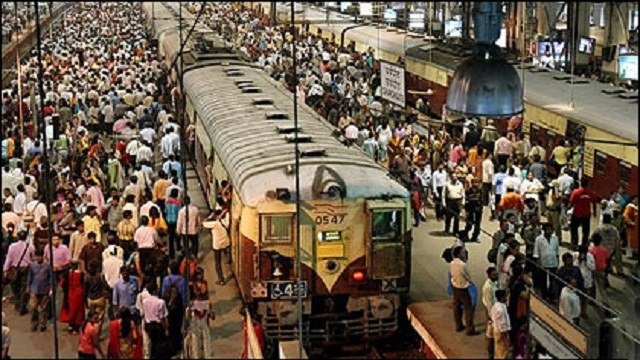
Mumbai is set to spearhead the Centre’s efforts at understanding and providing better railway services for the country. It will be the centre for the country’s first railway research facility in the country.

The centre is aimed at researching the current systems of railway transport, and come up with solutions to increase speed and efficiency of operations, thus impacting overall quality, says Union Minister for Railways, Suresh Prabhu. He adds, “Mumbai was the natural choice for such a research facility, since the genesis of Indian railways is here. The country’s first railway line was started between Mumbai and Thane. The Railways are constantly working on ways to upgrade infrastructure and services to world-class levels, and linking the process with a premium centre of learning like University of Mumbai was a natural progression.”

He says that new ideas for the better working of the 162-year-old Indian Railways will only come from research. “We will work on increasing speed, better services, passenger safety and optimum use of resources,” he adds.

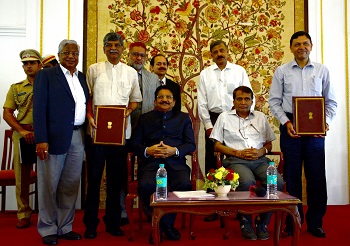
MoU at Raj BhavanA memorandum of understanding for the establishment of the Centre for Railway Research was signed between Ministry of Railways and the University of Mumbai at Raj Bhavan, Mumbai, last week, in the presence of Governor of Maharashtra Ch Vidyasagar Rao and Prabhu. “I urge all universities and colleges to adopt the railway station nearest to them and cleanliness drive there at least once a month,” the Governor said. 

A similar centre to study water resources and water transport will be set up at Ratnagiri, it is learnt.

(Picture courtesy www.railnews.co.in. Image used for representational purpose only)

Categories
Tech

Review: CyanogenMod 12 OS on the OnePlus One

We take a look at the OnePlus One’s hardware and software specs, and come away impressed by CyanogenMod 12 OS.
by Manik Kakra | @Manik_K on Twitter

OnePlus’ story in the Indian market has been quite unique. The company gained popularity on the social media for its invitation-based buying procedure (which the company has now stopped). So, when I got a chance to try the phone (64 GB sandstone black model) for more than just five minutes at my own leisure, I was obviously interested in checking how well its hardware and software really stack up for its price of Rs 21,999.

The looks. As soon as you pick the device up, you realise how different it is to other smartphones and how well it fits in your palm. The phone is not small, which has a lot do to with its thick bezel in the front. The front has a 5.5-inch full HD (JDI) panel (Corning Gorilla Glass 3 on top) with three touch keys at the bottom and ear-speaker grille, sensors, LED notification and 5 MP front-facing camera above. The top and bottom have a silver ring all across and a noticeable curve to them and gel well with the overall look of the phone.

The left panel has the SIM card tray – you get one nano SIM card tray inside the phone and one micro SIM card tray in the box, so you can use whichever you need. The right panel gets the Volume rocker and Power/Lock key – I just wish these keys had more tactile feedback for pressing. The top has a nicely-drilled 3.5mm headset jack and secondary mic; while the bottom gets the microUSB 2.0 port in the middle and speaker grilles and primary mic around it. The back sports a 13 MP oval camera module with a dual LED flash, and the OnePlus logo near the middle. The more you use it, the more it seems the company had a good idea on the paper for its design.

Software and performance. Under the hood, the One carries a Snapdragon 801 chipset (2.5 GHz quad-core processor, Adreno 330 GPU) coupled with 3 GB of RAM. The phone had CM11S (Android 4.4.4) out of the box, but I flashed its official CM12 zip file (though the official OTA update must have started rolling out when this piece goes up).

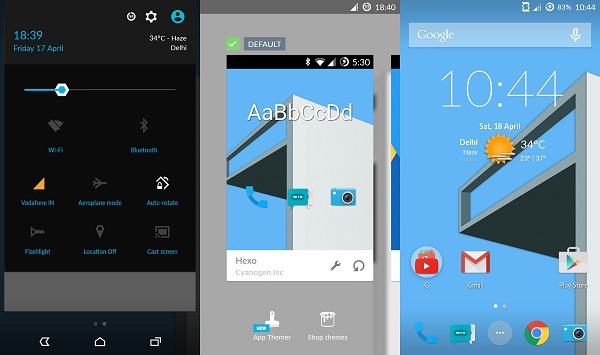
The first thing you notice on getting CM12 (based on Android 5.0.2) is the new Cyanogen boot animation. On getting the phone started, I liked how refreshing the new icons looked. There are no shabby or ill-fitted icons here. The default launcher has been assigned to the Google Now Launcher. The OS supports Ambient Display, which gives you a glance at notifications as soon as you pick the device, something we have seen on the Moto X and the new Moto E. It also supports double-tap to wake and double-tap to lock the screen. In the previous OS version, you can choose to either have on-screen navigation keys or keep using the physical touch keys.

As soon as you enable on-screen keys, the touch keys fade out and become non-functional. The pull-down notification and toggle button has been tweaked a bit. You can pull down to check notification and if you pull it lower you get toggle buttons, something that requires two swipes in stock Android, and this one feels better to use. You also get to see downloading speeds when updating or downloading an app from the Play Store, another thing that might be useful for a lot of people.

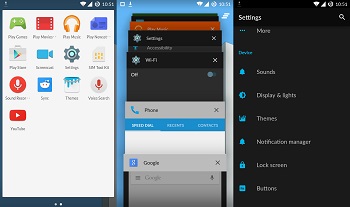
CM’s App Themer allows you to apply themes from their store, and also change icons, font, sound options. Using your Cyanogen Account, you can choose which ones you want to download and apply. Another interesting feature is Privacy Guard, which gives you full control of what apps (whether a system app or a third-party app) on your phone are required to access your location, network data, messages and phone resources.

The recent app Menu is same as card-like stock Android with an added clear button for clearing all apps from the list at once. Though I was a bit disappointed by the camera app, which could do with a bit of work on its viewfinder, focus and even sharpness, there’s some work in progress for the same, apparently. It won’t be wrong to say that CM looks cohesive and nice on the OnePlus One. There are not too many changes done, but quite a few useful changes and addition made to Android that many will like how their phone functions. The phone works smoothly, is able to load u and exit apps just as one would need and can handle multiple Web browser tabs without struggling. The phone’s battery life is also satisfactory.

The verdict. Overall, the OnePlus One’s OS is cohesive, smooth, well-designed and has many options users will like. You get a good 64 GB (54 GB available space) smartphone for these many bucks (and about Rs. 19,000 for 16 GB), an active community if you’re interested in tinkering with your phone, which makes it even better than several other phones for some. The invite system is still the procedure you would have to follow (can’t say I like it), though there are now also no-invite normal online sales once every week.

Categories
Places

A Buddhist temple at Worli

Blink, and you’ll miss it – look out for the sublime aura of the Nipponzan Myohoji temple at Worli Naka.
by Ritika Bhandari Parekh

Amidst the lovers waiting to reach the Worli sea face and the cars honking to go home, Worli Naka was engulfed by the flag-waving bike riders celebrating the India-Pakistan match victory in the 2015 ICC World Cup. Our search for the oldest Japanese-Buddhist temple in Mumbai on this day was met with curious glances from passers-by. I, fleetingly, remember a Japanese inscription written high on the walls of a shrine each time we passed the locality. But that evening, I was destined to experience its tranquil nature.

The Nipponzan Myohoji temple at Worli was built in 1952 by Jugal Kishore Birla. Legend has it that the philanthropist and Gandhian built the simple shrine on being impressed by the Buddhist philosophy imparted by a Japanese monk (Bhikhu) Nichidatsu Fuji. Fuji had come to India to fulfill and gain knowledge from the prophecy of a 13th century monk named Maha Bodhisattva Nichiren.

Nichiren had said that the ultimate salvation for all humanity lay in the western land (according to Japan’s position on the map) known as India, the place where Buddhism originated. With an all-welcoming attitude, the temple is witness to the changing nature of Mumbai.

A sublime experience

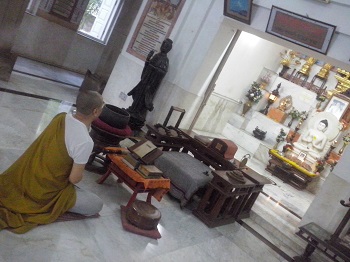
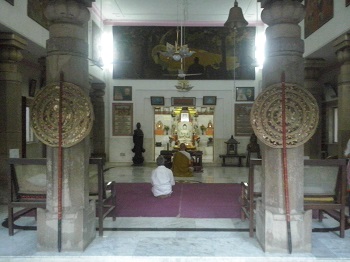
Once inside the premises, I heard the chant of ‘NaMu-MyoHo-Renge-Kyo’ mantra and in a second, all noises faded. The stress of a sleepless afternoon didn’t disturb me, as I took in the beautiful facade of the simple temple. It was evening time and we saw the resident monk, Bhikshu Morita, sitting and softly chanting the lotus mantra.

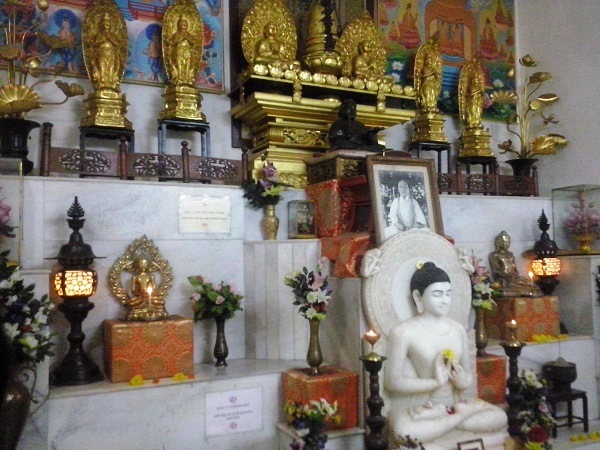
With just the two of us in the temple, i.e. my partner and myself, we explored the area leisurely. Quite a few clippings of the temple’s narrative along with Morita’s younger days are showcased in one corner. But if you glance up, you will be taken on a tour of the story of the Buddha – painted with vegetable dye.

While the main statue of the Buddha is made of marble and placed right in the centre of the temple, one will get a peek of other Buddha statues in different poses. One standing under the Bodhisattva or the Tree of Enlightment, another sitting in meditation, with another lying horizontally.

What catches the eye is the huge Japanese drum, being played in sync with the lotus mantra. There were two more devotees, who played to the beat on smaller tennis-shaped rackets. The hand-held rackets had the lotus mantra written on them.

As we went ahead, the monk urged us to silently go inside the main chamber and pray to Lord Buddha. We bowed our heads and took the prasad. Then we read about the birth of Buddha as Prince Siddhartha and saw a few postcards from different countries with wishes for the New Year.

And slowly, just like the setting sun we made our way out and back to the busy street. But this time the rush in our steps was not there. Just the calmness of our mind accompanied us.

Visit the Nipponzan Myohoji Buddhist temple located near Hindu Smashan Bhoomi, Jijamata Nagar, Worli.

 (See more pictures at www.facebook.com/themetrognome.in. Pictures courtesy Ritika Bhandari Parekh)

Categories
Watch

Dhruv and Ila go goth for ‘Dhima’

Mumbai musician, lyricist and guitarist Dhruv Ghanekar and folk singer Ila Arun star in ‘Dhima’, a goth-inspired video for ‘Voyage’.
by The Editors | editor@themetrognome.in

Mumbai musician Dhruv Ghanekar, after performing music across all genres and media, is now back with a new album, ‘Voyage’. The single Dhima in this album is composed and performed by Dhruv Ghanekar and noted folk artiste Ila Arun. Dhruv is confident that the innovative video will make audiences sit up and take notice.

“The video for Dhima can be described as a hybrid of gothic rock, North African rhythms, and new wave,” Dhruv explains. “The song is inspired by the desert of Rajasthan and North Africa. I have been listening to music from West and North Africa and found that there are so many intrinsic synergies in both the musical cultures. The marriage of these two sounds was screaming to be fused!” He adds that Ila Arun was a logical fit to sing the song as she is “the queen of folk music in India.” Karim Ziad, who hails from Algeria but is a Parisian, performs on the drums while Linley Marthe performs bass. “This sort of video has not been done in the country. Director Razy Ghai has given it a Steam Punk Gothic vibe and created a visually stunning interpretation that challenges the viewer both sonically and visually,” Dhruv explains.

He claims that the gothic grunge themed video features an eclectic blend of “the fantastic, the ghoulish, the bizarre and the forbidden”. The crew was excited about Ila doing the video – she excelled, decked out in a dark gothic attire with her signature husky voice bringing a distinct sound to the single. The sexy, extravagant video explores the dark side of human nature with visions of anarchy, monsters, love and death set in a Burlesque Goth setting. She says, “When I was asked to collaborate on an ethnic folk song on Dhruv Ghanekar’s international world music album with such a star-studded array of musicians from all over the world, I was thrilled and nervous. However, the experience of recording the song turned out to be fantastic and totally invigorating.”

Watch the promo of the video:


For the uninitiated, Dhruv Ghanekar is a composer, producer and highly respected guitar player based in Mumbai. He has performed and recorded with some of the biggest names in music in India and in the international arena. He has collaborated and performed with Vieux Farka Toure, Richard Bona, Trilok Gurtu, Ustad Zakir Hussain, Bernard Purdee, AR Rahman, Raul Midon, Bob Belden, Scott Kinsey, Etienne M’Bappe, Dominic Dipiazza, Louis Banks and Ranjit Barot, to name a few. He has also performed at many leading festivals around the world as a leader of his band ‘Dhruv’, and composed music for over 3,500 commercials, many of which have won awards in India and abroad.

Dhruv has also scored music for many chart-busting film hits and several television programmes, including the prestigious BBC 1 – UK, Star TV, PIX, SONY and many more.

Exit mobile version