Categories
Diaries

Locked up inside her house…for 10 years

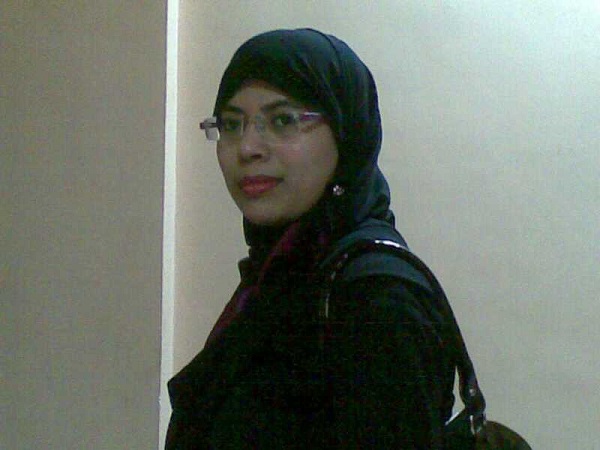
Ishrah Jahan’s younger sister Musarrat Jahan talks of the terrible years after her sister was killed in a police encounter.
by Humra Quraishi

Part 3 of the ‘Women’ Diaries

The case made international headlines when the news first broke – Ishrat Jahan, a 19-year-old student of a Mumbai-based college, was gunned down with three male friends, by police on a lonely stretch of road between Ahmedabad and Gandhinagar in 2004.
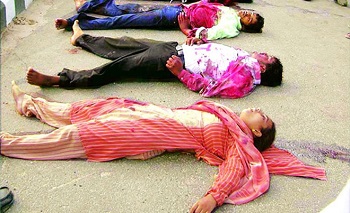
Ishrat Jahan encounterHer family back home in Mumbra heard about the case from the media headlines screaming out details of the encounter – it transpired that Ishrat had been on a ‘mission’ to kill Gujarat Chief Minister Narendra Modi, and was a trained LeT operative. How and why this bright 19-year-old student of B.Sc at Khalsa College got mixed up in the business is still unclear. However, both Narendra Modi and his closest aide Amit Shah have got clean chits in the matter.

After a long fight to get justice for their slain sister, Ishrat’s siblings and their mother are trying to rebuild their lives, though it is an ordeal. Shunned by society and friends, and left to their own devices – after all, who wants to associate with ‘terrorists’? – the family rarely interacts with anybody. However, younger sister Musarrat staunchly maintains that Ishrat was innocent and killed needlessly.

She also says that she has rarely stepped out of her house since Ishrat’s death in 2004. That’s 10 years of locking oneself inside one’s home.

Ishrat, the daughter and loving sister

Ishrat’s mother last heard from her daughter just three days before the former was killed on June 15, 2004. Ishrat had called from Nashik – she had gone from Mumbai by bus to meet her employer Javed there – and informed her mother that she had met him. She had been working as an assistant to Javed Shaikh – her family says that she’d met him just a month before the encounter – who offered her a job in Pune. The job involved frequent travel in India, and Ishrat would be frequently gone for a few days. Though her mother disapproved of the travel, the family was in such dire financial straits that there was no option but to allow her to go.

The family had lost its breadwinner – Ishrat’s father Mohammad Shamim died in 2002 after a long illness – and Ishrat, her older sister Zeenat and younger sister Musarrat started taking tuitions at home to make some money.

I first spoke to the family in the aftermath of the killing, and it was a depressing interview. It was difficult to not be depressed by the pain with which Ishrat’s younger sister, Ishrat's familyMusarrat and her mother Shamima Begum recalled the second oldest child of the house, how she had been financially supporting the family after the death of their father in 2002.
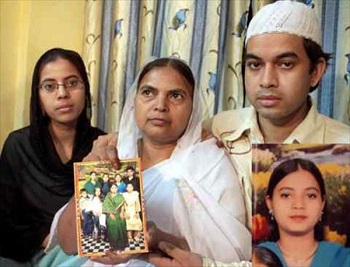
When I spoke to Musarrat again for this interview, I could hear the sorrow in her voice once again. It is apparent that in these last 10 years, the family has not been able to recover from Ishrat’s cold-blooded murder by the officers of the Ahmedabad Police Crime Branch.

I ask Musarrat if there is any change in their station or the realities they live with today, especially after it is now officially acknowledged that IB officers were involved in Ishrat’s encounter. Musarrat says, “Even now, we have not got insaaf (justice), because the two political men (at whose behest the murders were carried out) are not touched and they have not been named as culprits.”

I ask her to elaborate. She says, “That encounter in which my sister was killed was staged for political gains, so what justice is there if the two politicians – Narendra Modi and Amit Shah – are given a clean chit? After all, these two politicians had concocted the false charge that my sister had gone to (Gujarat) kill Chief Minister Narendra Modi, and so they had her killed in that encounter! They are responsible (for her death) and yet they are not named. Why?”

Home alone

Though in severe financial problems, Ishrat’s mother and sister continued to wage a battle for justice. To this day, the family stoutly maintains Ishrat’s innocence, and instantly refute the charge that she was mixed up in terrorist activities.

Still, I ask Musarrat, given the people she is dealing with, is she scared about being so outspoken about the issue? “If my family and I were scared, we wouldn’t have fought this case all these years. It’s been very tough for us. We have been ruined, devastated but we are still fighting for justice…we are determined to remove this terrorist tag thrown at my innocent sister, at us, at my entire family. You can’t imagine how difficult it has been for my mother and us to survive all these years. We have been ruined completely, but we are not giving up the fight.”

She adds, “It [Ishrat’s death] was such a blow, on all fronts – emotionally, socially, financially…ever since Ishrat was murdered, we just kept to ourselves and seldom moved out. We have become wary of stepping out and meeting even the neighbours. Our studies got disrupted completely and we were ruined…it was difficult to even survive, forget about books and studies. For five years I sat blank, in a trance-like condition. I gave up my studies, stopped going out, and didn’t meet even any relatives.

“All those years of our life are simply wasted. It’s only now that I have started doing a course, but only through correspondence. Even financially, our situation worsened. Most of my father’s relatives are no more. My maternal grandmother lives on her pension in her native place in Bihar and my mother’s brother also lives there. He is a salaried employee, so he just about manages to support his own family.”

The now 26-year-old Musarrat says that her family, originally hailing from Bihar, has been living in Mumbai for decades. Her father was a small-time builder who suffered heavy losses and died of a brain tumour in 2002. With the  death of her 50-year-old father, the entire responsibility of the family fell on the eldest siblings – Zeenat and Ishrat. Ishrat had even begun taking up part time jobs together with her college studies to keep the money coming in.

Musarrat says that to this day, the family has received no help from the Women’s Commissions which are supposedly there to help and support hapless women and their families. “No Ministry or even any political party has come forward to help us,” she says

And so the struggle continues…

Tomorrow’s diary: ‘I’m a traffic cop, but you make me feel inadequate’.

(Featured image courtesy Musarrat Jahan, other pictures courtesy archive.indianexpress.com, www.kashmirmonitor.in)
Categories
Diaries

Trust in God, but carry pepper spray

Don’t just wait for ‘manly’ help – it is not ‘unwomanly’ to raise an alarm and protect your personal dignity.
by Vrushali Lad | editor@themetrognome.in

Part 2 of the ‘Women’ diaries

I was first molested by a 20-something man when I was 10 years old. We lived in pre-Gulf War Kuwait at the time, and I had accompanied my older sister to the grocer’s just a few steps from where I lived. He touched me twice between my legs, and as I watched him walk away calmly a few minutes later, even at that young age I remember being so ashamed that I did not raise an alarm though I easily could have. I let him get away.

There were several more molestation incidents as I grew up. Hands reaching out to pinch. Elbows swinging into ribs. Bodies being pressed against mine on a crowded bridge. I dealt with these assholes, fearfully at first, then with increasing violence.

Did the behaviour of some men put me off the rest of them? Nope, funnily enough. All my friends are men. I love men, they’re awesome. Only the creepy ones make me mad.

Cut to 2014. My temper rises at the teenaged boy who, accompanied by his friend in the restaurant, thinks it’s totally okay to keep staring at me over the rim of his beer glass. Of course, I have gone out of my way to ‘deserve’ this kind of attention – I am the only unaccompanied woman in the restaurant, and I do not pretend that a male partner will be joining me soon. I order a huge plate of food, sit cross-legged on my wooden chair, watch an old cricket match on the restaurant’s TV, yell for water.

I give this silly staring infant a full five minutes to quit staring. I can’t know what he’s thinking, but as his head keeps swivelling around in my direction, I know he’s not thinking, “This is the kind of independent woman I will raise my daughter to be – who will go to restaurants alone and not mind being stared at.” His five minutes are up, and I look away from the TV screen. Looking directly at him I loudly ask, “Kya dekh raha hai, bho%#@*ke?”

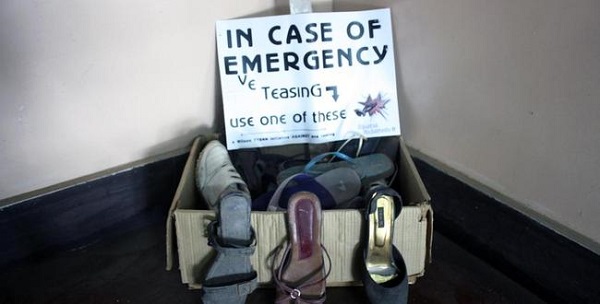
eve teasing Shocked, he whips his face around so quickly, I’m sure he’s broken his neck a little. Both boys do not look at me again. By now, I feel the eyes of the restaurant on me. The auntie on the next table looks murderous. “Kaisi besharam ladki hai,” she must be thinking. I finish my meal and ask for the bill.

I am 35, and by now, I have learnt several swear words. My potty mouth does not reduce my femininity (I think). My parents, however, worry about a bigger disorder that plagues their child – the one that makes me cause a huge scene and hit men in public. My mum tells me to be careful, my husband condoles the reason for my loss of temper, but not my outburst. “I worry for you,” he says, sighing.

Me? I find I care more for my peace of mind than creating a certain ‘impression’ about myself as a woman from a decent family, and I really don’t care, in the heat of the moment, if the guy I am pummelling turns around and starts pummelling me (though that would be embarrassing). The times when I haven’t reacted to such abuse are the times that I still recall with tears in my eyes.

Wherever a woman goes, whether returning home from work or going vegetable shopping with a child in tow, she is subjected to casual remarks, butt pinchings, breast gropings, and what not. At least more women are speaking out against these attacks (which are sweetly termed ‘eve teasing’). But most are still caught in the ‘Jaane do, these things happen,’ mindset. I can’t understand it – if we raise hell when somebody steals from us, why do we hush it up when we are humiliated for no reason?

Most people’s line of defence goes thus: ‘Go to the cops. File a police complaint. Get the perpetrator arrested.’ All of these are fine remedies, and they must be adopted, no question. But what happens in the few moments just after you’ve been inappropriately touched in a crowd, or a passing uncle whispers a disgusting suggestion in your ear? Do these remedies race through your mind first? Do you choose to keep walking as if you didn’t notice that hand on your breast, or do you turn around and satisfy your hurt ego with a filthy look?

You’ve got to do something.

I’m not saying everybody has to beat such men to pulp, but girls, don’t let them just walk away and grope somebody else a minute later. And trust me, no amount of filthy looks will help – those work only with close friends and family, who actually care for the sentiment behind the look. If you know who’s touched you, or said something disgusting, turn around that instant and go after the bastard. Run after him, turn him around by his shirt collar, and put all your strength into the hardest slap you can land on his face.

If he protests (and he will), slap him again. Kick him in the shins, for good measure. Don’t care if a crowd collects to watch you in action (and a crowd will, and don’t expect help either), and also swear at him loudly. If, after all this exercise, you still want to drag him to the cops, please do so.

As a journalist with Mid Day in 2005, I had to do night shifts for a week every month. Every city reporter, girl or boy, had a week of night shifts, where they literally worked all night, scouring the streets for stories, reaching the spot of a development, and so on. I’ve had more than my share of crackpot police constables asking me why I worked all night, directing the question to my chest than to my face, and with some even going as far as asking if I was single. I learnt to blank out the bad behaviour, choosing instead to wear heavy jackets when I could, and always going out for work fully dressed. I don’t know why it is, but the sight of a woman’s bare arms emerging from a sleeveless blouse drives some men crazy. They call it ‘modern’ clothes. Ergo, if I wore ‘modern’ clothes, I wouldn’t mind a bit of loose talk.

And despite my treatise on hitting back and the rest of it, dear girls, please also be careful. I’ve learnt to keep the punches arsenal in reserve, and to not go looking for trouble. In Mumbai, the ladies’ train coaches have a police constable after sunset. The sight of the police uncle in the train is a reassuring one, but he’s not going to escort you home. There’s no need to go all Princess Guerilla and carry a bazooka in your bag, but for your own sanity, be armed with a sharp tongue and a sense of instant justice. Keep a can of pepper spray handy for the times you may be mugged. Don’t merely wait for men or cops or the courts to help you – in a reasonable situation, at least make enough noise to pinpoint the abuser and attract attention to him in a crowd. Shame the man, and do it loudly.

More to the point, don’t be ashamed if some random man tries to get his thrills off you. The guilt is not worth it, and besides, isn’t it easier to own your life and your body than let the scum of the earth define what you should feel?

Vrushali Lad is editor of themetrognome.in. 

The Women’s diaries celebrate the spirit of women on the occasion of International Women’s Day on March 8 every year. Look out for Part 3 next: ‘Her sister was killed. But she fights on’.

(Pictures courtesy www.rnw.nl, archive.indianexpress.com. Images are used for representational purpose only)

Categories
Tech

Review: Samsung Galaxy Grand 2

A good screen, decent audio and camera come with Samsung’s latest release, but will the phone compete well with rivals?
by Manik Kakra

Samsung’s Galaxy Grand was a hit in the mid-rane segment. Many were attracted by the large-screen size and decent package it provided, but were left unsatisfied by the laggy performance and below average battery backup. With Grand 2, Samsung has made a few changes, so let’s see how good the Galaxy Grand 2 really is.

Hardware and design

Samsung’s Galaxy Grand 2 (G7102) follows pretty much the same form factor and material like the Grand and S4. The square looks combined with average matte plastic material make the Grand 2’s build and design. Having slightly thinner bezels than its predecessor is certainly a welcome change.

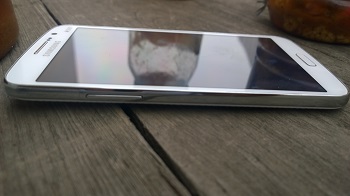
On the front is a raised Centre (Home) Button with chrome-like ring around it, Back button on the right, and Menu/Option on the left. Above the 5.2-inch screen are the Duos branding, front-facing camera and the usual sensors.

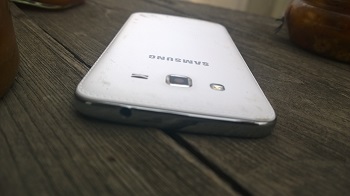
Things get interesting on the back. Samsung has gone with the same faux-leather, seen on the Note 3, back cover on the Grand 2. It looks decent, but as soon as you hold the device and start checking it, you get a clear idea that this is plastic and not leather. With stitching surrounding the back’s boundaries, it does look nice. On the rear is the 8 Mp camera along with an LED flash, loudspeakers grill right next to them, and Samsung branding towards the middle.

On the sides, there are the Volume rockers on the left, and Power/Lock key on the other side. The sides have a silver line across them and the buttons follow the same layout. These buttons are raised enough to give you a good feedback on being pressed. Again, the material and finish of these buttons could have been better. On the top, you have the usual 3.5mm headset jack, while the bottom sports the microUSB port.

Pulling off the rear cover reveals the 2,600mAh battery cell, two SIM slots and the microSD card slot, apart from circuitry, other bits and pieces of the camera module.

Camera

The Grand 2 boasts an 8 Mp camera along with an LED flash. The Camera app comes with a host of modes, settings and editing options, which are not difficult to use. Samsung has done a good job in the Camera UI department, making most of the settings accessible without too many taps. See a few sample images here.

The camera performs well. You get clear, decent colours, while low-light performance isn’t too impressive; the camera is more than capable of taking good shots in decent conditions.

Speakers

The speakers on the Grand 2 are pretty loud and audio is mostly clear. In-ear with the default headsets is clear, quite loud and doesn’t disappoint.

Screen

Coming to the 5.2-inch 1280×720 screen, it doesn’t let you down. The colours appear quite vivid, with a much higher resolution than the original Grand (and rightly so), and videos come out richer. The screen is definitely one thing that needed to be improved and Samsung seems to have done exactly that without over-sharpening the colours.

Call quality

As far as call quality is concerned, there’s nothing to complain about. I didn’t notice any unusual network reception, and was satisfied with the call and network reception of the phone.

During my usage, I got about 20 hours of backup from the phone battery on a single full charge. With sync on, lots of emails, Twitter, (brightness at 50 per cent) a few videos and calls, you would have to charge the device within a day, more often than not.

Software and performance

The Grand 2 runs on Android 4.3 Jelly Bean, along with Samsung’s TouchWiz UI on top. The overall look and feel of the whole UX very similar to what we have seen on the Note 3 and S4. You get five Home screens by default, and can customise them as and when you want – the usual Android manner.

Swiping top from the bottom of the screen opens up My Magazine, which Samsung’s style of Flipboard – giving you personalised content from your pre-selected online publications. Seen previously on the Note 10.1 2014 Edition, it is a good idea and helpful when you just want to glance through the entire day’s updates for a day.

You can access most of the settings right from the drop-down Menu along with your notifications. Lock screen, which, too, can be customized, gets unlocked by swiping in any direction (default way). App drawer, multi-app view and other nitty gritties remain the same that we have been used to seeing on Samsung’s Galaxy devices. You get around 5.5 GB of storage space (8 GB in total), and can expand storage via a microSD card.

This phone is a much better performer than the original Grand 2. After a few days of usage, you will realise there is a definite improvement in smoothness, resulting in better user experience. Having said that, we have Samsung’s own devices with better performance like the Note 3, but this comparison won’t be a fair one. TouchWiz does take its toll, but it certainly gives the user a few useful additions – Camera app, app folders, etc. – of stock Android. Google Now has been there for quite some time now and Samsung’s devices also come with the proprietary S Voice. It is basically a voice assistant that is far from being integrated into the OS and helpful than Google Now. I hardly ever used it, mainly because it recognised my voice less frequently and the overall experience was just average.

Concluding this review, the Grand 2, with its good screen, decent audio and camera, does bring a lot of things to the sub 23k phone range.  Performance isn’t really bad, but we could have had a much better material quality, especially now that Samsung admits slimy plastic isn’t always the way to go with its Galaxy range of devices. There are a few worthy devices that the phone competes with – Nexus 4, Lumia 820 – and it will be interesting to see if Samsung is able to continue its growth in this product range this year.

Categories
Diaries

Women on the high seas

Three women working in the Merchant Navy have battled sexism, back-breaking work and unprecedented challenges in the line of duty.
by Nidhi Qazi

Part 1 of the ‘Women’s Day’ series.

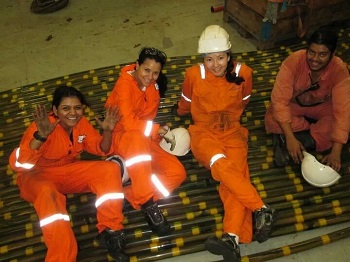
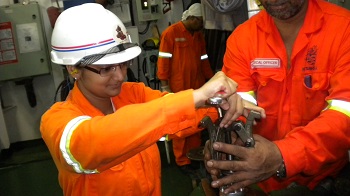
A woman on the seas? Now, that’s a novel idea. But, don’t let Ankita Srivastava, Mandira Nayak and Neha Rao hear you say that.

The field of marine engineering is a highly competitive and tough one, peopled as it is with men who are spunky and difficult to faze. So how does a woman enter this hallowed space, and more to the point, how does she survive?

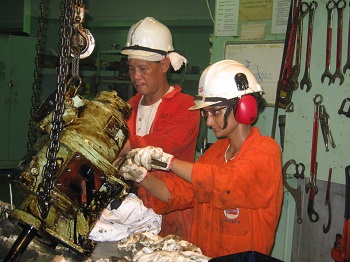
The Merchant Navy is a field fleet of merchant vessels that areused for transporting cargo and has two departments – the Navigation department, responsible for safely taking the ship from one place to another, and the Engine department, responsible for safe operation and maintenance of all the machinery (both mechanical and electrical) on board the ship.

So who are Ankita, Mandira and Neha?

The 30-something Ankita, based in Lucknow, is currently working with Campbell Shipping as Chief Engineer. She did her Marine Engineering from Tolani Maritime Institute, Pune. “I started my career as an Engine Cadet and after completing my sea time as Junior Engineer, I passed my Class 4 exam and subsequently the Class 2 and Class 1 exam. These exams are conducted by DG Shipping, India. Anyone seeking promotion to various ranks needs to clear these exams and acquire licenses to sail on the higher ranks.”

Says 28-year-old Mandira, who hails from Madhubani district of Bihar, “I am a Seismic Engineer, in WesternGeco Company which provides seismic acquisition technologies and techniques for subsurface imaging in any environment.” She has been an engineer since August 2007.

28-year old Neha, a resident of Mumbai, has been on the ship’s Maintenance Department which looks after the machineries for propulsion, electricity generation, air conditioning, refrigeration, sewage treatment, making fresh water, etc. “I started as an Engine Cadet, went on to become Junior Engineer and then Fourth Engineer. As a Fourth Engineer, I was in charge of the generators so had to carry out maintenance and repair on it. I was also in-charge of bunker operations. Bunker is the fuel of the ship. That is separate from the cargo that we carry. I was responsible for the loading operations of the bunker fuel and also its day-to-day monitoring.”

While Ankita and Mandira are still in the same field, Neha has shifted gears to pursue another career option.

The early days

While all three agree that the job is very different and challenging since no two days are the same, they also agree that as women, the challenges are compounded by other factors.

As Neha puts it, “I used to get too much attention from my colleagues. I was like a celebrity on the ship. I couldn’t fart without the whole ship (25 people) knowing about it. Half the time people kept falling in love with me! On a serious note, it is very tough to live normally when you know you are being scrutinised and judged more because you are a woman.”

In Mandira’s experience, since the field is male-dominated, there is constant pressure to perform in terms of physical strength and technical competence. “Even companies arriving for college placements were not keen on recruiting girls. We had to push ourselves harder to prove our competence.” She mentions that the general perception is that girls are not good at technical jobs and to further this, “our batchmates would tell us, ‘Seat kha rahi ho tum log, kyun ho yahan?’”

“But one needs to be strong willed and determined to not let all these perceptions and challenges affect you. If you enjoy your work, there are no limits to what you can learn and achieve. As a woman, what is important is to know your limits, have the required proper knowledge, skills and the right attitude,” says Ankita.

Already under constant questioning from people on the ship, matters were no different off it. People would make comments like, ‘Ship pe safe nahin hota, kitne aadmiyon ke beech rahegi?’ “People didn’t even know the nature of our work, but would still comment,” says Neha.

A typical day at work

Ankita’s usual day starts with the ship sailing from 7 to 8 am. “Everyone in the engine department meets in the control room to discuss the maintenance plan for the day. After going through various procedures and discussions, we go on to complete our job.” A job can be completed in a short while, whereas another job or some unforeseen problem can demand more time. She adds, “If all goes well, the day ends at around 6 pm. By that time, we are free and have ample time to enjoy with our shipmates, reading, watching movies, playing games, and hitting the gym – all of which are available on the ship. But when the ship is in port, the work can vary and can sometimes be very hectic as there can be inspections by authorities or maintenance of propulsion machinery or handling (operation and maintenance) of the cargo gear and other major jobs that have been planned.”

Neha’s typical day would start at 8 am with her reporting to the engine room. She would then be assigned the ‘Watch Task’, which involved either completion of maintenance work on generators or helping others with big machineries. “We would then break for lunch at 3 pm and again start the watch from 8 pm to 12 am,” she remembers.

However, the pressure to prove oneself is such that many fall into the trap of proving themselves so determinedly, that is sometimes exceeds the bounds of common sense.

Mandira recounts a case in point. “In our college practicals, for the tasks which were automated and required no manual work, boys would lift equipment to prove their strength. In our professors’ times, all tasks were to be done manually, but things had changed for us, but still the boys preferred doing the same manually in order to show that they were physically superior to us. In one such incident, a male professor sarcastically asked one of our female batchmates if she could lift a machine. She actually lifted it – it could otherwise be done through automation. Though nothing happened to her, it could have – she could have suffered a slip disc!”

What’s more, one’s partners need to be supportive if one has to succeed in this career. But that doesn’t always happen. “My ex-boyfriend would tell me, ‘There are girls who left sailing for their partners. Why can’t you?’” says Mandira.

Career high points…

Ankita’s career high points till now have been when she passed the exam for Chief Engineer’s license (Class 1) and got promoted later on. “I was aware that not many women had made it to that level and was happy that I was able to stay that long and make a place for myself in a male-dominated field,” she says.

Neha says, “My high point was when I cleared the Class 4 exams which we have to take before we can sail as independent Watchkeepers or Fourth Engineers. These exams were really difficult and I cleared them in a single try. I was also appreciated for my work a couple of times.”

…and the challenges…

“The biggest challenge is that you have to stay away from family and friends for months together. The job is physically and mentally demanding most of the times,” says Ankita.

Adds Mandira, “Being stuck in water for five weeks can be frustrating at times. Moreover, the 12-hour grill with operational and financial pressures in order to seek the company’s profitability keeps us busy and tired.” She adds that the nature of the job is such that one has to deal with rough weather, sea sickness, and disturbed sleep patterns on a regular basis.

Neha says, “I had to stay away from home, friends, boyfriend and any form of social life. Naturally, I would feel totally lost when I used to go back home – it was like the rest of the world had moved ahead and I was still six months behind.”

These factors aside, the engineers also face the dangers of natural calamities like hurricanes, high waves and pirates. As Mandira recounts, “Few months ago we lost a colleague in a heavy wave.” She adds, “We have to retrieve the ship gears in rough weather, and you may drown in the sea. Also, pirates are dangerous as they are everywhere and under the heavy influence of drugs and alcohol. We are trained to deal with them.”

Despite all the above challenges and perceptions, the career opens up a lot of space for experience and exposure, feel these women.

“Since my colleagues are from different nationalities, it is fun to be among a diverse group of co-employees. This is also a company strategy in order to prevent dominance of a particular nationality,” says Mandira. The field also offers the chance to travel the world.

As Ankita puts it, “At the end of the day, it gives a sense of achievement doing something the right way, of fixing things with your own hands. The satisfaction after trouble shooting a problem on your own gives a satisfaction which I think no other job can give. The effort, challenges and dangers aside, it’s all worth it.”

The Women’s Day series celebrates the spirit of women on the occasion of International Women’s Day on March 8 every year. Look out for Part 2 next: ‘Trust in God, but carry pepper spray’.

(Pictures courtesy Ankita Srivastava and Mandira Nayak)

Categories
Tech

WordCamp Mumbai arrives this month

All WordPress bloggers and developers, beginners and experts can be part of two-day WordCamp event on March 15 and 16.
by The Editors | editor@themetrognome.in

This is one event that users and developers of WordPress.com should not miss – WordCamp Mumbai 2014 comes to the city on March 15 and 16, 2014, and all users are invited.

The event will take place at Manik Sabhagriha, Bandra Reclamation. For event details and list of speakers, see here.

As per the organisers, “[The event] promises a lot of learning and interaction between a vibrant WordPress community of bloggers and developers.” Also, the event is a ‘Pay what you want’ one, where the attendee decides the price of the ticket you want to buy. However, the minimum amount payable is still Rs 300.

(Picture courtesy WordCamp Mumbai on Facebook)

Categories
Enough said

Election winds

Based on the current level of sloganeering and speeches by political parties, the upcoming elections should go exactly as planned.
Humra Quraishiby Humra Quraishi

The upcoming elections will probably move along expected lines, judging from the preparations for it. The so-called leaders of the country are running all over the place giving speeches, all hoping to convert their words into votes.

Funnily enough, when the SP’s Mulayam Singh tried going towards the Aligarh Muslim University to address a seminar there, he was stopped even before he could set foot on the campus; there were strong protests by students and teachers. The seminar was cancelled and Mulayam beat a hasty retreat.

The BJP’s Narendra Modi comes to the national capital this week, at the Habitat Centre, where he will launch two books and brag about what his State is doing for the welfare of women. Women’s Day comes next week, and Modi is not one to let go of an opportunity to boast of his many achievements.

I wish someone in the audience would quiz Modi on the blatant gender bias and factual blunders in the text books teaching children in his State. These books in the syllabi are published and printed by his State Government. His own knowledge of basic history is pathetic, to say the least, and now he is doing the unpardonable – relaying factually twisted and wrong information to school children of Gujarat.

His Government is also trying to do what the earlier NDA-led Government at the Center had done, with the then HRD Minister Murli Manohar Joshi trying to twist the facts pertaining to minority communities. In this context, the text books in the State of Gujarat are trying to omit some important facts. A recent news report carries this vital input: ‘Apart from gender stereotyping, instances of gender bias abound. The chapter on the Supreme Court in the social science textbook does not mention the first woman SC judge Justice M Fathima Beevi…’ 

Meanwhile, the AAP’s Arvind Kejriwal addressed Muslims at the India Islamic Cultural Centre. He spoke of the disasters that communal politics drags along with it, and focussed on communal politicians.

Humra Quraishi is a senior political journalist based in Gurgaon. She is the author of Kashmir: The Untold Story and co-author of Simply Khushwant.

(Pictures courtesy www.blog.sagmart.com) 

Exit mobile version