Categories
Tech

Nokia launches Nokia X in India at Rs 8,599

This smartphone is Nokia’s first to run Android, and was recently launched at this year’s MWC held in Barcelona, Spain.
by Manik Kakra | @Manik_K on Twitter

Nokia yesterday launched its Android-based smartphone, Nokia X, in India. The device was first seen at this year’s MWC, and is the company’s first ever smartphone that runs Android (AOSP 4.1.2, to be specific).

Nokia’s X sports a 4-inch 800 x 480 screen, and is powered by a Snapdragon S4 chipset (1 GHz dual-core processor) along with 512 MB of RAM. On the back, there is a 3 MP fixed focus camera. The phone packs in 1,500 mAh battery and 4 GB of internal storage and has microSD card slot too.

Nokia has loaded the phone with its own Fastlane UI, previously seen on its Asha devices, and launcher on top of Android and has made a lot of its own apps as well as third-party apps pre-installed on the device. This dual-SIM phone has also got the Nokia Store for downloading and installing Android apps, and if there’s some specific Android app not available on the Nokia Store, the Store shows you a link to a third-part apps store to download that app from.

As far as your existing in-app purchases (Play Store) are concerned, you would have to repurchase them when after downloading them from the Nokia Store. Google’s API and services are not being used here, and Nokia is providing its own APIs and Microsoft’s cloud services for developers publishing their Android apps on the Nokia Store. The Nokia X Software has its SDK available for developers, but it isn’t open source.

Connectivity-wise, there is Bluetooth, microUSB 2.0, and 3G. The Nokia X is available in Green, Yellow, Red, Blue, Black and White colour options. It goes on sale today and has been priced at Rs. 8,599.

Buy the device at a discount on Flipkart.

Categories
Tech

Motorola: Back with a bang

We review the Moto G, Motorola’s comeback phone in India, and find that it’s a great phone for the price.
by Manik Kakra | @Manik_K on Twitter

Motorola is back in India. And how. Motorola has been in the news lately and for some good reasons. The company has been recently bought by Lenovo, but it has continued to make decent strides in the mobile space to capture market share other than the high-end smartphone market. Moto G announced the company’s comeback to India, so let’s take a look at what this Moto is all about.

Hardware and design

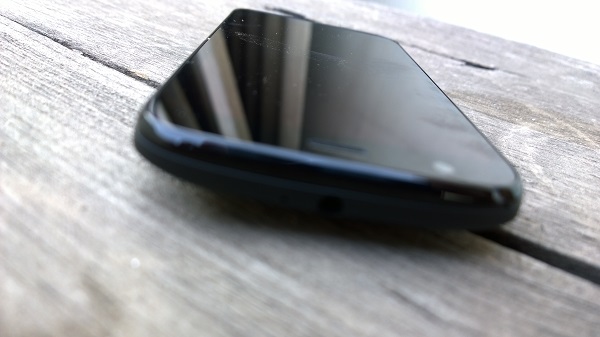
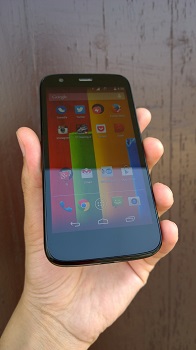
The Moto G (XT1033) has a subtle design. It’s, what I would call, simple yet elegant. As soon as you hold the device, you realise it’s a bit on the heavier size, which doesn’t appear to be the case from its height and width. Unfortunately, the back gets a lot of smudges and fingerprints very quickly. The front is dominated by the 4.5-inch screen – onscreen keys, mind you. The usual front-facing camera, speaker grill and sensors on its top, and primary mic and the microUSB port on the bottom.

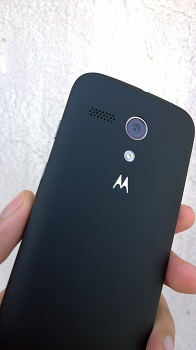
The right side panel hosts the Power/Lock button and Volume rockers – both protrude considerably but don’t feel fragile; while the other side is plain with no buttons or ports. The 3.5 mm headset jack, along with the secondary mic, sit on the phone’s top. Coming to the rear, you get the 5 MP camera with an LED flash, loudspeaker grill, and the Motorola logo dimpled on the rear cover. The device is a bit thick in the middle and does fit very nicely into your hand, thanks to its glass-plastic layer. The rear cover can be pulled off, revealing the battery cell, two SIM slots and the usual circuitry.

Screen

Coming to the phone’s screen, the 4.5-inch 720p IPS panel is definitely one of the best things about this Moto. You get a clear and bright screen with good viewing angles and it is probably the nicest screen out there for a phone that is priced this much.

Camera

This one isn’t so good. The 5 MP (AF) snapper on the Moto G is probably the camera you were expecting from a phone priced under Rs 15,000. It exists just to take a decent shot with great conditions, but performs badly, as expected, when thrown in day-to-day usage under various light conditions. You can click a photo by tapping anywhere on the screen, and can view existing photos or change settings by swiping from sides – similar to Nokia’s Lumia handsets. The camera is one area where Motorola seems to have cut corners keeping the cost factor in mind. Here are a few sample shots – http://imgur.com/a/3c4za

Call quality

The call quality on the Moto G is top notch. You aren’t going to face any unusual network reception issues here. Having said that, a few days after updating to Android 4.4.2, the unit started disconnecting to WiFi access points when no very near to the points. It’s a major and known bug, and a firmware update to fix this is coming pretty soon.

Sound

In-ear sound quality on the phone is more or less good. I wasn’t at all disappointed with the audio performance I got from this budget device, and found the default headphones to be good. The loudspeakers were also loud and clear, with a bit of distortion mostly on the two highest volume levels, and it’s hard to tell it apart from a high-end phone speaker.

With its 2,070 mAh battery, the Moto G, quite surprisingly, lasted me for a full day more often than not. Used for a lot of music, Email, Twitter, a few images and calls, the Moto G’s battery backup is as good as you would expect from such a device.

Software and performance

The Moto G, running on Android 4.4.2 (previously 4.3), is powered by Qualcomm’s Snapdragon 400 SoC (1.2 GHz quad-core processor, Adreno 305 GPU), along with 1 GB of RAM. This is another great thing about the device – its performance. The Moto G has probably the smoothest experience for a budget Android device. So much so, usually I would recommend a Windows Phone device when somebody has their budget under 15k, because you don’t associate a budget Android phone with snappy performance, but the Moto G does exactly the opposite. The phone runs smoothly, apps run and switch quite quickly, and the only time I saw some considerable performance issues was when I played a game like GT Racing 2. You could say that the performance department scores in favour of this device.

Motorola has made a few agile yet noticeable additions to the stock Android OS. The company hasn’t tried to change most things. There’s Assist to help you get around the phone for the first time, Motorola Migrate to help you transfer data to and from other Android and iOS devices, and a few other tiny touches like the Motorola camera app. Thanks to no heavy customising, we already have the Android 4.4.2 KitKat upgrade for the phone, and there’s nothing much wrong with the whole OS. If you are familiar with Android 4.4.2, you would feel at home using this device. There’s not too many changes, so it’s not very worthwhile to go deep into the design and UI part. 

The device comes in two storage variants – the 8 GB and 16 GB, and there’s no microSD card option, but you do get free 50 GB storage space on Google Drive for two years. Also, you don’t get any separate USB cable in the box, but that’s not really a problem since it uses the standard microUSB to USB cable (and also supports USB on the go).

Concluding this review, the Moto G gives what not any other device has done so far – a fun, non-frustrating experience to an Android user that doesn’t want to shell more than Rs 15,000. Things should only get better from here in terms of choice of phones in this price range. Snappy performance, good battery backup, average camera, decent build quality and best screen for a phone under 15k, Motorola has done a job well done, and it is not very surprising that the company decided to mark their Indian comeback with this handset, which has already become its best-selling device till now. If you’re looking for a smartphone in this price range, the Moto G (along with the usual Lumia 620 and Xperia L), is certainly the one to consider while deciding what phone to pick. 

Buy this phone on Flipkart for a discount.

Categories
Trends

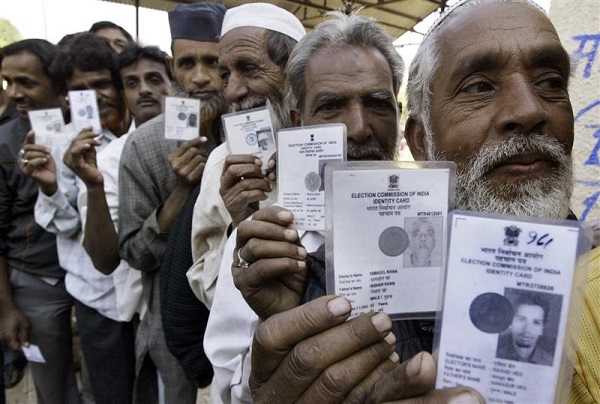
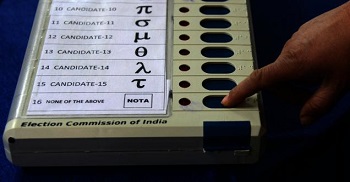
Senior citizens will use NOTA option this election?

Associations of senior citizens threaten to tell their 1 crore members to exercise NOTA option if their demands are unmet.
by The Editors | editor@themetrognome.in

Though they are not considered to be a part of mainstream society – and hence, there are not many policies implemented or infrastructure devised to suit their needs – but when one thinks about it, senior citizens form a considerable part of the country’s population.

And if this population decides to hit back at the Government, there is the potential to do some serious harm.

NOTAKeeping this in mind, the office bearers of several notable senior citizen associations in the country recently met to press for long-pending demands. All India Senior Citizens Confederation (AISCCON), Federation of Senior Citizens Confederation of Maharashtra (FESCOM), Association of Senior Citizens Organisation of Pune (ASCOP), HelpAge India and the International Longevity Centre (ILC) were a part of the meeting.

Seeing the apathy of the Government with regard to senior citizens’ issues, especially, with reference to the changing of the age definition of senior citizens from 60 to 65 years, a resolution was passed at this meeting. It was decided that 10 per cent of seniors would use the NOTA option for voting this election if their demand to lower this age limit is not met at the earliest,” said Anjali Raje, Executive Director, ILC.

She added, “When we realise that 10 per cent of the total population translates in to nearly 20 per cent of the voting population, this makes a big difference and when this big vote bank does not vote for any particular party, but uses the NOTA option, then the [political] parties would be the ones impacted.”

As per a resolution passed during the meeting, “The Government of Maharashtra has not allocated any amount in the State Budget for 2014-2015. The Action Group therefore recommends that 10 per cent of the total budget allocated to the Department of Social Justice, Government of Maharashtra, be spent for senior citizens.” If the Government fails to meet these demands, the Action Group will ask its members – numbering over 1 crore in the country – to exercise the NOTA option while casting their vote this election.
Do you think it is fair to influence members of senior citizen associations on the issue of casting their votes for political parties or using the NOTA option? Tell us in the comments section below.
(Picture courtesy www.thehindu.com, silverinnings.blogspot.com)
Categories
Diaries

Is gender equality a reality in Mumbai?

A Mumbaikar questions the term ‘gender equality’ in the context of Mumbai and comes away reassured, and also quite hopeful.
by Dr Pooja Birwatkar

Part 5 of the ‘Women’ diaries

A few days ago, tired after a hectic day at work, I had no option but to stand in the BEST bus. All the seats were occupied. I looked around, hoping that chivalry would prevail and some man would offer me his seat. But none of them did. It made me very cross with them. How could they sit comfortably when a lady was standing next to them? How rude!

As I mused over the issue later, I realised what a hypocrite I was. We talk so much of gender equality and female liberation, and so it should be completely okay that I was not offered a seat in a bus. If we talk of equality, then we must practice it as well. After all, like us women, even the men are tired. This brings me to analyse our own mega metro Mumbai. Is it equally easy being a woman here, like the men?

In Mumbai, with so many women heading out to work, it is clear that women are bread earners, too. They too contribute a handsome chunk to the family income. It is not unusual to find them in domains that are still considered male domains elsewhere. Women here are now traffic cops, ticket checkers, cabbyies, security officers, DJs, to name a few. Their office hours are as late as men’s. Of course, most working women also have the mandatory double shift, despite their jobs – one at work and one at home. There is still a long way to go when it comes to battling stereotypical women’s roles like cooking, cleaning and taking care of the children, that the female is naturally expected to execute. Men, wake up. We no longer expect you to offer us seats on public transport – should you expect us to handle all the house work alone?

You can walk on Mumbai’s roads care-free, as chances of you being ogled, stared and stalked are less in comparison to other places. Of course, there are sporadic cases of rape and molestation, and something better be done about it lest they become everyday occurrences. Yet, such incidents make us angry and not scared. Such episodes fill us with a sense of revolt and the courage to fight rather than bear it.

Single women, single mothers or divorcees, there is a place for everyone in Mumbai. No one labels you. They don’t have too much time to think about your life. You can stay alone in an apartment and have a life of your own, as the neighbourhood seldom keeps a tab on what you do with your life. You can eat alone in a restaurant and it can be the same restaurant on a daily basis. But I still feel there is a hesitance regarding this, as most women would, if alone, either occupy themselves with a book or be hooked to their cell phone. Wake up, ladies. You don’t need to pretend. It’s your world too and you have every right to be there.

And though I do not advocate it, you can smoke and drink without too many curious glances. There are friendly places where girl gangs can have their night outs. The city is quite open to homosexual relations and contrary opinions are normally not aired openly. Hearteningly, there are always a lot of people in your corner to support you.

I would not say that Mumbai completely believes in gender equality, but it fares much better comparatively. There is something about this city which makes you brave and hold your head high. You feel liberated and love life without questioning your gender identity. There is hope and place for all here and you are not made to feel different.

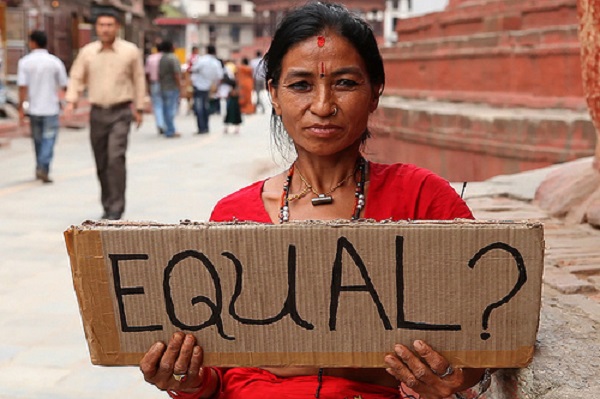
I just wish that on this Women’s Day all women resolve that we would not beg for equality but create equality in society. Let us start on the premise that we are and were always EQUAL. Do not thrust equality on us. We no longer need it. If at all any talk on equality has to happen, it should be from the angle of equalising men with women. 

Dr Pooja Birwatkar is currently pursuing post doctoral research and working in the area of science education. She has been associated with the field of education in the past as a teacher educator, and her area of interest is research in education. 

(Picture courtesy www.asianews.it)

Categories
Enough said

On the occasion of Women’s Day

A Spanish tradition, a bold photo exhibition and a doctor who took to Sufism…women continue to fascinate in many ways.
Humra Quraishiby Humra Quraishi

Today is International Women’s Day, and naturally, everyone’s talking about women and the realities they face in today’s times. But there are some positive signs of women being celebrated the way they deserve, and sometimes in the most unexpected ways.

Last week, at the opening of Italian artist Simona Bocchi’s exhibition, I was introduced to the cultural manager of New Delhi’s Instituto Cervantes. When he gave me his visiting card, I was somewhat intrigued by his name on it. He explained, “My name is Jesus Clavero Rodriguez. In our Spanish tradition, we put the father’s and also the mother’s name along with our first name. Jesus is my name and Clavero is my father’s name. My mother’s name is Rodriquez.”

Well, what a wonderful tradition! And after Women’s Day ends this year, I hope we consider doing something of the kind.

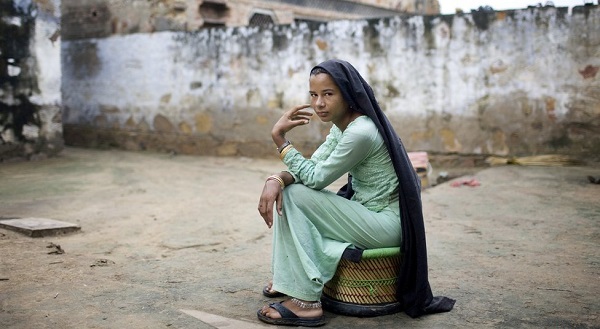
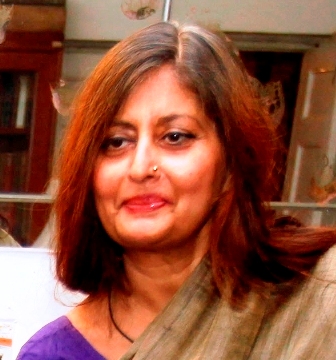
Last fortnight, I viewed a photo exhibition on the girl child, at the India Habitat Centre. Photographs by the Delhi-based photographer Mansi MidhaMansi Midha (in pic on right), who has been travelling to Rajasthan, Uttar Pradesh and around the capital city capture some absolutely hard-hitting shots of the girl child. Mansi did this project with support from the National Foundation for India.

She says, “In the midst of hollow claims of development, the reality is that even in this day and age, there is blatant discrimination against the girl child. It begins even before she is born with female foeticide being an ongoing, horrifying reality. Those who are fortunate to survive are treated as a ‘burden’ and face challenges at every stage.

“In a large number of homes, she could be married off as a child if not burdened with home chores. She is used as child labour, toiling in the heat and stench of landfills, working in the fields for long hours, picking rags in city streets or could be stashed away as a domestic servant. We live in a country where 74 per cent of child domestic workers are between the ages of 12 and 16. Though the Constitution of India guarantees free schooling to all children up to 14 years of age, gender disparities are a marked feature of the unequal access to schools.

“With her childhood snatched away, the girl child’s basic right to education is trampled upon. According to the World Bank, in 2010 India had the third highest number of out-of-school girls in the world with more than 3.7 million. 44.5 per cent of girls are married before the age of 18 and among the reams of material on trafficking in India, there is a staggering Government statistic that a girl child goes missing somewhere in the country every eight minutes …”

I think this exhibition ought to travel to lesser-known locales, so that people become aware of realities to ponder over, and not just on Women’s Day.

I recently met a doctor, Dr Jolie Choudhary Sabiri, who one day decided to give up her medical practice and take to Sufism. I couldn’t believe that this attractive 59-year-old doctor from Assam gave up all her worldly comforts and now goes travelling to Sufi dargahs.

She says, “I was born in a Hindu family in Assam and studied in a Christian school, at the Loreto Convent in Shillong. I have now taken to Islam, I call myself a Muslim Sufi. Somehow, as a medical doctor, I felt like a misfit, for I was always inclined towards literature. I was pressurised to pursue the medical profession because my father and grandfather were well-known doctors. I practiced for many years, even served in Bhutan, but about 10 years ago, I gave it up and moved towards Sufism. Now I travel to Sufi dargahs. Maybe one day I will write a book on my travels and on the Sufi tradition.”

But is she any happier today? She says, “I have gone through terrible tragedies in life. Today, though there is loneliness, I am at peace. It is hard financially, as I am living on my savings. Travelling is tough for a single woman, but I’m so drawn to these dargahs that nothing can hold me back.”

One hopes that this doctor-turned-Sufi will write a book. It will be refreshing to read about this woman born in an upper middle class family, give it all up in the search for a higher truth in far flung locales of this land.

Humra Quraishi is a senior political journalist based in Gurgaon. She is the author of Kashmir: The Untold Storyand co-author of Simply Khushwant.

 (Pictures courtesy www.bbc.co.uk. Featured image was one of the photographs on display at Mansi Midha’s exhibition)

Categories
Diaries

A different kind of road rage

Two traffic policewomen talk about their jobs, how citizens pose many challenges and why a little respect would be nice.
by Nidhi Qazi

Part 4 of the ‘Women’ diaries

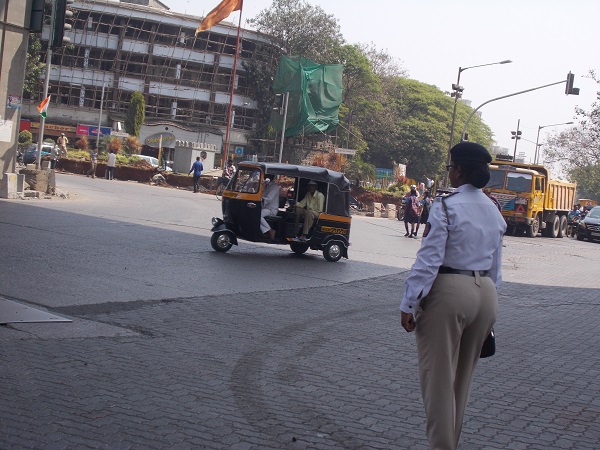
It’s a normal day. Commuters are going to work. Vehicles are inching ahead of others to reach their destination as fast as possible. There is heavy traffic at junctions.

And there is the traffic cop stopping commuters who have broken the road laws in some way. Further down the road, there is a woman officer stopping vehicles, checking licenses, issuing penalty receipts. But wait. Within a few minutes, a driver breaks the signal and rushes past in a jiffy despite the woman constable’s stopping him.
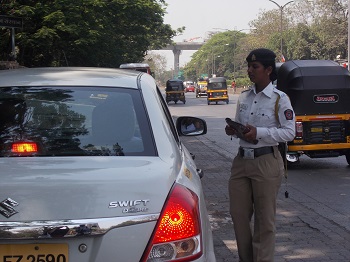
“Many a times, we women are not taken seriously. People break the rules often when they see a woman traffic cop,” laments Madhavi Naik (name changed), a head constable at a junction in one of the central suburbs of the city. Madhavi’s day starts at 7 am and lasts till 3 pm, and she is on the roads for all that time. She adds that the job has its challenges like all other jobs; but as a woman, it’s the perspective of people around that is the most challenging.

“People still feel that the police force is best suited to men. Though my family is supportive, my husband takes care of children, packs their tiffin, drops them to school…but society still questions my choice of job and feels, ‘Aurat kya handle karegi traffic, kaise kaam karegi’”.

An aside here: when I was chasing this story, my request for an interview was turned down several times by the women, saying, “Hum kya baat karenge, humein permission nahin hai. Aap bade sahab ya kisi male constable se baat karo.” Nevertheless, I was able to hold clandestine conversations, albeit, faced with risks of getting caught!

Coming back to the women traffic police, what is a typical day in their lives like? “On a daily basis, we regulate traffic, ensure smooth movement for preventing accidents, penalise those who violate rules and also, at times, when traffic signals are not functioning properly, we inform the companies to look into the matter,” says Smriti Desai (name changed), a head constable at a Bandra junction. But performing these duties is easier said than done, as the traffic police face problems at both the micro and macro level. As Smriti puts it, “How do you ensure that people don’t violate rules when they don’t know the rules in the first place? Worse, they are not ready to accept that they have violated the rules.”

Madhavi says, “Out of, say 100 commuters, there are only two or three commuters who will accept their mistake and instead of arguing with us, actually pay the fine. We are humiliated almost every time but now we are all used to it. On a usual day, if you catch a commuter, he or she will either argue endlessly and say things like “Aap uniform ka faayda utha rahehain, humari koi galti nahin hai.” But Madhavi and her colleagues have learnt to laugh such allegations off.

The big picture is also a worrying one. “Over the years, the number of vehicles has grown but the width of the road remains the same. Moreover, whatever spaces exist are also taken up by vendors who come to Mumbai in search of livelihood. It is on these roads that the traffic police have to run the show,” says Smriti.
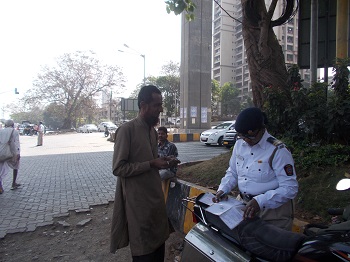
According to traffic police, around 300 to 400 vehicles get registered in a day in Greater Mumbai. The traffic police also laments the under-utilisation of the BEST bus transport.

Further, since there is a manpower crunch in the RTOs (Regional Transport Office), this gap provides an opportunity for agents. “People lack awareness about rules, also because they get their licenses made with the help of these agents and thus, they needn’t pass the driving test. There are no checks undertaken by the license-issuing authority – how does anyone know if the applicant is eligible to drive?” asks Smriti.

Citizen consciousness, or the lack of it…

“From traffic rules to traffic itself, it is the citizen’s attitude which really matters,” feels Madhavi.

She raises further concerns: “Why don’t pedestrians use the skywalks which are meant for their safety? Why can’t people use public transport or carpool if they are going in the same direction? Why do commuters not talk to us properly? We are public servants and thus deserve some basic courtesy and respect. For us, the women, it is worse. Even women defaulters look down upon us and feel that we are intentionally insulting them by penalising them.”

But all this said, these women also feel that they are respected and given total co-operation by their male counterparts. “There are days when I feel, ‘Why am I doing this job?’ Then I feel proud about being a public servant, a part of this system,” says Madhavi.

Though citizens need to take precaution, be better aware of rules, and the pedestrian’s sense of judgement needs to improve, these women also feel that they, as police need to engage with the younger generation on three pillars of road safety – Education, Enforcement and Engineering.

Meanwhile, a little respect, please?

The Women’s diaries celebrate the spirit of women on the occasion of International Women’s Day on March 8 every year. Look out for Part 5 next: ‘Does gender equality exist in Mumbai?’

(Pictures courtesy Nidhi Qazi)

Exit mobile version