Categories
Deal with it

The scrap house

An artist put a lot of scrap and unused material to creative use and created a themed home in Sion. Read on to know how.
by Vrushali Lad | vrushali@themetrognome.in

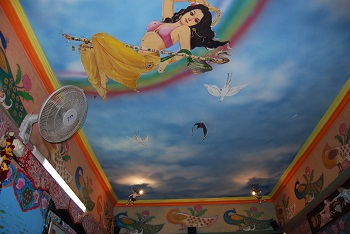
I was invited to view the Jamkhedkar residence in Sion last week, amidst the Ganpati fervour. The Jamkhedkars celebrate the festival with a 10-day themed Ganpati decoration, and at first sight, I was slightly bewildered by the living room in which I was invited to sit. I could hear a waterfall close by and the ceiling, with angel motifs and a beautiful woman on it had an eerie 3D effect.
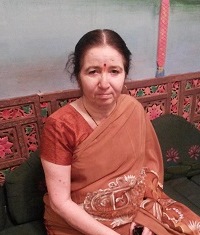
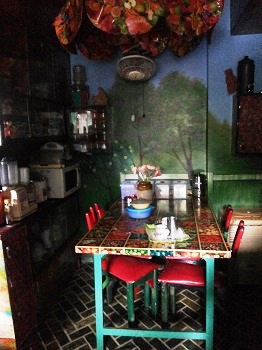
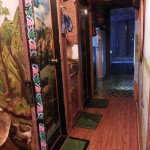
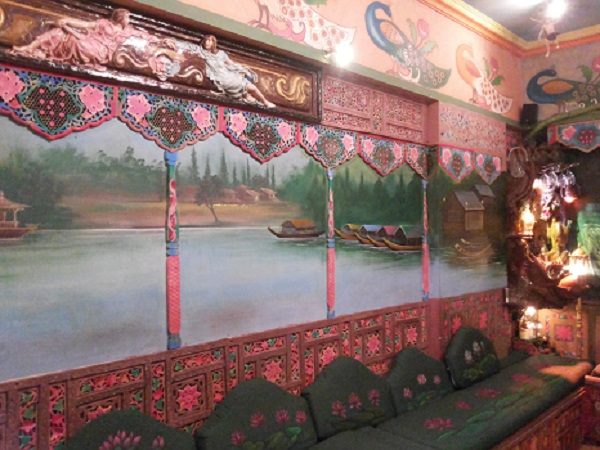
Dr Neela JamkhedkarActually, everything about the house is themed – the bedroom’s theme is ‘Khajuraho’, the living room is a ‘Kashmiri shikara’ (see pic above), the kitchen is a ‘garden’ and the music studio they own on a lower floor is ‘cave’ themed. Says Dr Neela Pimparkhede Jamkhedkar, (61, in pic on left), whose idea the house’s design is, “When we purchased the house and studio about 10 years ago, we had little money left over to get the interiors of the house done with furniture and all the fixings. Besides, I had always wanted to decorate the house my own way.”

Neela’s idea of decorating the house was simple – decide on a theme per room, then look for items she already possessed and which could be put to use, and lastly, go sourcing for items she would need. “You will be amazed at the amount of things every house has, things which are no longer usable but which we can manipulate and use as something else. I got a lot of such items together – an old painting of a woman I had done, urns and murtis I had brought from my maternal home, and even sheets of cardboard that were just lying about.”

Getting down to work

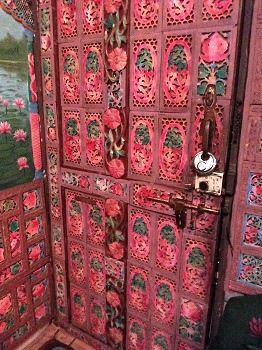
Chor Bazaar became Neela’s favourite go-to refuge for things she could buy. “My husband and I would do the rounds of the place, and I picked up so many beautiful, ornate things there,” she says, pointing to the sliding door that closes off the living room from the passage, and the front door of the house. “See how beautiful these doors are. I got them at not over Rs 2,000 per door at the time. Then I got them home and made my carpenter work on them to create the designs I wanted.”

She also sourced several wooden partitions and strips from a local scrap shop, which she would buy at Rs 30 a bag (till the shop owner wised up and demanded an exorbitant amount). Door done up with wooden strips“I had hired a local carpenter, Rampreet, a most patient man who would do exactly as I said. I got him to carve each strip to the design I wanted, and then these were pasted in a pattern (in pic on right).” She even hired a local painter, Nandu, to implement her designs and assist her wherever required – Neela is an accomplished artist on both fabric and canvas.
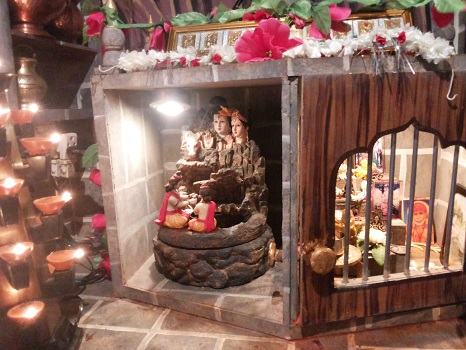
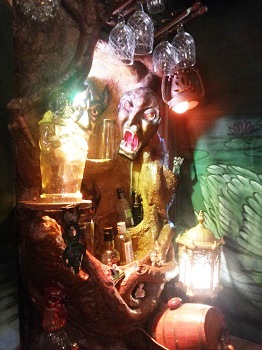
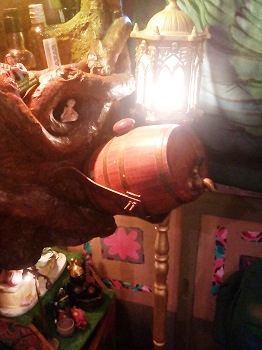
Chor Bazaar also came to the rescue when Neela wanted knick-knacks and smaller items. “For example, I got a lovely little beer keg for the bar that I created for my husband and son,” she says, showing off the little corner which is adorned with a mural and which holds bottles and a running waterfall. “I also bought a measure of cloth and stitched it myself for the lamp over the dining table. Besides this, I got a small mandir from Satguru’s and created a little puja corner in the bedroom. It is everyone’s favourite space in the house,” Neela says.

Lessons learnt

Neela says that though putting the house together this way took a long while, it gave her the kind of creative satisfaction nothing else could give. “Our house is not expensive, but it has taken a lot of effort and ideation to get it to this stage,” the former Ayurvedic practitioner says.

“The setting up of the house had taken over my mind completely. There were days when we would have no money left over for the cab home after making our purchases. My husband and I once carried giant murtis home in a BEST bus!”

She contends that it is easy to decorate your home yourself, provided you have a clear idea of what you want and the resourcefulness to procure the items you need. “I am always looking for interesting objects that can be put to use. And I make a lot of things at home myself – I have painted entire carpets and put together canvasses too,” says the artist, who has also held exhibitions of her work previously.
“In a city like ours, using every square inch of space is essential. Besides this, one must keep learning all the time,” the senior citizen says. “I learnt to use the Internet so that I could browse different designs and interpret them my way. I look up a lot of Street Art as well. When I’m not painting, I’m designing sarees or strolling through interiors exhibitions. Eight years ago, I got a diploma at JJ School of Art, which honed my skills further. I also plan a different theme for Ganpati each year. Planning and designing my house taught me several things.”

She adds, “I have learnt one thing – the world is a beautiful place and we have to participate in its beauty. If we invest ourselves in beautifying our homes, we will find the kind of happiness that nothing else can give us.”

Dr Neela Jamkhedkar is open to conducting a paid tour of her home and explaining the various ideas she has used in designing it. If you want to see her house and get design inputs for your own home, write to editor@themetrognome.in and we will facilitate the interaction.


Categories
Campaign

Mumbai’s observing World Alzheimer’s Month

A few Mumbai-based NGOs and colleges have partnered to organise a series of events and talks on Alzheimer’s this month.
by The Editors | editor@themetrognome.in

It is a disease that has ravaged millions of people over the years, and it continues its onward march every day, unchecked. Alzheimer’s is the most common form of dementia, and is known to affect a person’s memory, behaviour, learning and thinking patterns. According to alz.org, Alzheimer’s is the sixth leading cause of death in the United States alone.

In India, too, the numbers of those affected by this disease is worryingly high. Even more grim are recent findings that the disease, though traditionally known to strike those in advanced years, is beginning to show signs and symptoms even in those who are 40 or 50 years old.

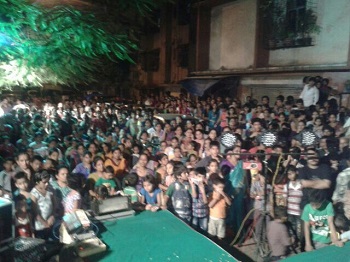
September 21 is celebrated as World Alzheimer’s Day every year. In our city, the NGO ARDSI (Alzheimer’s & Related Disorders Society of India) Greater Mumbai chapter and Silver Innings have set aside all of September 2013 for Alzheimer’s awareness, and the two entities are jointly observing Alzheimer’s Month. “The partners for the initiative also include SVT College, YWCA Andheri, Pushpa MA Foundation, St. Thomas Orthodox Church, Helpage India , Nirmala Niketan College of Social Work and A1 Snehanjali Assisted Living Elder Care Home,” says Sailesh Mishra of Silver Innings. “Currently, the street plays are in progress, which are conducted in a very attractive manner. The plays address real-life case studies and have an instant connect with the audience. Also, Ganpati mandals have been very supportive as they want to address social causes. This way, we are helping to spread the message with religious and cultural programmes and events,” Sailesh adds.

Some pictures from the street plays:

The month-long initiative aims to spread awareness about dementia and Alzheimer’s, their effects on both the patient and families, caring for the sufferer, how to know if it’s Alzheimer’s, and various other topics. “This will be done through a series of street plays, interactive talks, memory walks and interaction between experts, students, senior citizens, medical professionals and whoever is interested in attending,” Sailesh explains. The events are free and open to all, but with prior registration.

Programme schedule:

September 12 to 28: Street plays for sensitisation and awareness at various locations and Ganpati mandals in Mumbai , Navi Mumbai and Thane District by Nirmala Niketan Students of Social work, in association with Helpage India and Silver Innings Foundation.

September 20, Friday : Interactive talk and street play at Asha Kiran Senior Citizens Facility, YWCA, near Navrang Cinema, Andheri (west), 11 am onwards.

September 21, Saturday : Memory walk and street play at Pushpa Ma Foundation, Dada Dadi Park, Veer Savarkar Udyan, LT Road, Borivali (west), 5 pm to 6.30 pm.

September 22, Sunday : Interactive talk and awareness campaign at St Thomas Orthodox Church, SV Road, Chincholi, Malad (west), 11 am to 12.30 noon. Contact Tony Varghese on 9820486605 for details.

September 27, Friday : Interactive talk and street play at A1 Snehanjali, Silver Innings Assisted Living Elder Care Home, D’silva Nagar, Nala village, Nalasopara (west), 4 pm to 5.30 pm. Contact  9323919145 for details.

September 28, Saturday : Sensitisation seminar ‘Understanding and respecting individuals with Alzheimer’s’, a lecture supported with skits, videos and a poster exhibition, by students of Family & Child Enrichment Center, Department of Human Development, Mini Auditorium, SVT College, SNDT University, Juhu, 2 pm to 4 pm. Contact 9820498738, 9821488790 for details.

Email ardsigreatermumbai@gmail.comsilverinnings@gmail.com or a1snehanjali@gmail.com for programme registration, or contact ARDSI Greater Mumbai Chapter/Silver Inning Foundation : 9987104233/ 9029000091 (Monday to Saturday, 10 am to 6 pm).

The Metrognome is proud to partner the Alzheimer’s Awareness Month. If you have a story or an insight about dementia and Alzheimer’s to share, do write to us as editor@themetrognome.in or tweet to us @MetrognomeIndia and we will feature your thoughts. 

(Pictures courtesy Silver Innings Foundation and www.ekantipur.com)

Categories
Wellness

How a 12-year-old’s renal cyst was removed in 30 minutes

From treating only minor ailments, doctors in the city are increasingly turning to laparoscopy to excise cancerous tumours and cysts.

Dhaval Desai (name changed) was playing in his Govandi home with his younger brother a few days ago, when the younger boy jumped on his abdomen. For the next few minutes, the 12-year-old experienced excruciating pain in his flanks, and told his parents about it. “He complained of severe pain so we took him to our family doctor,” said his father, Vinod.

Their family physician prescribed medicines for stomach ache, but the pain persisted. Alarmingly, Dhaval was seen to pass blood in his urine. “Our doctor told us to get a sonography and CT scan done. We were told that he had a kind of tumour above his kidney. I was stunned to hear it, because Dhaval had never complained of any pain or discomfort before,” Vinod explained.

Dhaval had a seven-centimetre cyst in the upper regions of his right kidney. The fall brought to light this cyst, and had to be immediately removed.

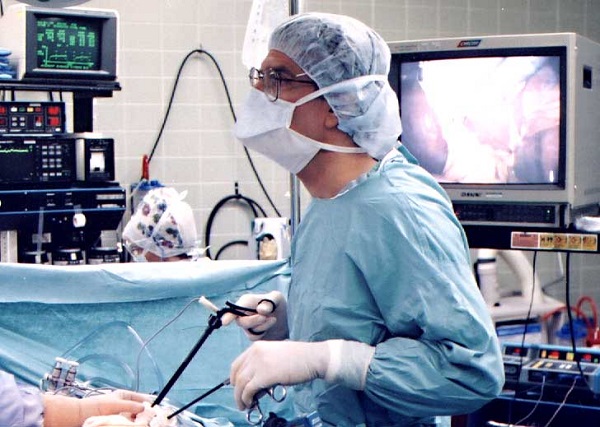
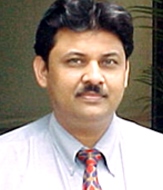
Dr Roy PatankarDr Roy Patankar (in pic on left), noted gastrointestinal and laparoscopic surgeon, treated the case. He said, “The conventional procedure in this case would have been to cut open the abdomen and remove the renal cyst. But we find that cutting patients open does several debilitating things – you have to cut all muscles open, there is the possibility of high blood loss, and there is a long recovery time. It is best to avoid invasive procedures especially in young children, whose recovery and short-term mobility may be compromised.”

He added that with conventional surgeries, the patient would also be exposed to a higher risk of hernias later on, since a lot of flank muscles would have to be cut into to expose the kidney before excising the cyst.

In Dhaval’s case, Dr Patankar tried a less invasive approach – laparoscopy. “We got the cyst with just a tiny incision on his abdomen. Where the boy would normally have spent at least a week in hospital, followed by post-op care, Dhaval was able to go home in two days and he resumed school in just five days.” On his part, Dhaval says, “I do not feel any pain at all after the operation. I am now waiting to go to school.”

Laparoscopy in cancer surgeries

Though surgeons in India have largely confined laparoscopy as a surgical tool to such treatments as gall bladder removal and uterine procedures, Dr Patankar says that in the last two years, doctors are using laparoscopy in cancer-related surgeries, too. “There is too much tissue injury and blood loss in conventional surgeries, and after the operation, about 80 per cent of the patient’s pain is caused by the surgical procedure used, than the actual surgery or ailment itself. With laparoscopy, the component of pain attached to surgery is removed.”

Apart from being minimally invasive, which leaves no scarring post-operation, laparoscopy also helps the surgeon get to the root of the issue faster and in a way that is safe for the patient. “While operating, since a camera attached to the probe magnifies the area significantly, it helps the doctor navigate the area better and faster. We have been able to operate on several cancer patients successfully with the use of laparoscopy when removing tumours and cysts,” Dr Patankar says.

He says that doctors in India are increasingly finding takers for cancer-related laparoscopic surgeries from such countries as Sri Lanka, Tanzania and Nigeria. “However, most patients from the West flying to India for laparoscopic surgeries are still opting for bariatric surgeries. Their insurance doesn’t cover the costs of the operation back home, and we do it at a fraction of the cost.”

(Pictures courtesy www.lapsurgeon.in, www.evergreensurgical.com. Feature image is used for representational purpose only) 

Categories
Do

The sound of music…in Mumbai

Lower Parel’s got a world-class contemporary music school at Sun Mill Compound recently. Mumbai musicians, get your groove on now!
by The Editors | editor@themetrognome.in

It’s a bright red building with a purple signage, in the heart of the bustling market area on Lower Parel (west). The cacophony of the various chaiwallahs and various sandwich stalls and paanwallahs sets the mood for the area, a space where offices jostle for space with Hanuman temples, and where everybody moves quickly through tiny lanes, since there’s not much place to dawdle.

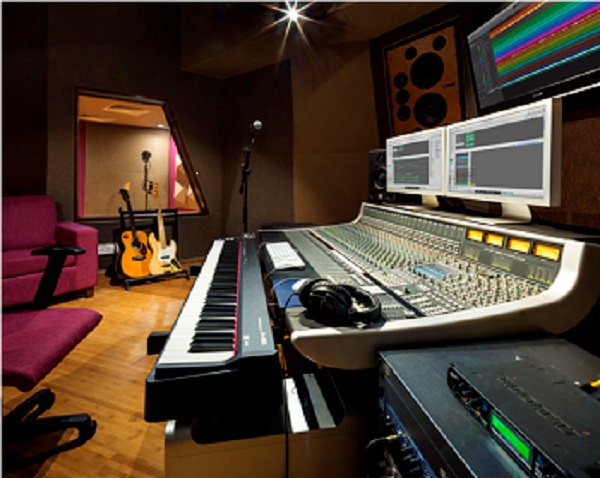
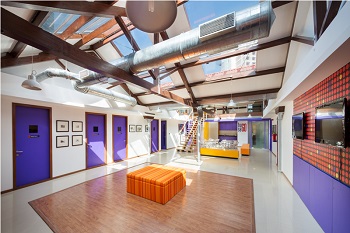
So the True School of Music (TSM) comes as a bit of a shock in these dreary surroundings, and not just because of its violently red exterior. On the inside, the 15,000 square feet of space is sunny (the central courtyard being lit by natural light through skylights), plush and completely world class. TSM was formally inaugurated last week on September 5, Teachers Day, by its founders, renowned music composer Ashutosh Phatak and sound engineer Nitin Chandy.

Ashutosh Phatak, Founder, TSMThe duo decided to start the first-of-its-kind music facility “to educate everybody in music.” Ashutosh (in pic on left) explains, “We want to provide music education of the highest calibre, and at a fraction of the cost that one would incur if one took admission to a music school abroad. We’ve already got over 30 students enrolled and we’re raring to go. We want to discover, educate and empower people in music with the skills necessary in their music careers.”

What’s so special?

For starters, TSM is set up in association with the Manhattan School of Music, the Academy of Contemporary Music (UK) and the Trinity College of Music, London. Besides, the school has “employed some of the world’s best professional tutors and claims that all graduates will be given professional placements.

“We got the facility done in three months, and there are two schools within it – the Foundation School and the Professional School,” Ashutosh explains. “The Professional School will feature five Western instruments (keyboards, bass, guitar, drums and vocals) as well as music production, composition, DJ and live sound engineering. Whereas, the Foundation School will have the same five Western instruments plus the five Indian instruments of tabla, sitar, flute, harmonium and vocals,” he adds.

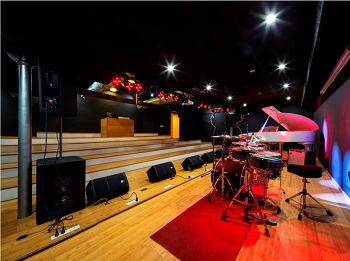
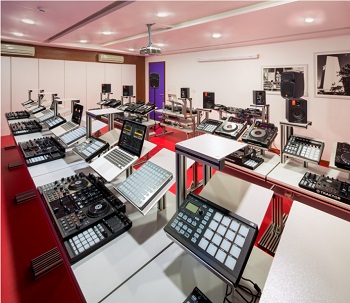
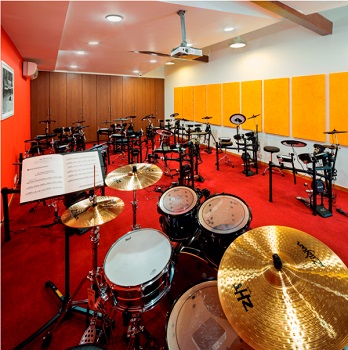
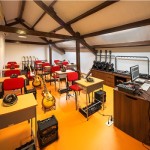
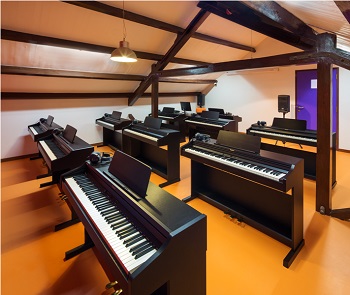
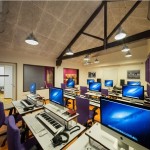
There are classrooms, practice rooms, jam rooms, a recording studio and a world-class auditorium on the premises, for a well-rounded musical experience. “TSM will give employers like clubs, filmmakers, ad agencies and production houses the luxury to choose from a wider range of talent in music,” Ashutosh says.

If you want to know more about the courses TSM offers, log on to www.trueschool.in. You can also take a tour of the facilities till September 12, 2013. TSM is located at Sun Mill Compound, near Lower Parel station (West), close to the Hanuman temple. Classes begin from September 23, 2013.

(Pictures courtesy TSM)

Categories
Learn

CM allows music up to midnight during Ganeshotsav

But cautions that sound norms may not be flouted; Ganesh mandals have requested that norms be relaxed during the festival.
by The Editors | editor@themetrognome.in

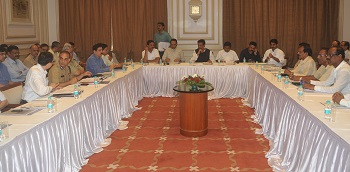
Ganesh mandals meet with the CMGaneshotsav comes to the city on September 9 this year, and mandals across the city are gearing up to welcome the elephant god. A meeting yesterday between mandals and the Chief Minister of the State, Prithviraj Chavan, was held to discuss various issues related to the festival, prominent among those being the relaxing of sound norms during the 10 days of the festival.

While the Government gave no immediate assurance on this front, the CM is learnt to have allowed mandals to play traditional music “within reasonable sound limits” till midnight for all 10 days of the festival. Recently, the BMC too, had issued an appeal to mandals to not play music beyond midnight on any of the 10 days of the festival.

Overall, Chavan is learnt to have taken a soft stand against Ganpati mandals in the city. “There were mandals that met with police trouble last year, over law and order problems and over noise pollution norms. If such mandals write to the Government appealing that the charges against them be dropped, the Government will look at the case sympathetically,” he reportedly said. Chavan is also equally sympathetic about new Ganpati mandals mushrooming in the city after Ganeshotsav 2012, and has asked the BMC Commissioner Sitaram Kunte to consider each new case.

Apart from these, Chavan has asked that all mandals help in spreading awareness about the issues, especially terrorism, that currently plague the city. He also wants the BMC to set up CCTV surveillance of visarjan areas, that police train each of the major idol sites in safety, and that monitoring agencies should immediately apprehend those selling spurious mawa and milk during the festival.

(Pictures courtesy DGIPR and mmclaughlin11.wordpress.com)

Categories
Become

Creating beauty from junk

Mumbai designer Arjun Rathi creates some beautiful products from scrap, and says that his quirky products are finding several buyers.
by Rachel Tseng

Walking through the numerous by-lanes of the crowded scrap markets in Mumbai can be very exhausting and cumbersome. But for someone like Arjun Rathi, it is a creativity inspired adventurous experience. A casual walk through Bharat Bazar in Mumbai 2011 was what introduced Arjun to the world of product designing using scrap and recycled products.

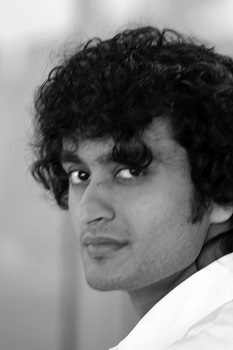
Arjun RathiArjun (26) is a professionally-trained architect and a product designer by passion. After graduating from Kamla Raheja College for Architecture, Mumbai in 2010, Arjun took up a summer course in Switzerland and worked with a Swiss firm specialising in industrial buildings. In India, Arjun has worked with Indiabulls Real Estate and has been a part of their Panvel Greens township project and their mall projects in Jodhpur and Kota.

We interviewed Arjun and this is what he had to share with us about his quirky passion and new-found profession.

What inspired you to design products out of scrap and recycled material?
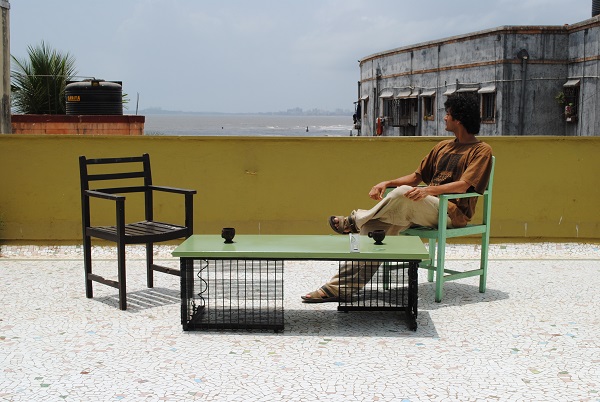
I was travelling around the scrap markets of Bharat Bazar in Mumbai and happened to stumble upon a retro Kelvinator refrigerator door. I immediately got an idea of converting it into a coffee table. Since then, re-using recycled materials for furniture design became a passion. The raw industrial look of recycled metal was very appealing to me.

Growing up as a child in the 1990’s, there are fond memories of a majority of the items we find in present day scrap yards. There is a lot of emotional connection to things like the Ambassador cars, retro fridges and the Walkman, as I have grown up with them. Re-using those items to give them functional purpose is great fun. Also, using scrap for functional design is a great way to recycle. Sustainable design doesn’t end with designing green buildings but zeroes down to micro-design of furniture as well.

How much money did you invest to begin work with?
I started experimenting with furniture and product design from my savings. More than the money, knowledge and good technical sense of what you’re doing is required. Furniture with recycled material is relatively cheap as your investment is in the core scrap product you want to design around. Negotiation is key at that point, if you’re purchasing them second hand or from scrap markets. The next step is either making the product yourself if you’re skilled enough, or getting it fabricated. Rates can vary from person to person.

How long did it take you to establish this business and make it functional?
As I lacked formal training in product design, I spent more than a year working hands-on with fabricators to understand the limitations of various materials like metals, plastics and glass. Knowing your material is key to designing a great product. It is also important to build multiple teams of different fabricators for orders of different scale and number. I am presently into my third year where I am professionally designing products, lighting and furniture.

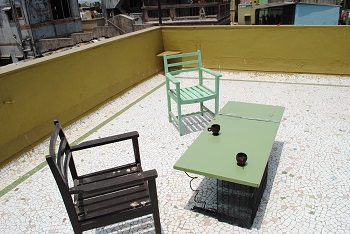
Arjun Rathi Refrigerator TableWhat inspires you while developing/designing a product?
Usually by looking at the key recycled product you want to design around, one is able to give it a function. As a process it works in two simple ways – where you find an item and design something using it, or you look for specific items that fit your concept.

Most of the time when doing specific client work, it is important to understand the emotional and functional needs of the client before searching for the right materials or objects.

What is the approximate time frame to develop a product?
Designing a good product can sometimes take a lot of time. Working around a concept and finding the right recycled materials in the best condition is also a tedious task. Though once all the material is procured, we can generally assume two to five weeks for a project, depending on its size and complexity.

Apart from the Kelvinator fridge door converted to a coffee table (see featured image and pic on left), what are the other products that you have made using scrap or recycled material?

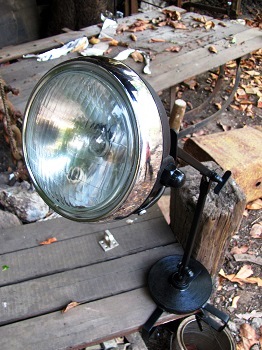
I have made desk lamps using Ambassador and Enfield motorcycle headlights. The natural casted form and raw industrial look of the headlights make for very interesting interior Arjun Rathi Enfield Lamp Product Design Desk Lampobjects, while the internal reflective surfaces of headlights are very functional for interior lighting.

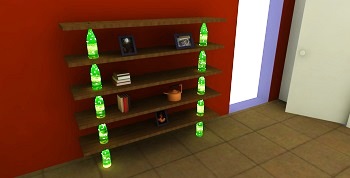
I have also designed a shelving system using champagne bottles as structural supports. Champagne bottles, unlike most wine bottles, are made of much thicker glass, hence can be used as structural supports for a shelf if executed properly.

Another light installation is presently under production using 24 Ambassador headlights and pipes to create a very industrial look for a private client’s space.

You make very unique and interesting products. Who do you consider as your competitors?
Design is a highly competitive and saturated field. The market is flooded with designer products targeted at all income groups. Most of the products I design are due to self-initiatives or constant urge to experiment with processes or materials. Most of the products are a result of my emotional response to them. I design products for myself and if someone wants to buy them, they are welcome to do so.

Is there a growing interest among people for decor of this kind?
The trend for customisation is rapidly picking up in India. The client is able to get a unique product designed for their space at a fairly lesser cost than purchasing an expensive branded design. Also the fact that their piece will never be replicated again. There has been a lot of interest for lighting products through recent clients. Luckily all clients I have dealt with are open to experimentation with design concepts and materials. They have a clear understanding of what they want as well. Most products require some appreciation space in the apartment; hence clients so far who have commissioned highly customised work have larger homes.

How do you pitch for clients?
Most products are designed due to my emotional connections with recycled scrap. I tend to design them for myself, then approach design stores and websites if they’re interested in selling them. Many clients also approach me directly for a specific piece to be customised for their space.

Where do you retail?
Some of my products are being retailed at the design store Chromakey, opposite the Warden Road Church and on the website www.homehero.in. You can also view my products on my blog and the studio can be directly contacted on email for product inquiries.

We also do a lot of niche design work for clients who need specific pieces or furniture or accessories. These are usually exclusive lighting design or furniture customised and designed specific to their space.

Arjun Rathi Champagne Bottle ShelvesWhat is the price range of your products?
Most of the products are limited edition or one-off pieces as the same fridge door/ headlight sample or recycled item cannot be procured at will. Every product is handmade by fabricators and a unique piece by itself. Also, there is minimal interest in the studio for mass production as it deviates from the larger scope of urban and architectural proposals.

Limited edition products generally start retailing from Rs. 14,000 upwards. All client-specific jobs depend on the design and scale of the project.

What has been the most satisfying part of your work?
The satisfaction after a successful execution of a concept is unparalleled. The process of exploring materials, design and meeting new people is great fun.

What message would you like to give people wanting to start a product line like yours?
Be open to learning. I’ve learned a lot hands-on through the process of trial and error. Some technical knowledge is essential or you might get taken for a ride by the fabricator. I remember when I was making the Refrigerator Coffee Table, I changed my fabricator twice because I was unhappy with their quality of work. It’s also good to know the general market rates for materials, as sound budgeting is important for any business.

(Pictures courtesy Arjun Rathi)

Exit mobile version