Categories
Read

Angrezi chhori in an Indian car

British journalist Vanessa Able drove the Tata Nano 10,000 kilometres all over India, then wrote her first book ‘The Nanologues’. We speak to her about her experiences and about putting the book together.
by Vrushali Lad

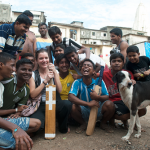
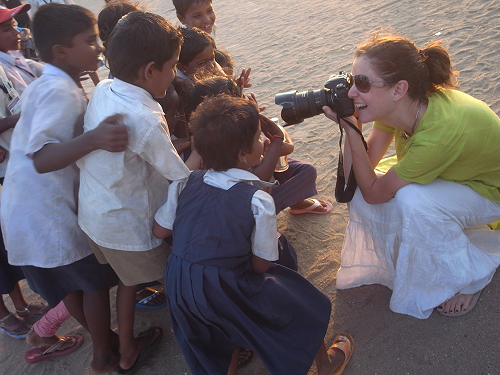
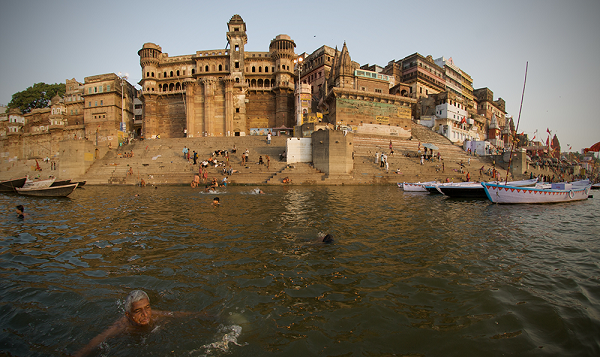
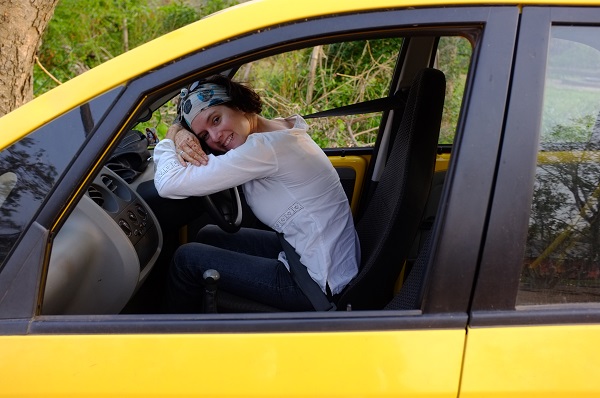
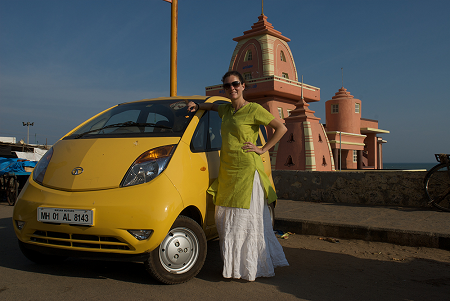
Vanessa Able read up on the Tata Nano, the ‘world’s cheapest car’ and decided to take the car on a test drive in 2010 – across 10,000 kilometres, starting from Mumbai, on a circuitous route from the South to the East to the North and back to Mumbai. Vanessa’s trip lasted three months, and in the interim, she had a host of adventures with the car (she lovingly named her ‘Abhilasha’), had a run-in with several crazed Indian drivers on the roads, drove through the Naxal corridors with some trepidation, and at the end of her travels, even met Ratan Tata at his Mumbai office.

We interviewed Vanessa over email about her book, The Nanologues, which chronicles her journey and which was culled from a blog she maintained during her travels. Do look out for an excerpt from the book at the end of this piece.

Excerpts from the interview:

First of all, congratulations on an excellent and entertaining book. I’m not even a driver and I still loved reading about your adventures. How has the response to the book been?
Thank you. It’s been great. Which is quite surprising for me, as a foreigner. I was never sure how people in India would receive the writing, but both the blog and the book seem to have gone down well so far.
Can you describe the general feeling in the UK about the Nano, when the car was first launched?
I’d say that most people in the UK, although they’ve heard about the Nano, tend to not know so much about it. For sure Tata as a company is on the British radar, especially after their acquisition of Jaguar and Land Rover, and the innovation of the Nano has contributed to many people’s view that India’s engineering industry is on the rise.

Mostly, I think people are excited at the prospect of a similar car being brought to Europe, though in reality that still seems to be a way off.

You mention that you planned your trip using a Lonely Planet guide book and a map. What other research did you conduct before deciding on the trip?
Very little. I was more interested in letting the road and the trip itself lead me. I knew that as I drove, the places I wanted to go and the things I needed to do would become apparent.

How have your driving habits changed after your India tour? You give an account of how you loved to cut across other cars and toot your horn when cars took too long to move out of your way? What is it like now?
Well, since getting back to Europe, I’ve had to tone down my Indian habits a bit, as the English don’t take too kindly to being honked at in traffic or being mercilessly cut up at junctions. Having said that, my husband and I now live in Rome, Europe’s most notorious city for reckless driving. In my opinion, it has nothing on India, but I have to say that my training in the likes of Mumbai and Delhi certainly primed me for Rome, which is a cakewalk by comparison.

Has anyone written to you asking for help/tips on undertaking a similar road trip?
Not really, no. And I don’t blame them 😉

Say Abhilasha had actually given you the kind of problems drivers don’t want to encounter out on the Indian roads. Did you have a backup plan in place?
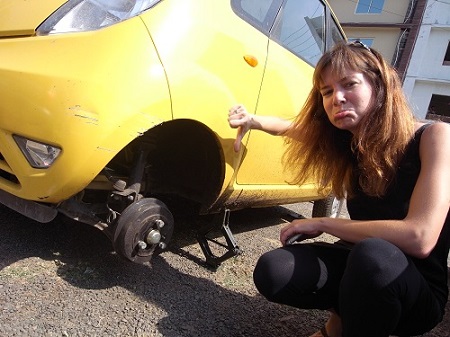
None whatsoever. I have a lot of faith in the spirit of the moment.

You mention a (quite hilarious) meeting with (journalist and former editor-in-chief of Time Out Mumbai) Naresh Fernandes in Mumbai. Post your trip, did you get the chance to meet him again?
We’re Facebook friends now, and we chat from time to time. He’s a great chap with a wicked sense of humour. I hope to meet him again next time I’m in India.

Did you ever face problems from men in India, seeing as you were an unaccompanied white female?
None. I’m not sure if it was pure luck or the aura of my naiveté. I know that many women in India do face dangers when they travel unaccompanied, but then that’s also a global phenomenon. My advice to my sisters is to always be cautious, but not to let fear get in the way of doing what you want to do and going where you want to go. An empowered woman has an energy about her that is more likely to put off predators.

How long did it take for the blog to translate into a book? Were there any revisions/rewrites required?
About 3 years! Yes, it required a lot of revision. The blog was a visceral account of the adventure, whereas the book required a lot more in terms of structure and narrative. And I discovered that the editing process can be long, much longer than the writing part.

How many photographs and videos did you shoot during the trip?
Thousands, literally.
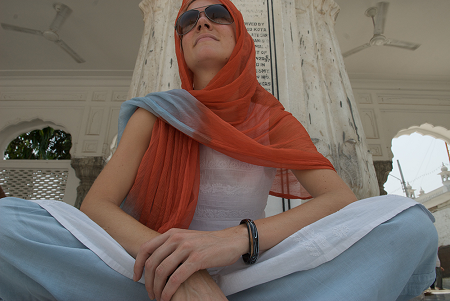
You were in Mumbai twice, at the start and the end of your journey across India. What were your impressions of the city?
Mumbai makes my head spin through its sheer size and the implications of so many diverse people living together in one metropolis. As a foreigner, the city only gets interesting to me when I’m able to penetrate the surface through the friends that I have there and the other people I meet. But for sure I’d like to spend more time there and get to know the place better.

What is your next project? Are you working on a new book?
I’m still working on the UK and US editions of this book. It’s a never-ending job. It’ll be released at the beginning of 2014 under the title Never Mind The Bullocks, a play on the name of the Sex Pistols album.

Would you say an Indian on the road is a very different animal than the Indian at home?
I’d take a chance to say that, yes. But I think that people in general are very different behind the wheel to how they are in person. Driving depersonalises people: the vehicle becomes an avatar and gives us the courage to behave with previously untested vigour. Road rage is an excellent example, and I’ve experienced it myself. I would never act in front of a human being the way I do when they’re in their cars, but somehow when you’re driving, you never see the person, you only see the car.

If you hadn’t teamed up with Abhilasha, which car (in retrospect) do you think you would have chosen on a trip like this?

I’d like to see if an Ambassador could take the pace. Or a nice jugaad.

Do you plan to undertake another journey, with say, another route, in India?
I’m coming over for ‘Literature Live’ in November, so I might be tempted to go for another spin then. Perhaps through the centre of the country.

Where is Abhilasha now? Have you sold her yet?
I sold her on to a friend who lived in Auroville, near Pondicherry. The last I heard, the lady in question moved to France and left Abhilasha with her son in Chennai.

____________

An excerpt from The Nanologues:

‘A horn parped from behind and a motorbike appeared in my side mirror, squeezing itself through the space between the Nano and the Ashok Leyland. Ten tiny fingers and then a larger pair of hands walked their way across Abhilasha’s back window, steadying the bike that was already wobbling under its hefty load. From what I could see, the vehicle was being steered by a five-year-old girl with braided pigtails, gripping the handlebars from between the legs of her father who was deeply involved in some kind of transaction via his cell phone. Behind him sat a woman, presumably his wife, who was holding a baby to her chest, recognizable as such only by the appearance of a set of minute toes that peeked out from under a blanket. The woman was wearing a pink-and-yellow sari that flapped around her and beat against the number plate, while the tail end of the fabric danced teeth-clenchingly close to the spokes of the back wheel.

She was sitting side-saddle with a look of nonchalance more appropriate to the resigned boredom of a doctor’s waiting room than to moving among large vehicles along a main road with nothing to hold on to, wrapped in five metres of hazardous fabric. The hands that should have been clutching her husband or a pillion bar were instead occupied with clinging onto her newborn child with the kind of relaxed composure I could only replicated embedded in an armchair, sleepily thumbing a remote control. They were like a campaign family for suicidal bike riding.’
 

 (Pictures courtesy Vanessa Able)
Categories
Event

You can now study the Aryan problem

Sathaye College launches three beginners’ courses on ancient Indian culture, Buddist Studies and Sanskrit in collaboration with Vikas Adhyayan Kendra.
by Shubha Khandekar

To a lay person, the historical ‘Aryan problem’ means only two things: one, the Indians who claimed this identity and composed the Rig Veda in the hoary past and two, the ‘Aryan race’ that became the chief intellectual weapon of Adolf Hitler for unleashing World War II.

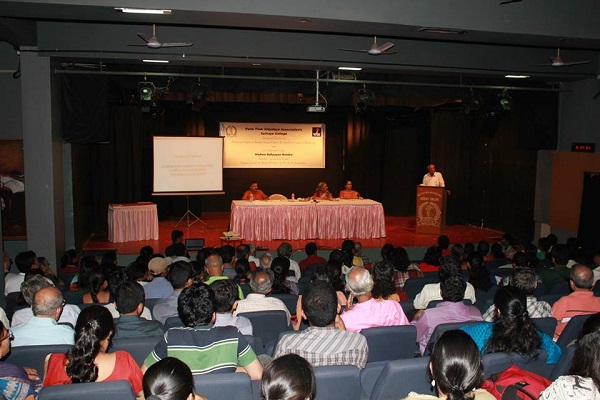
Aryan ProblemBut as Dr AP Jamkhedkar, former director of the department of archaeology, Maharashtra state and vice president, the Asiatic Society of Mumbai,  explained the genesis, development and the current status of “The Aryan Problem”, the audience sat, rapt, at Sathaye College as the multidimensional nature of this centuries old academic challenge unfolded before them.

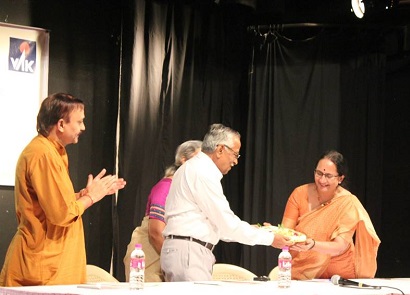
He was speaking at the inaugural function of three beginners’ courses launched by the Sathaye College in Vile Parle on Saturday, July 6, which also happened to be his 74th birthday. Professor Gauri Mahulikar, head of the department of Sanskrit, Mumbai University presided over the function.

The three independent but organically inter-related courses are Ancient Indian Culture, Buddhist Studies and Sanskrit, in collaboration with Vikas Adhyayan Kendra. They will be run as part time one-year courses during weekends and the only qualification for admission, as announced by the principal Kavita Rege is, “the passion to learn”. Sanjay Kelapure of Vikas Adhyayan Kendra revealed that the Kendra is engaged in creating an India-centric world view by promoting Sanskrit even in the neighbouring countries of the subcontinent.

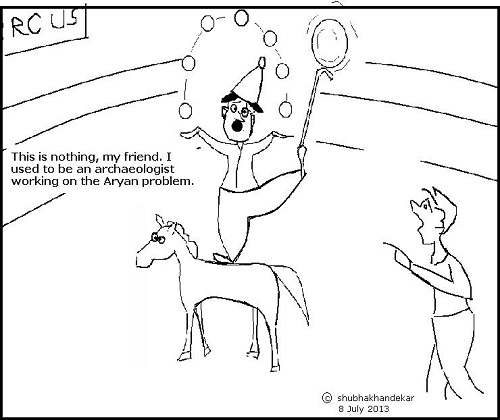
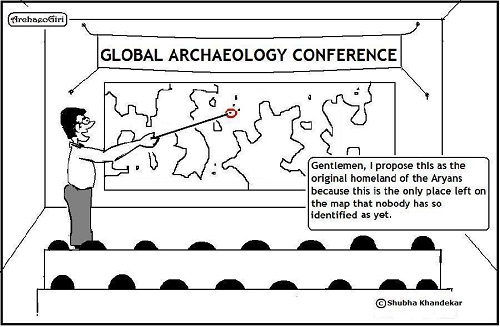
It would be rare to find an archaeologist in India who has not been tickled by the ‘Aryan problem’ at some stage in his Aryan Problem, cartoon by Shubha Khandekarcareer. Tracing the emergence of the theories about the original homeland of the Aryans from the Arctic Circle to Scandinavia to Central Asia to India, Dr Jamkhedkar meandered through the contributions of the linguists, anthropologists, historians, archaeologists, mythologists and many others towards an identification of the elusive Aryans. The crux of the problem is, that although the Rig Veda constitutes the oldest extant corpus of hymns composed by people who proudly declared themselves to be Aryans, they seem to have left behind no archaeological remains anywhere in the world that can be unequivocally correlated to the Rig Vedic narrative.

Dr Jamkhedkar described how linguistic similarities were noticed by early Europeans who stepped into India and thus evolved the concept of a common Indo-European ‘mother language’ in the past. “As evidence piled up from across parts of Europe and Asia, it became necessary to search for corroborative archaeological proof of the Aryans,” he said, describing how the Bogaz Koi inscription dated to 1380 BCE, the Avesta, the Andronovo culture of Western Siberia, the domestication of the horse – an animal so highly extolled in the Rig Veda, and the soma plant – all were harnessed towards the identification of the Aryans – to no avail!

“A search nearer home yielded some clues in the form of recent archaeological material from sites in Haryana as well as those in West Asia. Records found in West Asia, which are contemporary with the Indus-Sarasvati civilisation, considered pre-Aryan, have about 40 to 50 names of Sanskritic origin! This could mean that the Indus-Sarasvati civilization was not Dravidian in character as has been claimed for long by many scholars. And it could also turn on its head the earlier theory that the Aryans were neither the destroyers of the Indus-Sarasvati civilization, nor immigrants pouring in peacefully in groups after groups, but were in fact part and parcel of the Indus Sarasvati civilisation!”

AryanHome_01Many scholars in India, particularly Dr MK Dhavalikar, have proposed, on the basis of circumstantial archaeological evidence, that the so-called Late Harappan people, the residue of the glorious Indus-Sarasvati civilization, were in fact the composers of the Rig Veda, and hence, by inference, the Aryans.

To unlock this ‘riddle, wrapped in a mystery, inside an enigma’, a description that Winston Churchill had used for Russia, but could well fit the ‘Aryan problem’, Dr Jamkhedkar said that a thorough knowledge of Sanskrit has emerged as the main key. “For this reason, the courses on Sanskrit and Ancient Indian Culture started by Sathaye College become complementary and integral to each other,” he said.

Dr Mahulikar pointed out that since a lot of Buddhist and Jain literature is composed in Sanskrit, “political biases should not be allowed to stand in the way of acquiring knowledge of this classical language, which is crucial for unravelling the secrets of the past.”

Admissions are open till Saturday, July 13, 2013. Contact Suraj Pandit on 9930830834/surajpanditkanheri@gmail.com, or Sandeep Dahisarkar on 9930774241.

(Pictures courtesy Siddharth Kale, cartoons by Shubha Khandekar)

Categories
Event

‘Accessible Arctic’ comes to India

An exhibition of photos from the Arctic starts today and ends on Saturday, at High Street Phoenix. Don’t miss it.

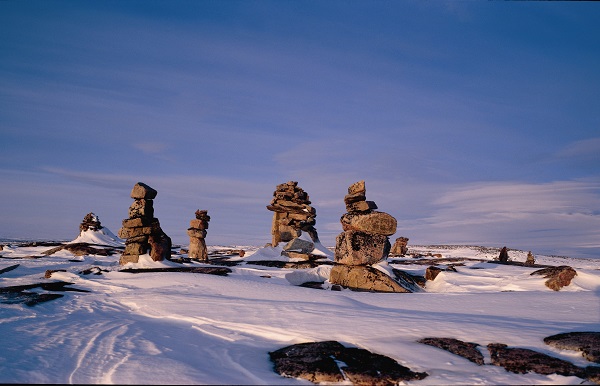
Accessible ArcticIn May this year, India was granted ‘observer status’ in the Arctic Council – a high-level intergovernmental forum that addresses issues faced by the Arctic governments and the indigenous people of the Arctic. With this admission, India will contribute its scientific expertise, particularly its polar research capabilities, to the work of the Arctic Council.

Now, to welcome India to the Council and to celebrate Canada Day (July 1), the Consulate General of Canada in Mumbai will host Accessible Arctic, a photo exhibition at High Street Phoenix from July 3-7 as part of its World Wednesday initiative. “To many, the Aurora Over Fish Creek YukonArctic is a distant and mysterious place. We are excited to bring the incredible people and landscapes of the North closer to Mumbaikars.  The timing of this exhibit marks India’s newly-granted observer status at the Arctic Council. Canada as Chair of the Arctic Council welcomes India to this important global body,” Richard Bale, Consul General of Canada in Mumbai, said.

Assembled and curated by the Canadian Museum of Nature, the photos are the property of the Royal Canadian Geographic Society and feature a cross-section of photographers who have contributed to Canadian Geographic, a magazine which showcases the natural beauty and diversity of Canada’s Arctic. ‘Accessible Arctic’ has photographs published in the past 80 years and range from flowers to fields of grazing caribou to icebergs and polar bears.

Accessible Arctic is on from July 3 to 7, 11 am to 8 pm at the West Court Drop Off, 2nd Floor, Palladium, High Street Phoenix, Lower Parel. For details contact 022 43339994.


Categories
Tech

The best tablets to buy

Looking to buy a tablet, but confused about specs and prices? We’ve got a handy list to get you sorted.
by Manik Kakra

In the last four years, tablets have taken consumer technology by storm. Be it Apple’s dominant iPad, or Android’s vast options, the gizmo is surely been talked about, and its effect is visible. Be it slow PC sale or the smartphone’s shift to larger screens, tablets are here to stay. Here are some of the best tablets to choose from:

Apple iPad 4, Rs 31,000 to Rs 51,000: No surprise here, right? Apple’s iPad 4 is arguably the best tablet available out there. It has got the looks, a beautiful 9.7-inch retina screen, and hardware inside to make performance and gaming smooth on it. Plus, there are tons of quality iOS apps to install. The iPad 4, available in black and white colour options, comes in WiFi and WiFi + 3G variants with three storage options. It starts from Rs 31,000 and goes up to Rs 51,000 for WiFi + 3G 64 GB variant.

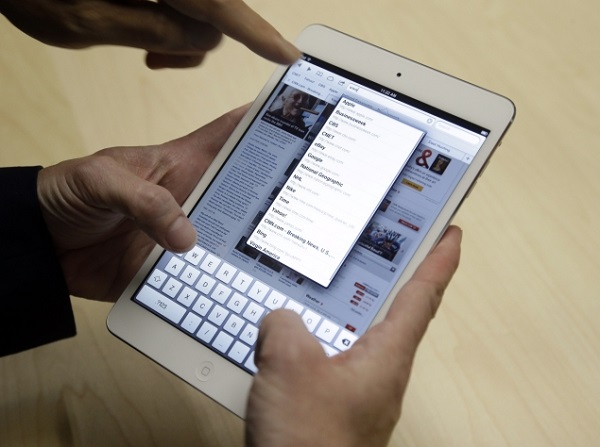
Apple iPad Mini, Rs 21,800 to Rs 41,000: Ever since Apple released the mini version of its tablet, consumers have shown how much they want this form factor. Having all the IOS apps made for tablets, the form factor and convenience make this tablet a hot seller. Sporting a 7.9-inch (1024 x 768) screen, this tablet, too, comes in 3G and WiFi-only variants.

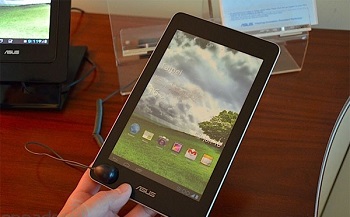
asus-nexus-7ASUS Nexus 7, Rs 14,000 to Rs 21,000: If you want an Android tablet right now, this is the one to get. Having stock Android and the tablet, which made Android’s apps story serious on the tablet side, it comes with a 7-inch (1280 x 800) screen. This is a feature-packed tablet without too much fuss. Starting from Rs 14,000 for WiFi-only 8 GB variant, and going up to Rs 21,000, the Nexus 7 is surely a value-for-money tablet.

Sony Xperia Z Tablet, Rs 44,000 (approx): Sony’s tablet is the one you should consider if you are looking for good looks as well as a big screen. This tablet boasts a quad-core processor and a great 10.1-inch (1920 x 1024) screen, and it runs on Android 4.1. In fact, it is also water resistant and dust proof, so you don’t have to worry too much about its handling.

Samsung Galaxy Tab 2 (P3110), Rs 9,300: If you are going to buy your first tablet and don’t want to spend too much, this samsung-galaxy-tab-2could be a good option for you. Samsung’s Galaxy Tab 2 runs on Android 4.1, has a 3 Mp rear camera, VGA front-facing camera, and it features a 7-inch (1026 x 600) screen. It has WiFi and Bluetooth for connectivity. This is the cheapest tablet on our list.

(Pictures courtesy gadgets.ndtv.com, www.engadget.com, mobiles.pricedekho.com)

Categories
Film

Go for the Terrence Malick film festival

One of the world’s greatest living filmmakers is being feted for a day, today, at Peddar Road. Don’t miss it.
by Medha Kulkarni

Lovers of good cinema in this city have another reason to rejoice. This weekend sees the Terrence Malick film festival at the Russian Centre of Science and Culture, Peddar Road.

Terrence-MalickHailed as one of the world’s greatest living filmmakers, Terrence Malick stands apart from others in being a filmmaker-philosopher whose films are simultaneously beautifully impressionistic and hauntingly profound. Malick is a Rhodes Scholar and a teacher at the prestigious MIT and his films are a spellbinding visual experience and traverse the field of questions about existence, god and nature. With a visual and narrative style that is consistent throughout his entire body of work, he works with an enigmatic approach to narrative and character, innovative voice overs and a subtle juxtaposition of natural beauty with violence and an almost poetic investigation into dreams and nightmares.

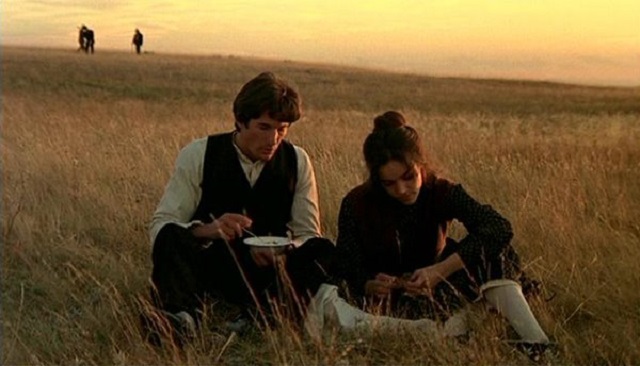
With a career spanning over four decades, he has made only seven films, being a ruthless pursuer of perfection in his work. The one day festival will showcase three of his best works, namely To The Wonder, Days Of Heaven (in pic above) and Tree Of Life.

The festival has been organised by the Enlighten Society, an arts and media organisation based in Mumbai.

You can get more information about the festival and about the Enlighten Society here or on their Facebook page. Book tickets for the festival here

(Pictures courtesy andrewsidea.wordpress.com, www.anomalousmaterial.com)

Categories
Watch

Rape of the flock

Film to be screened today discusses how American soldiers are raped by fellow personnel, and how the establishment plays cover-up.
by Medha Kulkarni

invisible-war-These news items come to the fore on and off and are discussed widely for a while before being buried under other, more urgent news. It is a worrying statistic that a female soldier in Iraq and Afghanistan is more likely to be brutally raped than killed or injured by enemy fire.

A documentary, The Invisible War, will be screened by Vikalp tonight at Prithvi House, Juhu, today (see below for details). Directed by Oscar and Emmy-nominated filmmaker Kirby Dick, the film is “a searing expose of the epidemic of rape of soldiers within the US military, the institutions that perpetuate and cover up its existence, and its profound personal and social consequences.”

The Invisible War was the recipient of the 2012 US Documentary Audience Award at the prestigious Sundance Film Festival.

American defence personnel, both men and women, who have dedicated their lives to the service of their nation are being raped and sexually assaulted by their own fellow soldiers, commander and officers – the very people whose job is to protect and guide them, rather than by the enemy force.

The film centers on the stories and experiences of Military Sexual Trauma survivors with the courage to come forward, tell their stories, and let us into their lives. Kirby Dick’s strong belief and main motivation behind making this film was that it would “shed light on these heinous acts and the larger systemic issue. The film intends not only to bring much-needed attention to this disturbing issue but also to stimulate the public to demand for legislation to protect the next generation from the horrors of sexual assault and the lifelong trauma that follows.”

The film screening will be followed by a talk by Sana Contractor (Research Officer at Centre for Enquiry into Health and Allied Themes (CEHAT). CEHAT, an NGO, is involved in research, training, service and advocacy on the issue of rape and allied themes. Joining her will be Robin Chaurasiya (of Kranti, an NGO that empowers girls from Mumbai’s red-light areas to become agents of social change.)

Get more details on the film here. The film will be screened today, June 24, at 7 pm at Prithvi House, opposite Prithvi Theatre, Janki Kutir, Juhu Church Road, Juhu, Mumbai. Entry is free but on a first-come-first-seated basis.

Exit mobile version