Categories
Tech

Review: The LG G2

Our tech writer has the goods on LG’s newest smartphone offering, and what’s good and not so great about it.
by Manik Kakra

There is a smartphone race going in the market today, which mainly involves a race for specifications and who’s the first to catch the bus. This has been going on awhile. LG has been in the front seat for a bit, but the race is now getting more or less about who capitalises better on their top spot, and whether they provide updates, decent prices, have any standout usable feature or not. LG’s G2 is the company’s flagship device and is an interesting addition to the Android space. This is our review of the phone.
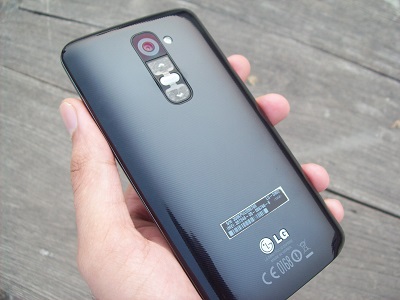
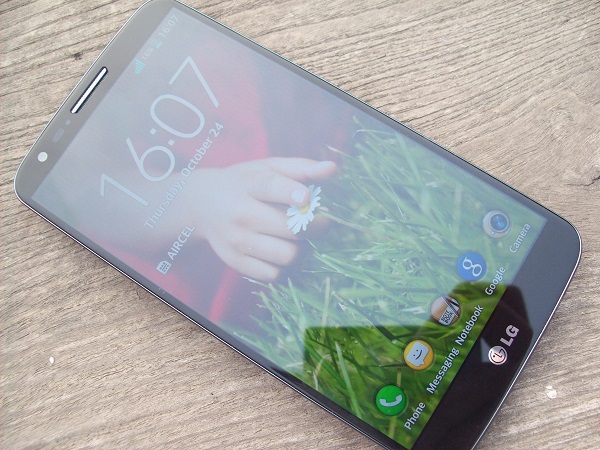
LG G2 (2)Hardware: The LG G2 is quite a beast when it comes to hardware. Under the hood, there is a 2.3 Ghz quad-core (Krait 400) Snapragon 800 chip that has got Adreno 330 GPU, along with 2 GB of RAM. The back has got a 13 MP camera, plus, the phone’s volume rockers as well as Power/Lock button. The front has got a 2.1 MP camera that can do HD videos, and no other buttons on the front side.

Software and Performance: LG’s G2 runs on Android 4.2 out of the box, with LG’s own Optimus UI on top. The whole software from LG hasn’t changed too much. We pretty much get too see the same icons, UI elements, animations, etc. What was new was lock screen customisation – you can now access camera and a widget of your choice by swiping left and right from the lock screen. By default, there are three home screens (as usual all are customisable), make folders, rename them, different icons, widgets and all such known stuff.

You get QuickMemo where you can write down on the screen using your finger, and save them to your notes. Swiping down to get the notification centre, you also get access to all the QSlide apps. These are the apps that support running simultaneously on screen. For instance, you could have calculator running on the screen’s upper half, and the stock Web browser on the lower. Pretty handy at times, and it works smoothly.

The phone is smooth, really smooth. I didn’t notice any stutters, serious lags or unusual app crashes. The phone feels responsive in day-to-day usage, and doesn’t disappoint.

As far as the battery life goes, I was satisfied with what I got from its 3,000 mAh pack. The phone lasted just over a day for me, usually, on a single full charge. The whole chipset and OS combination seems to be doing pretty good to the battery, and it shows in the battery life you get – definitely a plus point for the device.

Design: LG hasn’t done anything radical in design. There’s the same slab design with plastic in use. On the front, you get a 5.2-inch 1080p screen, and very thin bezel, really nicely Designdone by LG. In fact, bezels may well be the first thing you notice as soon as you hold this device. The cheap plastic feel is very much evident once you hold the phone on its back.
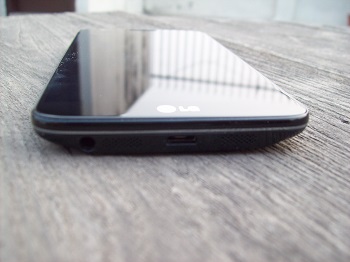
There is a diagonal line pattern for looks’ on the back; there isn’t much LG has tried to achieve with the materials used here. To put it bluntly, I’m not at all impressed with the material selection here, while the bezel part is a top-notch approach for a phone this size. On the right side, the SIM tray sits, and there’s no other port here. The bottom gets the microUSB port as well as the 3.5 mm headset jack and loudspeakers. Touch buttons are on-screen, and there is only the usual LG logo under the screen. Just above the screen, other than the front-facing camera, you have the sensor, speakers.
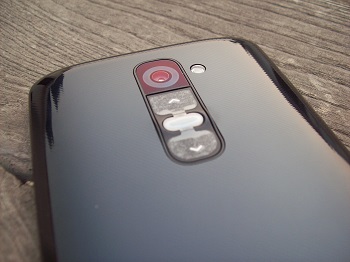
G2 cameraCamera: The G2 comes with a 13 MP camera that can shoot 1080p videos at 60 FPS. The camera has different shooting modes, as usual, and here’re a few images (https://app.box.com/s/1u8w9h78llhepy8tspe7) clicked with it. One more thing, I didn’t face any focus problems that have been the case with previous LG phone cameras. It’s good to see that LG has fixed it. Also, there are options to choose manual focus for a better control over your camera settings.

The camera is pretty good. More or less, you won’t be disappointed by its performance, but it could have done a better job with low light condition and without too much sharpness.

Audio: Coming to audio performance, the G2 is a serious phone in this department. It does 24-bit audio recording and playback, and its audio output is very good. You should ideally not be using the bundled earphones. Plug in your own headset par, and you will realise how well the phone drives them. The only downside is on the loudspeakers side. They are loud and clear, but their placement, at the bottom, might well be a problem for those who play a lot of games. Playing in portrait mode means on of your hands covering the loudspeakers and all the sound getting muffled. There were no issues with the phone’s call quality, and I didn’t notice any network reception problems either.

What’s different: Usually your phone has volume buttons on one side and Power/Lock button on the top or on either side, but, here it is different. All those are around the camera sensor. You have to click there to adjust volume (can also be used for the camera), Power and lock screen. LG has also added ‘double tap to wake and lock’ feature, which was previously seen on Nokia’s N9, when on a home screen, you just had to tap the screen twice to lock it and double-tap it again to unlock it. This works for 7 out of 10 items, and is indeed a very handy feature. You might just start doing it once you get another phone, and miss this feature on it. At least I did, and I certainly liked the double-tap feature. But not so much the buttons placements, I hardly ever pressed the right button on the back accurately, and found it cumbersome when the phone was actually placed somewhere and you can’t adjust the volume from either sides.

The best part: Let’s take a look at the full HD IPS (423 ppi) used here. In my opinion, this is the best part about this LG phone. And that isn’t very surprising considering LG has been consistently coming out with great screens for the last year or so. The screen is very bright, colours seem rich and it has got decent viewing angles. Watching a full HD video on it, on the go, is a treat. It is coated with Gorilla Glass 32, which is a bit noticeable once you closely look at the sides of the screen – it appears pretty nice, though.

What could be better: While LG’s skin is lightweight, it is far from stock Android designs, and you have to really dig to see if they have left any part of the OS untouched. A few additions to the whole stock Android experience are definitely needed – camera, QSlide apps – many changes could be avoided, but then that’s what custom Uis bring to the table.

All in all, LG has done a really good job with the G2. It is good to see more and more manufacturers realising that battery life, camera optics, software enhancements are important. The screen, battery life and audio are its best part, the only things the G2 falls short are its material choices and it could probably do with a little less customisation on the Optimus UI side.

Categories
Do

Two events to liven up your Monday

Mondays start the working week, but there’s no reason you should have a sombre evening. Pick from two events today.

Yes, Mondays sure are a painful day of the week to go through, but why not set the stage for a cheerful Tuesday with some dance and art? Today, two events – one on classical dance from Assam and the other, an art showing at Colaba, are worth checking out.

#1: Sattriya: Classical dance of Assam

India is home to some exceptional forms of dance, with each state boasting of it’s own kind. On October 28, Dr Sunil Kothari will give an illustrated talk on ‘Sattriya’, the classical dance of Assam, with excerpts from a DVD on the Sattras, or Monsatries, on Majuli island on the banks of the river Brahmaputra, at Jnanapravaha.

The Sattras have been practicing a form of devotional dance for the past 500 years, written and directed by the 15th century scholar and the Neo-Vaishnavite saint Sankaradeva. He propagated ‘Eka Nama Sharan’ and his dance drama from ‘Ankiya Bhaona’ has morphed into a classical dance Sattriya, which is now recognised as the eighth Indian classical dance form.

Dr Kothari will be accompanied by Prateesha Suresh, an exponent of Sattriya to perform the salient features of this rare form.

Padma Shree and Sangeet Natak Akademi awardee, dance historian, scholar, author and critic Dr Sunil Kothari, is a former Dean and Professor at the School of Arts and Aesthetics, JNU, New Delhi. He has authored several books on dance including ones on Bharatnatyam, Kathak, Odissi, Kuchipudi and New Directions in Indian Dance. A Fullbright Professor, he has lectured at several universities in India and abroad.

Head to Jnanapravaha, Queen’s Mansion, 3rd Floor, Ghanshyam Talwatkar Marg, beside Cathedral Middle School, Fort. The event starts at 6 pm. Entry is free but on a first come, first serve basis and seating is limited. Call 022 2207 2974/75 or look up www.jp-india.org.

#2: Solo showing: Perceptions from the Precipice

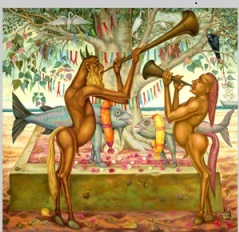
marriage of fishes, gopikrishnaKerala-based artist Gopikrishna’s solo show titled Perceptions from the Precipice opens at Art Musings, Colaba, today.

The paintings are in oils and watercolours, where humans and animals interact together in a mythical space born out of the artist’s imagination. A storyteller at heart, Gopikrishna paints vivid scenes with his mythical creatures and characters and the effect is as mesmerising as pages from any fairytale. Myriad hues combined with fluid but defined forms add a dimension of surrealism to these works. The ordinary and the impossible, unity and solititude, illumination and darkness, all come together in a seamless harmony in the series.

The works were painted in a two-year time span, between 2011 to 2013. According to the artist, “This body of paintings represent what has been glimpsed, experienced, memorised and realised through this period. Life, as always, has been a traverse through pinnacles and ravines. Paintings thus born bear evidence of the secretive existences perceived from the precipices of life. They reveal a state of timelessness as unaffected by the bangs of the time-bound. They see out the spiritual fibres deeply hidden in the structure of the life-forms.”

The show opens on Monday,October 28 and goes on till December 5.The artist will be present at the opening. Catch the showing at Art Musings, 1, Admiralty Building, Colaba Cross Lane. Call 022 2216 3339/2218 6071 for details.

(Compiled by Medha Kulkarni. Pictures courtesy www.jp-india.org and artmusings.net)

Categories
Event

When softball comes to Mumbai

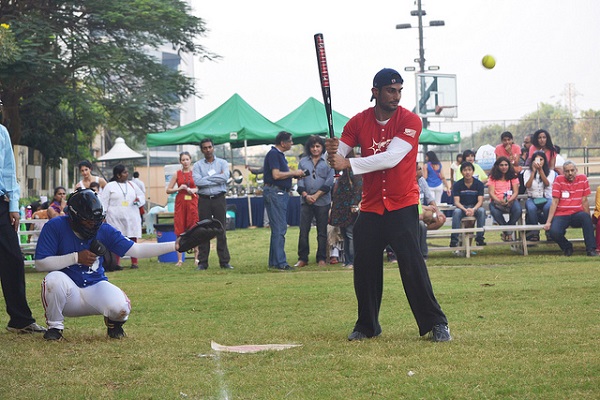
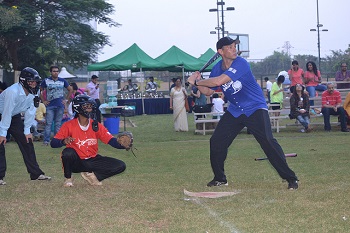
Exhibition softball match and special outdoor screening of ‘The Only Real Game’ took place at BKC on Saturday, October 26.
by The US Consulate General, Mumbai

The US Consulate General Mumbai and Namaste America co-hosted an exhibition softball match and a special outdoor screening of the American documentary The Only Real Game on Saturday, October 26, 2013.  The event was held in association with the American School of Bombay and the Mumbai City Baseball Association.

baseballThis year, The Only Real Game made its Asian debut at the Mumbai International Film Festival (MIFF).  Previously, the film was named the best Documentary Film at the New York Indian Film Festival. In honour of the film, Consul General Peter Haas, President of Namaste America Atul Nisar, actor Prateik Babbar, filmmaker Kailash Surendranath, and other guests took to the field for an exhibition softball match.  Dave Thoudam, a young filmmaker and musician from Manipur opened the exhibition match by singing ‘Take Me Out to the Ballgame’ in English and Manipuri.

After the match, the Consulate hosted an outdoor screening of The Only Real Game.  Among others in attendance were the film’s Director Mirra Bank, Producer Muriel Peter, and Indian columnist Anil Dharker.

The Only Real Game documents the work of a group of baseball-loving New Yorkers and two Major League Baseball Envoy coaches who team up with Manipuri men, women and children to share their love of the sport.

Categories
Event

City gets cricket development centre

Cricketer Shaun Tait inaugurates a cricket development centre at Powai-based school, offers tips and tricks about the game to students.
by The Editors | editor@themetrognome.in

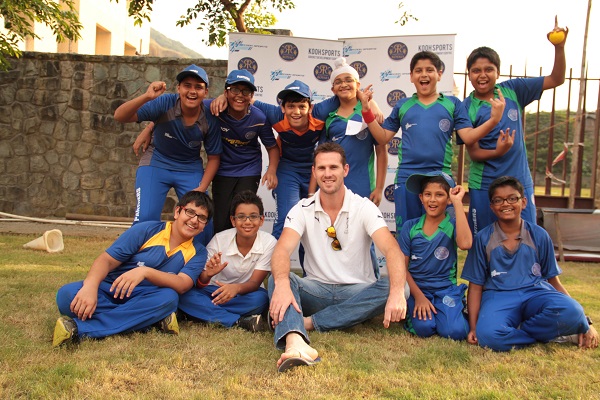
Shaun Tait with KOOH Sports Cricket Development Centre kids in HFS, Powai KOOH Sports organised a press conference today, October 24, to announce the launch of their first Sports Cricket Development Centre in Mumbai, at Hiranandani Foundation School.

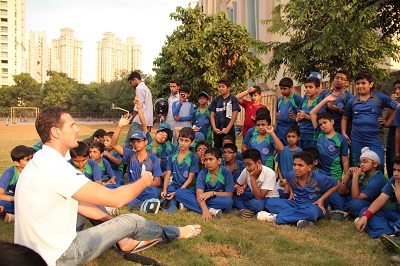
Australian cricketer and Rajasthan Royals player Shaun Tait, and key officials from Hiranandani and KOOH Sports were a part of the conference. Post the do, Shaun Tait spent two hours with the children on the ground and shared best practices and tips about the game.

Dedicated to imparting sports education in India through a multitude of programmes that will cut across grass root level initiation and identify and nurture talent, KOOH Sports is setting up more KOOH Sports Cricket Development Centres to target students from the 6-17 years age group across the country. In partnership with Rajasthan Royals, the academy claims that it will leverage the experience of seasoned sportspeople to nurture talent at the school and community level by providing them a specialised learning environment to coach them in cricket.

Categories
Tech

Apple announces new iPad Air and iPad mini

New tablets were unveiled and new devices announced in Apple’s fall event. Here’s a quick review of the new offerings.
by Manik Kakra

Apple has announced two new iPads in its fall event – iPad Air and iPad mini Retina. The company also announced the new MacBook Pro, Mac Pro, OS X 10.1 Mavericks and new iWork and iLife software. Let’s take a look at what all Apple unveiled on the tablet side:

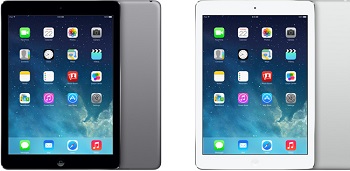
iPad AiriPad Air: The iPad Air is Apple’s fifth generation iPad, but now you have the term ‘Air’ added to its name –specifically because the new iPad is lighter (1 pound) and thinner (0.75mm) than the previous generation models. Apple has decreased the bezels on the iPad Air’s side to improve screen estate in the same size.

The new iPad Air is powered by the A7 (64-bit) chip that we previously saw on the iPhone 5s. Sporting the same 9.7-inch Retina screen as the previous two models, this iPad also boasts M7 commotion processor for saving battery and doing tasks related to motion like accelerometer, gyroscope, etc. On the back, there’s a 5 MP camera; while the front gets a better iSight camera with larger pixels for low-light performance.

Connectivity-wise, there WiFi with MiMo techlology thanks to its dual antennas for faster data exchanges, 3G and LTE (depends on model). The iPad Air also features dual microphones for better voice recognition and calls. The tablet goes on sale in the US and several other countries starting November 1, with a base price of $449 for 16 GB WiFi-only mode, and goes up to $929 for 128 GB WiFi + cellular model. The iPad comes in silver + white and space grey + black colour options.

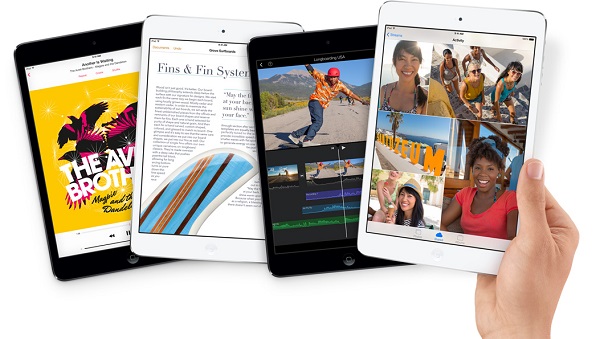
iPad mini Retina: The Retina display on the next-gen iPad mini (in featured image above) was very much on the cards. It will be interesting to see how much its battery life is, considering that the size is pretty much the same, while the display is now much better than before. With its 7.9-inch Retina screen, with the same resolution as the iPad Air (2048 x 1536), the new mini is also powered by the same A7 (64-bit) chip and M7 motion coprocessor.

Having the same MiMo technology as the iPad Air for WiFi, and Bluetooth 4.0, the mini Retina also comes with a 5 MP rear camera, and the same front-facing 1.2 MP iSight camera. The tablet will start selling from November 1 too, with its base price for 16 GB WiFi at $399, and going up to $829 for 128 GB WiFi + cellular. The iPad mini Retina comes in silver + white and space grey + black colours.

The official covers for the iPad mini Retina and iPad Air are available in blue, green, pink, yellow, black and red, and the smart case for the iPad air will be available for $79, and $69 for the iPad mini Retina.

Apple also announced that it will continue selling the iPad 2 16 GB WiFi for $399 and 16 GB WiFi + cellular for $529, and the iPad mini 16 GB WiFi for $299 and 16 GB WiFi + cellular for $429.

Categories
Event

“Crisis of credibility in journalism”: Sir Mark Tully

Noted journalist and author Sir Mark Tully puts today’s journalism in perspective, and talks of the challenges of establishing credibility.
by Salil Jayakar

At 78, he’s far more energetic and enthusiastic than most people of any age are. His mind and memory are still as sharp as ever. No wonder then he continues to be an authority on India several years after he left the BBC. And unlike most of his ilk, he doesn’t hesitate to give credit where it’s due. “Let me clarify again, it is always erroneously mentioned that I first broke the news of Indira Gandhi’s assassination. I did not. In fact, it was my BBC colleague Satish Jacob,” he stated.

Meet Sir Mark Tully. Almost priest, journalist, author and Indophile, whose love affair with India continues…

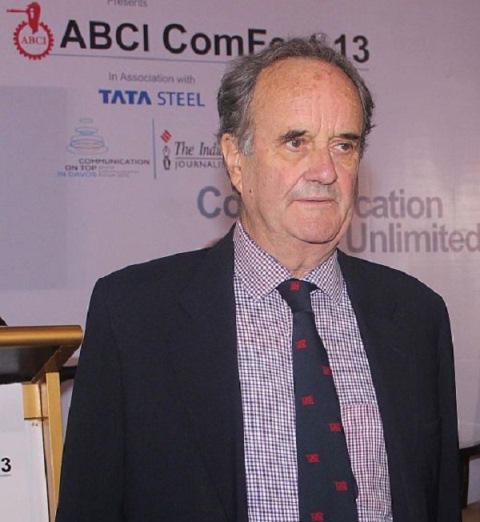
In Mumbai over the weekend of October 17-18, Sir Mark spoke at Com Fest 2013 organised by the Association of Business Communicators of India (ABCI) at the Taj Mahal Palace & Hotel, Colaba. Like most British people, his self-depreciating humour was there for all to see. For me, as an ex-journalist and media professional, it was a bit of a fan boy moment as I had the opportunity to interact with him.

Sir Mark, without a doubt, has inspired young journalists in India and abroad with his no-nonsense style of reporting, which is why we need to sit up and take notice when he declares: “There is a crisis of credibility in journalism today” with reference to the UK phone hacking scandal and the kind of live news journalism we see in India. According to him, the dangers of instant communication to journalism are real – as seen during the Varanasi bomb blasts and the Mumbai terror attack.

“Journalists today speak instead of writing or telling a story. They are talking, instead of crafting a story. At a time when mobile and television can communicate a message in an instant, there is a real danger of miscommunication,” he said. How do journalists then maintain their presence? “Journalists need to be trusted. More so now in times of the Internet; they need to carry the torch of reliability and trustworthiness.”

Citing the BBC, Sir Mark had harsh words for his former employer and says the credibility of the BBC Trust has been severely undermined by the hacking scandal and the Jimmy Savile sexual abuse scandal. He stressed the importance of a media regulator that has both politicians and journalists on its Board. Dismissive of the Indian Broadcast Editor’s Association, he says they are not doing a good job. According to him, a public service broadcaster (PSB) is necessary and should be independent of the government to be able to do a good job.

Sir Mark lamented the fight between management and editorial, the realities of running a paper or TV channel and the need to make money or profit. He believes that management has to realise that journalists are creative people and need to have the last word on a story. “The editor needs to be in control at all times. Irrespective of commercialisation, news needs to be credible and trustworthy. There has to be a balance between credibility and commercialisation,” he stated.

In his sartorial style, Sir Mark summed up the state of journalism and journalists today when he said, “Journalists need to keep in mind – this is not my story, it’s the story of the person.”

(Picture courtesy ABCI)

Exit mobile version