Categories
Do

Attend: ‘Stillness in Motion’, pottery and painting exhibition

A melange of canvas and clay, the showing will feature pottery work by Shalan Dere and paintings by Radhika Bawa. Don’t miss.
by The Editors | editor@themetrognome.in

With the onset of the festive season, the city is currently deluged with several high-quality events and exhibitions. A noteworthy example of these is ‘Stillness in Motion’, an exclusive display of art work through a culmination of paintings and pottery.

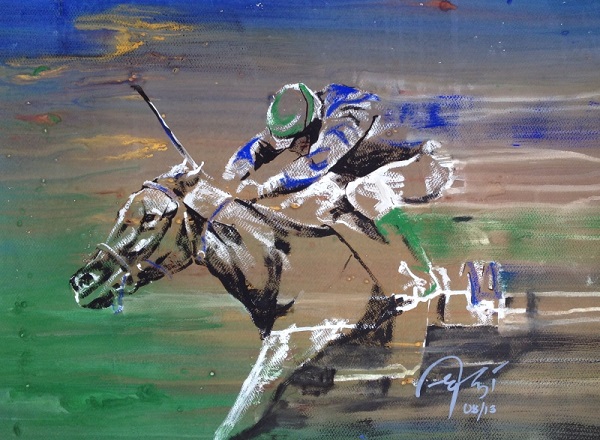
The week-long exhibition starts today, October 6 and continues till October 11 in Mumbai and includes a marvellous collection of horse paintings by Radhika Bawa and enticing colourful pottery by Shalan Dere. The motion of the wheel and horses produces the beautiful stillness that has been captured in the form of pottery and paintings with the artists’ mindfulness and enthusiasm for art.

Shalan Dere's work for Stillness in Motion - CopyShalan Dere, a business management professional-turned-potter is the proud owner of Potters Place, a pottery studio in Mahim. She also conducts regular pottery classes. Radhika Bawa is a painter and an art connoisseur who creates magic with her paintbrush and has participated in numerous shows. Shalan and Radhika have come together for the first time to express their unique interpretation of colours and forms.

Shalan will showcase simple wheel-thrown forms in unique shades of colours. With great likeness for aesthetic sensibility, she brings various forms of clay to life. Testing and trying new hues with different glaze techniques is her forte. Every pot is a piece woven with amazing colours especially blue, turquoise and brown. Fired with alternative firing techniques, like Raku resulting in a vibrant metallic sheen and Saggar firing which results in very soothing, marble like finish, each pot is unique in its form and color.

Radhika will showcase a series of paintings of horses in acrylic and water colors as a medium to express her understanding of the physical form. A horse lends itself as an apt medium due to its rugged yet graceful structure and symmetry in its creation. What makes these conversation pieces stand out is the artist’s attempt to visualise plains and contours through different colours and textures alone and eliminating the infusion of lines in the painting. Radhika has beautifully captured the various moods of a horse through her brushstrokes and brought to life its power, agony and beauty.

Largely self- taught, both artists believed there is a certain stillness in every motion.

Head to the Bajaj Art Gallery, Bajaj Bhavan, Jamnalal Bajaj Road, Nariman Point, between 11 am to 7 pm. Call 9773095005/9820329807 for details.

Categories
Tech

Review: Karbonn Sparkle V (Android One)

Backed by Google, this Karbonn phone is one of the latest to join the low price, high feature smartphone bandwagon.
by Manik Kakra | @Manik_K on Twitter

The Android space has been buzzing with the launches of low-priced handsets that offer better user experience than the OS ever has before. We have seen the likes of Motorola and Xiaomi bringing affordable Android phones and proving that its experience doesn’t have to be bad, as a result, many companies have been caught off guard and are now rushing to have a better low-end offering.
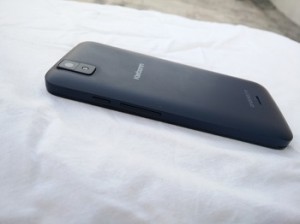
Along comes Android One, a new project backed by none other than Google, to partner with various phone manufacturers and chip suppliers aiming to give good Android experience at a sub 10k pricing. Karbonn is one of the first manufacturers that Google joined hands with for this project and the result is the Sparkle V.

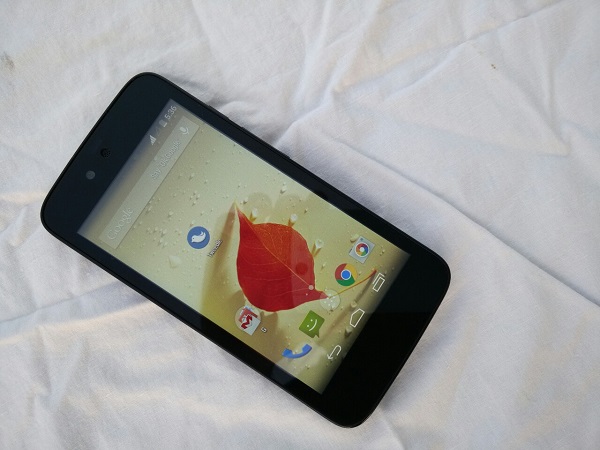
Karbonn’s Sparkle V, as with other Android One devices, comes with the promise of guaranteed OS updates, something we have not really seen in the past for when it comes to budget Android phones. The phone is very similar to the Micromax Canvas A1 and Spice Dream Uno, except for its design and material. The Sparkle V features a 4.5-inch (854 x 480) touchscreen with the 2 MP front-facing camera and circular speaker grill above that screen.

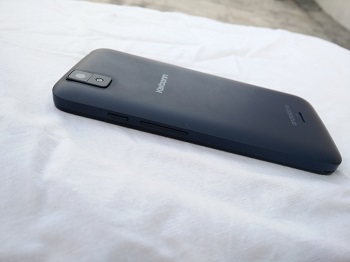
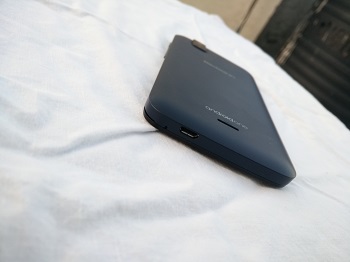
On the right side panel, you have the volume rockers and Power/ Lock key towards the top – both are quite slim but not bad, giving nice feedback when pressed. The left side is plain; while the 3.5 mm headset jack is on the top; and the microUSB port at the bottom. Coming to the back, there is a 5 MP camera alongside flash and the camera module protrudes a bit from the surface, though not too much. The Karbonn logo in the middle and speaker rill towards the bottom complete the rear.

The looks. The phone uses decent plastic materials and has a matte back. The front, including the screen, are prone to smudges and fingerprints, so much so that you might want to carry a small piece of cloth for cleaning them up with every now and then (or you could use a decent screen guard, if that’s your thing). The phone’s bezels aren’t thick, but it is still a relatively good-sized phone to carry even for a person with small hands. Rounded edges and grippy back means you can carry it without having to worry about dropping the device.

The Sparkle V sports a 4.5-inch (854 x 480) screen that is, just as you expect, an average display in the crop of phones available today. The screen resolution is on the lower side, but colours actually look decent and the screen holds quite well for reading small articles. It is far from being a USP of the device, but it isn’t something you’re expecting to be excellent on the first place anyway.

Camera. Talking about the phone’s camera, this 5 MP (AF) camera can take nice shots in good light conditions. The camera app is the default Google camera app, which seems familiar to use as soon as you switch on the camera for the first time. There are a few setting options to choose from, like HDR, Panorama or even switch to manual exposure. Here are a few sample images

The camera can take nice shots, but clearly struggles with low light. There is also a bit of a problem with its focus, which means your exposure and contrast could suffer. You would not want to click your own pictures with the front-facing camera, but it works for video calls.
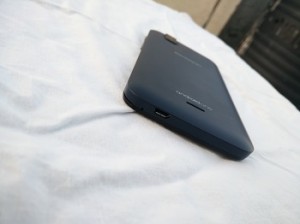
Sound. Coming to the phone’s sound quality, the bundled headsets are actually decent but not very comfortable to wear (depending on your ear size), especially while commuting. The sound is quite loud, clear for vocals and FM Radio. The loudspeakers on the back are also loud but they struggle to give a reliable experience for games and videos. There aren’t any strange call drops or network issues and in-call audio is also clear and without distortion on the other side. Also, PS lock-in, WiFi connections, etc were also reliable, with no drop-outs or bugs.

Battery life. The phone comes with a 1,700 mAh battery unit. This isn’t a particularly high capacity for smartphones today. The phone lasted me less than 20 hours on heavy usage. There’s no inbuilt power-saving mode and you might want to use a separate app for that. More often than not, you would have to charge the phone twice a day in order to get your tasks done. It would have been appreciated had Karbonn gone with a higher capacity cell or even done a better job with the software regarding battery optimisation.

Software. The phone runs on Android 4.4.4 with near-stock look and feel that we are used to seeing on the Nexus devices. There are just a few pre-loaded apps other than the ones you usually see (like the OLX app, PayTM, and Saavn). Even the boot animation is quite similar to the one we had on the Nexus One.

The phone is powered by MediaTek’s 6582 chipset (1.3 GHz quad-core processor, Mali 400MP2 GPU) with 1 GB of RAM. There is an occasional lag you may notice. There were hardly any app crashes during my suage and I felt it is one of the few Android phones that are under Rs. 8,000, which doesn’t perform poorly. It isn’t as smooth as the Moto E, but it is surely not a frustratingly-slow phone. It can handle games like Asphalt 8 well, but the things aren’t too good on the graphics side.

Navigating though the OS, closing and resuming apps are quite smooth. There is a minor bug in the OS where the notification center doesn’t show you the percentage an app has been downloaded or updated while it is being downloaded or updated in the Play Store. With a left swipe (leftward-most), you arrive at Google Now. Making and editing folders, modifying Home screens, on-screen keys, lockscreen, Dock, app launcher, Settings are all just like stock Android and familiar to use.

15 months of manufacturer warranty, plus, MediaTek has open-sourced its kernel sources and other stuff, which it didn’t have for so many other phones, so you can expect custom ROMs for the device soon – make this a much better package. Oh, and you require a microSD card to take an image or video or even take a screenshot as the internal storage space can’t be used for that because it’s reserved for the OS and your apps (you can move your apps to your microSD card, though).

Concluding our review, this phone (along with other phones in the line) is much more than just another Android phone. This is Android One that promises updates that no other low-end devices do. At about Rs 6,000, this is a good deal. The overall experience with the phone – sturdy body, decent screen and camera, below average battery, satisfactory performance – is rather good. But it makes me look forward to the second line of devices under Android One, especially with the likes of HTC, Qualcomm and Lenovo joining in. The project is off to a decent start and seems it can only get better and bigger from here on.

Categories
Do

Group of Mumbaikars takes up Modi’s cleanliness challenge

CST Station receives a much-needed clean up on October 2, on Gandhi Jayanti, to observe cleanliness, sanitation and community health.
by the Observer Research Foundation and Triratna Prerana Mandal, Mumbai

As part of Gandhi Jayanti celebrations on 2nd October, the Mahatma Gandhi Centre for Sanitation, Cleanliness and Community Health, a joint initiative of Observer Research Foundation (ORF) and Triratna Prerana Mandal organised ‘Shramdaan’— a clean-up drive at Chhatrapati Shivaji Terminus (CST), Mumbai.

Mahatma Gandhi dedicated his entire life so that India could attain ‘Swaraj’ but cleanliness was a cause that was even closer to his heart and above all he encouraged and promoted cleanliness of the surroundings, as he strongly believed that “if we do not clean our backyards, our Swaraj will have a foul stench.” Therefore, cleaning public places, like the CST, is the highest form of tribute to pay our beloved Bapu, father of the nation.

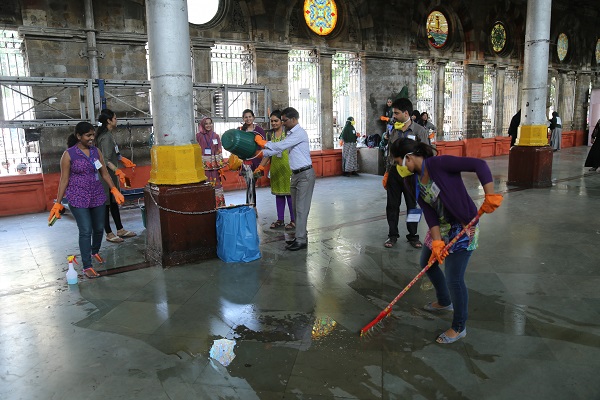
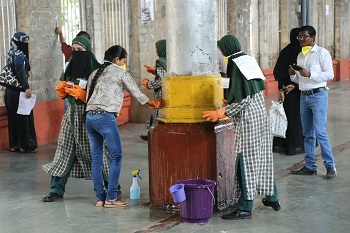
Cleaning up CST stationAnswering the clarion call by the Hon’ble Prime Minister of India, Narendra Modi, all the enthusiastic participants followed in his footsteps by devoting their time towards the 100 hours of ‘Shramdaan’ to promote the ‘Swachh Bharat Abhiyan’. On this occasion, Central Railways had called for public participation in their efforts towards honouring their commitment under the Clean India Mission 2019.

The staff of ORF researchers and interns, as well as volunteers that mainly included school students, teachers and many other citizens worked hand-in-hand to clean Platform No.1 and the adjoining entrance lobby of CST. Everyone contributed to the event with the sweep of a broom, the scrub of a brush and ardent words of appeal to keep Mumbai and our public places clean.

CST station, a UNESCO world heritage site — littered with garbage, posters on the walls and the splotches of paan stains — is not as welcoming to travellers and commuters as it should be. In an honest effort from all those who participated and without any hope or expectation of pats on the back, five hours were spent diligently scrubbing the station and to ensure that it was left in a better condition than before. Students and teachers from the Al-Muminah Girls School at Masjid Bunder participated enthusiastically in the clean-up and awareness campaign to encourage commuters to do their part towards keeping India clean. As the day progressed, commuters and curious onlookers also joined in. And, that is not all! Those who took a break from cleaning duties switched to spreading awareness by engaging commuters at the station.

On Independence Day 2014, Observer Research Foundation Mumbai and Triratna Prerana Mandal (TPM), one of Mumbai’s best-run community-based organisations, launched a joint initiative − Mahatma Gandhi Centre for Sanitation, Cleanliness and Community Health. This Centre aims to take up research, policy advocacy, activism and leadership development in the areas of slum sanitation, waste management, waste recycling, water conservation and public health in Mumbai and the larger Metropolitan Region (MMR).

Categories
Read

Review: ‘One Life Is Not Enough’

Natwar Singh’s book on his life and times as a bureaucrat-turned politician is a fascinating insight into a life well-lived.
by The Editors | editor@themetrognome.in

We rarely have any patience with politicians in India, and politicians over the age of 80? Let’s just say, Congress politician and famed Gandhi family loyalist Natwar Singh’s autobiography would ordinarily not have made any ripples on the Indian book scene.

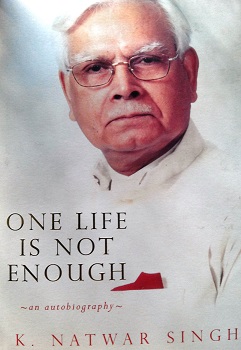
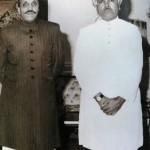
Book coverBut, as with most book releases lately, when controversial details of Sonia Gandhi’s (mis)handling of affairs and spicy excerpts about the highs and lows of the Congress party began to make their way to publications, Singh’s book One Life Is Not Enough, suddenly acquired a must-read status.

Nor does Singh disappoint. Far from being a stodgy, self-righteous look at the life and times of pre-independent and post-independent India, One Life Is Not Enough is a frank, no-holds-barred account of life behind the scenes of Indian politics. It is also an illuminating look into the machinations of the External Affairs Ministry – imagine dealing with the Chinese Premier on an ill-fated trip to India ending with failure of talks with Jawaharlal Nehru, or being constantly on the ball on a posting to Karachi during President Zia-ul-Haq’s reign. The book also describes in detail the failure of the Rajiv Gandhi Government in effectively dealing with the internal affairs of Sri Lanka, and Singh’s part in the creation of the independent country of Bangladesh.

He also describes, in not very modest terms, his successful organisation of two high-profile, international summits in one year – the Commonwealth Heads of Government meeting and the Non-Aligned Movement Summit, both in 1983. In between his role in several milestones in Indian political history, Singh also gives glimpses into his personal life – his education in England, his marriage to an Indian princess, his friendship and admiration for Indira Gandhi, and the thorny relationship he shared with Sonia Gandhi. In the preface, he writes about how Sonia sent her daughter Priyanka to ask him if he intended to write about ‘the events that took place in May 2004 before the swearing-in of the UPA Government’.

I said I intended to,” Singh writes. “No one could edit my book. I would not skirt the truth, nor would I hit below the belt. Certain proprieties cannot be ignored. Just then, Sonia walked in. ‘What a surprise!’ I said. Her overly friendly and gushing greeting bewildered me. It was so out of character. It was a giveaway. Swallowing her pride, she came to her ‘closest’ friend to surrender her quiver. It took her eight-and-a-half-years to do so.

“My book has aroused unexpected interest. I am flattered. Also mildly worried. The expectations are sky high.”

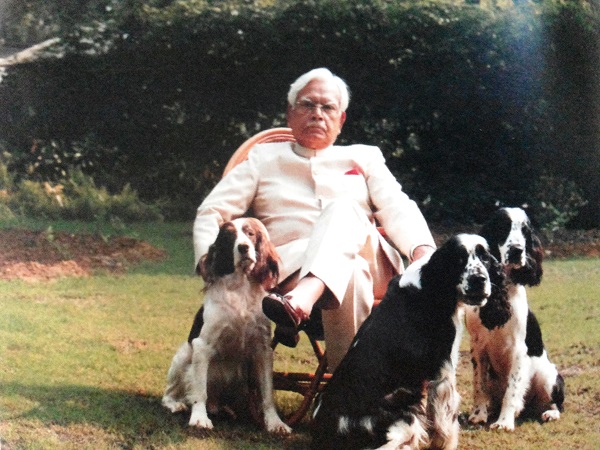
See pictures from the book:

Expectations were bound to be sky-high, come to think of it. Singh has been present in the background, and several times, the foreground, as major events shook the country in independent India. He was witness to the events leading to the Emergency in the 1970s, the rout of the Congress thereafter, the assassination of Indira Gandhi and the anointing of Rajiv Gandhi as her heir, the killing of Rajiv Gandhi and the taking over of the Congress by his widow Sonia after eight years, and the subsequent rise and fall of the Congress under the Sonia-Rahul Gandhi combine. In this context, Singh’s account is a valuable one for chroniclers of Indian history.

Besides, he writes with charming candour and humour about situations both in his personal and professional life. Interestingly, he relays even politically incorrect comments and opinions. Sample some of the comments he mentions:

I once asked Mrs Gandhi what she thought of Margaret Thatcher. She said, ‘What Iron Lady? I saw a nervous woman sitting on the edge of the sofa.”

I was walking on my terrace one day when my servant came and told me, ‘The President is on the line.’ When I took the call, President Zia, after inquiring about my health, asked me if I was free to have dinner with him that night. I agreed. He said, ‘Could you also give me a list of names of your friends?’ I replied, ‘Sir, your intelligence agency already has the names of my friends. AS for the one or two who aren’t on the list, I would like you to spare them!

[Sonia’s] English is near perfect; Hindi is the problem – she cannot speak the language without a written script in front of her. To my suggestion that she learn by heart a chaupai or two of Tulsidas’s or Kabir’s dohas and use them in her speeches, she threw her hands up. ‘I go blank even with a written text. You want me to say something extempore? Forget it.'”

For those outside the corridors of power, One Life Is Not Enough is an essential read on events in Indian history that need clarification. Singh certainly sets the record straight on many points – on how Sonia was forced to give up her idea of assuming Prime Ministership after son Rahul categorically told her not to take up the job, on how strained relations with then PM Morarji Desai posed many roadblocks in his work, and also how his jump from bureaucracy to politics was a relatively simple progression.

Rating: 4/5. One Life Is Not Enough is available for sale on Flipkart

 (All images sourced from ‘One Life Is Not Enough’)

Categories
Event

Attend: Photo exhibition of Chitpur Road, Kolkata

21 German photographers got together to document, celebrate Kolkata’s Chitpur Road. Mumbaikars can see the results at Max Mueller Bhavan today.
by Galerie Max Mueller Bhavan, Mumbai

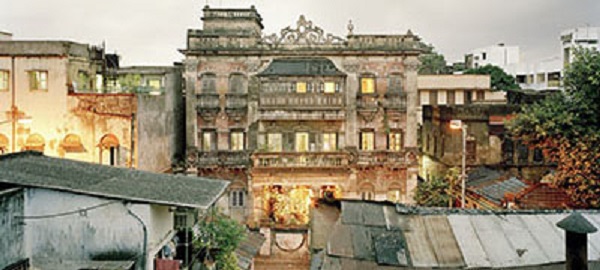
Goethe Institut/Max Mueller Bhavan Mumbai will today present ‘Calcutta: Chitpur Road Neighborhoods’, a presentation of photographs by 21 German photographers, under the guidance of Peter Bialobrzeski. This body of work is unique in its methodology as its main aim was to develop a coherent, unified approach towards the subject. It challenged traditional ideas associated with originality and aimed at creating a more universal aesthetic of photography shared by these 21 photographers.  This reversal of thinking was in itself a challenge, and it was absolutely important to overcome it in order for the project to be a success. The participants worked in groups and took turns to direct the shoots. Their aim was to “A good picture a day”.  They worked under the collective name:  ‘A Kolkata Heritage Photo Project’, and are the joint authors of this body of work.

During the 19th century, Kolkata was one of the most economically affluent cities in India under the British, the city elites demonstrated their affluence by building huge palaces in a unique mix of traditional Moghul architecture with classical and Victorian elements. Today, the neighbourhoods around the historical axis of Chitpur road in North Kolkata, still exhibit the remnants of this architecture style. Though decaying as architecture monuments, they still house a vibrant community. The project aimed at capturing these two extremities of the area, without deviating from their set approach.

In 2008, Hatje Cantz published the book ‘Calcutta: Chitpur Road Neighborhoods’, based on this project. Though all the 21 photographers were students of Peter Bialobrzeski at the University of Arts Bremen in 2006, today they are all individual professional photographers. The Kolkata Heritage Project consists of Claudia Aguilar, Johanna Ahlert, Björn Behrens, Jörg Brüggemann, Tine Casper, Franziska von den Driesch, Anja Engelke, Tobias Gratz, Christian Güssow, Dörte Haupt, André Hemstedt, Manja Herrmann, Torben Höke, Britta Isenrath, Joanna Kosowska, Jørgen Kube, Pia Pollmanns, Silke Schmidt, Inga Seevers, Marion Üdema, Sandy Volz.  

The exhibition is a presentation of photographs by twenty one German photographers, under the guidance of Peter Bialobrzeski can be seen from October 1 to 31. The Mumbai presentation is designed by Tanvi Mishra and Kaushik Ramaswamy.

(Picture courtesy Max Mueller Bhavan, Mumbai)

Categories
Tech

This just in: BlackBerry’s Passport, Huawei’s Honor 6

Priced at Rs 49,990 and Rs 19,999, the two devices are great additions to an already exciting Indian smartphone market.
by Manik Kakra | @Manik_K on Twitter

BlackBerry has launched its flagship smartphone in India. The BlackBerry Passport (in pic on left) has a unique squarish form factor with a full QWERTY keyboard that is also touch-sensitive.

BlackBerry PassportFeaturing a 4.5-inch (1440 x 1440) display (1:1 aspect ratio), the Passport is powered by Qualcomm’s Snapdragon 801 chipset (2.2 GHz quad-core processor, Adreno 330 GPU) coupled with 3 GB of RAM. The phone is equipped with a 13 MP (with OIS) rear camera that can shoot 1080p videos at 60 FPS; and a 2 MP front-facing camera. There’s a 3,450 mAh battery unit in place and 32 GB of inbuilt storage, which is expandable up to 128 GB.

Running BB 10 OS, this device has Bluetooth, WiFi, NFC, GPS and 3G connectivity. Available in black and white colour options, it has been priced at Rs 49,990, with a special tie-up with Amazon where you can get 5,000 JPMiles on pre-ordering a unit.

Huawei has also launched its new Android 4.4.2 smartphone, the Honor 6 (in featured image above). Sporting a 5-inch full HD touchscreen, it has Huawei’s Kirin 920 chipset (1.3 GHz quad-core + 1.7 GHz processor, Mali T628 GPU) and 3 GB of RAM.

This dual-SIM phone boasts a 13 MP (BSI) camera and a 5 MP front-facing camera. Powered by a 3,100 mAh battery unit, this Huawei device is loaded with Bluetooth 4.0, WiFi, NFC, GPS, and 3G connectivity.

Running Huawei’s Emotion 2.3 UI on top, the device 16 GB of internal storage and comes in white and black colours. It goes on sale in a week exclusively on Flipkart for Rs 19,999.

Exit mobile version