Categories
Watch

Watch: Documentary films at Max Mueller Bhavan

Starting today, there will be screenings of films every evening till March 5, 2015. Do not miss these important films.
by The Editors | editor@themetrognome.in

The Max Mueller Bhavan, Mumbai, continues with its good work of bringing quality and relevant cinema to Mumbaikars. This week, the Max Mueller Bhavan is screening some very important documentary films starting today, March 3 to March 5, 2015.

The screenings this evening will be followed by a discussion with the directors of the evening’s films. The screenings are being held in collaboration with DocEdge Kolkata, Asian Forum for Documentary, Kolkata.

The schedule for the event is as follows:

ABU HARAZ | Dir.: Maciej J. Drygas | 73 min, 2013
A film about a Sudanese village on the River Nile, where a large dam will be built and village will disappear under water.

ROOMS OF SHADOW AND LIGHT | Dir.: John Webster | 57 min, 1999
The story of an organisation that helps women in the red light district in Mumbai.

March 4, 2015 | 6.30 pm

SOUND OF TORTURE | Director: Keren Shayo | 58 minutes, 2013
An award winning film on live calls from a radio broadcast to the torture camps in Egyptian Sinai desert, where hundreds of Eritrean refugees are held hostage.

TWO MOTHERS (Meine Mütter – Spurensuche in Riga) | Director: Rosa von Praunheim, colour and b/w | 87 min., 2006
The German gay film icon Rosa von Praunheim (Holger Mischwitzky) goes in search of his ‘real’ unknown parents, which leads to a moving view of German history.

March 5, 2015 | 6.30 pm

MASTER OF THE UNIVERSE | Director: Marc Bauder, colour | 88 min., 2013
Rainer Voss used to be one of Germany’s leading investment bankers. The film paints an alarming picture of a megalomaniacal, quasi-religious parallel universe, hidden behind mirrored facades.

Categories
Event

Attend: Art exhibition celebrating Women’s Day

The art exhibition titled ‘Timeless Energy – An Art Connect’ is conceptualised by eight women, alumni of Sophia College, 1979 batch.
by The Editors | editor@themetrognome.in

There’s nothing quite like art to make one muse on the deeper complexities of life. Eight artists from the 1979 batch of Sophia Polytechnic, Mumbai are celebrating the upcoming International Women’s Day (March 8) with an art exhibition commemorating the spirit of women.

The exhibition, titled ‘Timeless Energy – An Art Connect’, aims to “celebrate the spirit of art and creativity and support women empowerment with an ingenious exhibition of art.” The three-day event starting February 27 is a prelude to the forthcoming International Women’s Day.

The participating artists are Parveen Antia Hemmady, Aneeta Malhotra, Rupande Kaku, Jasmine Jehangir, Shefali Randeria, Krishna Khanna, Qamar Ahmad, and Lili Menon.

‘Timeless Energy’ is an art show of free spirited expression, presented by an art connects between the eight female artists, all alumni of Sophia Polytechnic, Mumbai, 1979 batch. The creative energy that flows through their art is presented by bold strokes, colour blocks, textures and interesting treatments of varied mediums on surfaces from canvas to fabric, wood, glass and porcelain.

Head to The Easel Gallery, 32, Janki Kutir, Near Moshe’s, Church Road, Juhu, from Friday to Sunday, February 27 to March 1, 2015, between 11 am to 7 pm.

Categories
Tech

Review: Karbonn MachOne

Karbonn’s new under-8k price range phone is a satisfactory device but needs a few corrections in its battery and camera performance.
by Manik Kakra | @Manik_K on Twitter

Karbonn has been one of the Indian players to capture a considerable amount of phone sale share and keep its brand value intact over the last couple of years. One of the things working in its favour has been low-end smartphones. The MachOne Titanium is another such device from the company that caters to sub-8k price segment without having to sacrifice on the performance side, as per Karbonn. So is it worth spending Rs. 6,990 on this phone?

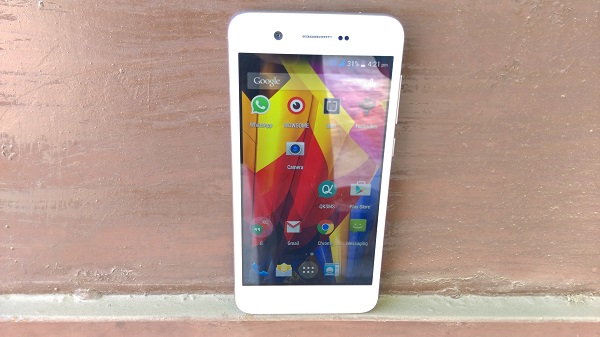
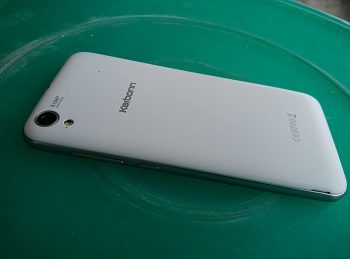
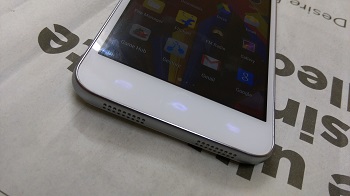
The looks. Karbonn’s MachOne Titanium (S310) follows a typical form factor that you expect to see from an Indian manufacturer. With its silver curved sides, thin plastic sheet used for rear and a front design that isn’t very unique, the design is just okay and not something that would wow you on the first look. You might even say they could have done better by not trying to imitate the iPhone 6 (check those speaker grills at the bottom), and I won’t disagree.

The front sports the 4.7-inch HD screen along with the 5 MP front-facing camera with the LED notification light tucked in, ear speaker grill, and sensors as well LED flash for the front camera. The screen is prone to smudges and dust, so do wipe it clear often. At the bottom of the screen are three touch buttons – Multi-app view, Home and Back – which lit up dully. The top houses the microUSB port as well as the 3.5mm headset jack; while the plasticy hard volume rocker and Power/Lock key (nearer the middle) are placed on the right side panel, leaving the left side panel plain.

The camera is on the top-left corner next to the LED flash, with the Karbonn logo, and a secluded secondary mic. You can open the rear cover using your finger nail through the slight opening on the left side, revealing the battery unit, two SIM slots and microSD card slot.

Display. The phone’s 4.7-inch (1280 x 720) display is the best thing about the device. It is not a bad screen at this price. You can watch HD videos, view images and read webpages well. There isn’t a wow factor to its colour production and sharpness, but there’s not much of a downside considering other panels in this price range.

Camera. The MachOne boasts an 8 MP (AF) camera. Here are a few sample images.

The camera takes decent photos in daylight but struggles in any mode that doesn’t have good light. Images usually look grainy and only once in a while did a photo appeared detailed and quite sharp. You might want to try the HDR mode more often. The app seems similar to the Google Camera app, but the camera is definitely not worth much more than shooting outside for casual shots.

Audio. The device has a decent in-ear output using the bundled headset, and the loudspeakers, though distorted at the maximum volume, is loud and usually clear for games and videos. Call quality is fine and network reception as well as WiFi network connections didn’t give any trouble.

Battery. Battery life of the phone (using one SIM card) was inconsistent. At times, with moderate usage, its 1,800 mAh battery unit lasted nearly a day, but at other times, with similar usage, it struggled to give over 18 hours. There were three minor firmware updates within a week I started using the phone and were aimed at better battery (besides a few other things), so Karbonn may well be aware of it. There’s a built-in Stamina mode, which you can select to switch on at 20% battery level to get a bit more phone uptime.

Software and performance. The device runs on Android 4.4.2 with very little added or changed from stock Android look and feel. Under the hood, there is a MediaTek 6582 SoC (1.3 GHz quad-core processor, Mali-400 GPU) coupled with 1 GB of RAM. The user gets about 5.5 GB of available storage space, which can be expanded. The general performance of the phone seemed satisfactory. Apps opened without any hiccups, scrolling through Settings, swiping though Home screen and going back and forth between apps was easy.

With a few days of usage, I wouldn’t call it to be a very snappy smartphone, but it did handle most tasks pretty well. You shouldn’t have much of a problem in playing HD videos or viewing and swiping through images. As for additions done by Karbonn, the screen supports double-tap to wake as well as double-tap on a Home screen to lock it, and this handy feature works well. Karbonn has also added a few gesture modes, by which you can unlock the screen by writing a letter in the screen to land straight into the app pre-set for that letter.

Lock screen has also been revamped a bit. Apart from the usual camera and battery setting shortcuts, it shows you notifications on it – missed call, SMS, and if you swipe left on a notification icon, it gives you the option to call the contact directly. There are two themes available under Settings – Dark (default) and White. There are few more colour options available for Home screen options, but that option only gives you coloured icon backgrounds, which look quite ugly, so you wouldn’t want to change the default transparent style. Other than that, the overall look, customization options and features are a standard set associated with a low-end Android phone.

Notification centre and toggle buttons appear in one screen and you have to swipe left to access more toggle buttons from the swipe-down center. Dual SIM handling and data connectivity option are handy and most users shouldn’t find it difficult to switch between them. While it does have satisfactory performance for a budget device, it would be great if Karbonn could give the Android 5.0 update soon. Not only will it give it an edge among many other smartphones available out there, but also give a better impression that the company is actually serious about software upgrades.

To sum up, the Karbonn MachOne Titanium seems like a phone that does most things quite well – satisfactory performance, useful screen gestures, good screen, but lacks a bit on the camera and battery parts even at this range. All in all, the device seems like a worthy option in a segment that’s getting a lot of attention these days.

Categories
Do

Participate: The ‘Make it happen’ photo contest

The US Consulate, Mumbai, is observing Women’s History Month with an online photo contest for Indians, till March 15, 2015.
by The Editors | editor@themetrognome.in

The International Women’s Day is coming up soon (on March 8), but for the US Consulate, Mumbai, the festivities have already begun. The US Consulate, Mumbai is celebrating Women’s History Month all through March with an online photo contest on the theme ‘Make It Happen.’

As per the contest rules, you have to send your photo taken in India, celebrating the roles and accomplishments of women on any one of the contact coordinates (listed at the bottom of this article),
The photo must be an original one, which shows how women can have a positive influence on their families, neighborhoods, communities, country, and the world. The shot must be an action one, celebrating women’s achievements and highlights the important role they play. Photos need to be the original work of the contestants, and to be shot in India within the past two years.

The contest is open to Indian nationals residing in the five states of the Consular district: Chhattisgarh, Goa, Gujarat, Madhya Pradesh, and Maharashtra. Once a photo is submitted, it is considered a final submission and may not be modified or edited, or replaced. Contestants may submit no more than five photos, and only one photo will be eligible for a prize. Look up www.facebook.com/mumbai.usconsulate/events for full contest rules and submission guidelines.

Send your entries email to MumbaiPublicAffairs@gmail.com or via Twitter to @USAndMumbai using the hashtag #MakeItHappenPics. The contest has already commenced and will close at 23:59 pm on March 15, 2015.

Categories
Watch

Watch: ‘Begin Again’

The 2013 film features Keira Knightley and Mark Ruffalo in leading roles; music and song writing form the film’s backdrop.
by The Editors | editor@themetrognome.in

PVR and NCPA are launching their ‘Director’s Rare’ programme from today, a new monthly series of films picked by PVR.

The 2013 film Begin Again, an American musical comedy-drama film written and directed by John Carney and starring Keira Knightley and Mark Ruffalo, will play tonight at the NCPA’s Little Theatre. In the film, Knightley plays a singer-songwriter who is discovered by a struggling record label executive (Ruffalo) and collaborates with him to produce an album recorded in public locations all over New York City. Gretta’s world takes a turn for the better when Dan, a disgraced record label executive, stumbles upon her performing on an East Village stage and is captivated by her raw talent.

After the success of his 2007 musical film Once, Carney wrote the script for Begin Again in 2010 and employed Gregg Alexander to compose most of the film’s music. With an US$8 million budget, production began in July 2012 with filming taking place in various locations around New York City. The film premiered in September 2013 at the Toronto International Film Festival and was released theatrically on June 27, 2014, in conjunction with the release of the film’s soundtrack. It has grossed over $63 million worldwide and received mostly positive reviews from critics. It was nominated for an Academy Award for Best Original Song.

The screening is free and open to all on a first come first seated basis. The film begins at 6.30 pm.

(Picture courtesy tribecafilm.com)

Categories
Tech

Review: Xiaomi Mi4

What’s new and improved in the Mi4 model that the Mi3 didn’t have? We do a check to find out.
by Manik Kakra | @Manik_K on Twitter

What comes to your mind when you hear the name Xiaomi? Good hardware specifications, reasonable pricing, and flash sale, right? And now, Xiaomi seems to be building further on those thoughts. With the Mi 3 making its India debut, the company made quite a few ripples in the online retail space – flash sale for a mid-range device that has hardware specifications you would associate with higher-end models. Does the Mi 4, with its revamped UI, upgraded camera, new design have what it takes to ship Xiaomi’s ship further in the Indian market? Let’s try and find out.

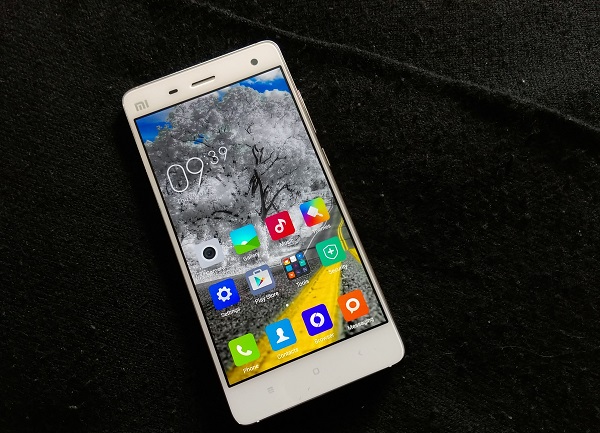
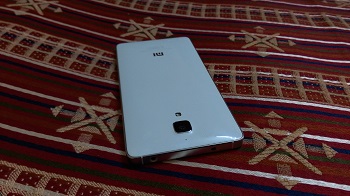
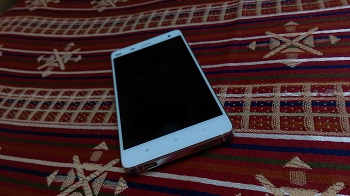
The looks. Xiaomi’s Mi 4 (MI 4W) follows a different design language than the Mi 3. Having stainless steel frame around with chamfered edges, hard back with no curves and two vertical cuts on the top and bottom, the phone does have some heft to it and feels sturdy to hold. There are no creeks or random loose give to it. Besides the 5-inch full HD panel on the front, you see the silver Mi logo, sensors, ear speaker grill and front-facing camera while below the screen are the three touch keys – Menu/ Options key, Home and Back key, plus the oval-shaped LED notification light. These buttons and light lit up just about the right amount – not dull or too bright. On the left side panel, there’s the micro SIM card slot, while the right side panel houses the volume rockers and Power Lock key, both are made out of metal, requiring you to press a bit firmly.
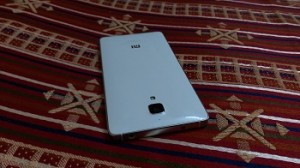
On the hard white rear, you’ll see the 13 MP camera near the top-middle, surrounded by the LED flash and secondary mic, and the Mi logo towards the bottom. On the top, the infrared port and 3.5mm headset jack are placed; and the bottom sports the microUSB part and loudspeaker. The Mi 4 seems like having better design and feel than its predecessor, and it’s good that Xiaomi didn’t just follow its previous design pattern.

Screen. The device boasts a 5-inch (1920 x 1080) screen that’s manufactured by JDI, which it claims provides a better solution than Gorilla Glass. The display produces good colours, is usable under direct sunlight and seems to have good viewing angles. Watching full HD videos and images, the screen won’t disappoint, provided you haven’t been using a high-end phone panel as the Mi 4 doesn’t quite seem as sharp and vibrant as the most high-end phones, but it does the job pretty well.

Camera. Talking about the 13 MP (f/1.8) camera, the company claims it has been upgraded and vastly improved. Here are a few sample images.

The phone takes detailed, bright images when used under daylight conditions. Its shortcomings come to the fore when taking close-up shots and using it in low-light conditions. I liked the app, which has a lot of options and modes like Refocus, Burst, HDR, Panorama and also the manual mode, and yet the camera app is smooth and simple to operate. The front-facing 8 MP camera is more than capable in handling selfies and making video calls. Thanks to its wide-angle sensor, you can cover more area for group shots.

Network and call quality. The phone handles basics like network reception, call quality and network switches without any trouble. I didn’t notice any network issues or call drops and WiFi, GPS and Bluetooth worked fine. Infrared connectivity, on the other hand, was a bit glitchy as it took me a while to sync and control a Samsung LED TV. On the audio side, the loudspeaker is loud and clear and not bad for games and videos, but it could have been placed ideally at a better place. You don’t get any bundled headsets, but using a basic pair of earphones, the phone delivers above average in-ear output.

Battery. I found the 3,000 mAh battery unit a downside. The phone hardly ever lasted me a full day as it needed to be plugged in within 24 hours of a full charge. At about 30 per cent brightness, using Email, Twitter, Reddit and a bit of music and calls, you may end up with more juice when switching to the power-saving mode.

Software and performance. The Mi 4 runs on Android 4.4.4 with the new MiUI 6.3.9 in place. Under the hood, there is Qualcomm’s Snapdragon 80 SoC (2.5 GHz quad-core processor, Adreno 330 GPU) coupled with 3 GB of RAM. Scrolling, swiping and opening of apps is fairly smooth. One thing worth mentioning is that the launcher often redraws, re-launches and you would have to wait a second or two to tap somewhere on your Home screen after exiting an app. This wasn’t the case with the Mi 3 running MiUi 5, so hopefully there’s a quick fix for this issue. With the 16 GB model, you get about 2.4 GB of storage space, so you might want to spend a bit more to get a 64 GB variant.

The new MiUI 6 seems like a more colourful, refreshing and minimal skin than earlier. With having all your app shortcuts and widgets on the Home screens and no separate app launcher, the setup isn’t very different. What’s different is the icons and widgets, which have been given a cleaner look.

Notifications have been given a major overhaul. You now get a pop-up like notification shade (similar to iOS) on getting an Email, SMS, etc. and can tap to reply no matter what app you’re in. You can choose which app is allowed to show notifications in pop-up, preview its icon in the status bar and Lock screen. Status bar icons are redesigned also a bit more on the monochromatic side of looks. Clock has been shifted to the left side and Lock screen looks simpler now with the only shortcut being the camera app. App icons now show you if there’s any unread message (showing a number), which is handy. Swiping down gives you toggle buttons and swiping left lands you at the notification shade. All in all, the new MiUI seems like a good step towards cleaner and neater UI, while there’s surely shades of iOS at various places, there quite a few useful things and tricks to like in it.

Concluding our review, the Mi 4, which we would have appreciated if Xiaomi had launched sooner than six months of its initial launch, seems like a worth competitor in this mid-range. It has a good screen, average battery life, capable camera, it might not be as compelling as the Mi 3 for its price, but is a worthy competitor to the likes of the HTC Desire 820Q, OnePlus One, Lenovo Vibe X2, giving a bunch of good options to buyers to pick from.


Exit mobile version