Categories
Achieve

Fulfil your dream of studying abroad

Follow this 7 step guide that covers everything from researching your study options to getting accepted at a foreign university.
by Rohan Ganeriwala, Co- Founder, Collegify

1. Study Abroad programmes are becoming increasingly attractive as more and more college students seek meaningful ways to spend college breaks or explore true diversity of cultures. As a result, not only has a great international programme become more expensive, but also a lot more competitive to get accepted in to.

2. Research. Talk to parents, teachers, current students abroad as well as alumni to evaluate if you would be interested in studying abroad. Contact an education consultant who is looking into study abroad applications to understand what’s best for you, how you should plan your timeline of standardised tests and applications to colleges abroad. Remember to study hard for your standardised tests (SAT, SAT Subject Tests, ACT, TOEFL, IELTS etc.) and register well in advance. Plan your test dates well so you have time to retake if required.

3. Build your profile. It’s important to build your student profile with project work, summer internships, extra-curricular activities and volunteer work. If you know the industry you’re looking to get into, network with people in this industry to understand job trends and skill set required to enter the industry as it well help you in selecting programs and schools for applications. Shortlist universities with your education consultant and carefully evaluate the available options criteria such as offered programmes, rankings, location, campus life, eligibility, scholarship and financial aid opportunities.

4. Look for new horizons. Some destinations like the US and the UK are well known to international students but the picture is changing and new study abroad destinations are making head way. University World News recently featured India as an increasingly popular destination for study abroad. Given today’s global economies, it is imperative that all students acquire knowledge of and sensitivity to global issues. This knowledge and experience will enable students to participate fully in tomorrow’s workforce that will be even more ethnically and culturally diverse than it is today. Students are spending thrice the amount only for accommodation, away from families and home.

Research the university. Finalise universities after thorough research online, speaking to current students and alumni, and maybe attending a college education fair where you get to interact with faculty and staff members from the universities. Work on application documents such as worksheets, essays, short-question answers, statement of purpose, high school transcripts, predicted scores and mark sheets as per the requirements of the universities.

Contact admissions committees of colleges you are applying to with queries and doubts. They are always happy to help you out and their guidance may highlight points that an admission consultant or the college website may not provide. Including these insights in your documents may give you an edge over the other candidates.

5. Prepare your documents docket. Compile all the application documentation such as resumes, essays, worksheets, letters of recommendation, certificates and financial aid forms if required and forward the final packet to universities well before their deadlines to ensure timely receipt and consideration of your application.

6. Prepare for interviews. Some universities may schedule interviews with you before granting admission or if they consider you for scholarships. Prepare for the same and make sure you keep corresponding with the admissions office regularly. When you hear from colleges regarding your acceptances, select a college and enroll well before the deadline. This usually requires the payment of a fee.

7. Get your personal documents in order. Lastly, get your passport, visa and financial documentation in order along with health immunisations, health insurance, a credit card that works the world over, and your travel bookings. While loans are always an option, we encourage students to apply for scholarships or need-based financial aid first. To apply for scholarships, you will require an IELTS score of 6.5. India has only 27,000 foreign students and has no plans for any regulated increase because of controls in higher education. Also vocational education percentage in India is at meagre 5% of its total employed workforce of 459.10 million as against 95% of South Korea, 80% of Japan and 70% of Germany.

You’re now ready for a great experience abroad!
Categories
grey space

The problems of the old in Incredible India

An American medical student writes about interacting with seniors in Mumbai and Bangalore and the many insights into Indian life.
by Robin Reister

Part I

India is big, crowded, and changing faster economically and socially than it can seem to keep up with. The largest democracy in the world with over one billion people, it is completely overwhelming and exhilarating, but there is also a prevalent warmth and hospitality within the people wherever you go.

India’s history is as rich and colourful as it can get, with hundreds of different conquerors and border changes, the famous story of independence led by Mahatma Gandhi, and evidence of it all remaining in the temples, statues, and preservations of countless historical sites. The culture is heavily influenced by religion and their daily rituals influence almost every part of the lives of the Hindu people I interacted with. Muslims and Christians, along with Sikhs, Buddhists, Jains, Jews, and Zorastrians also are seen openly practicing their religions, and all living in relative peace and symbiosis with each other.

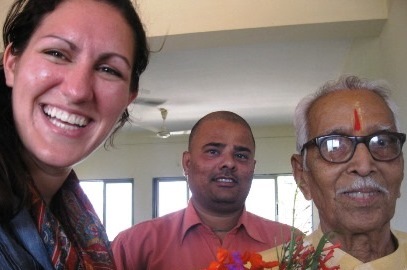
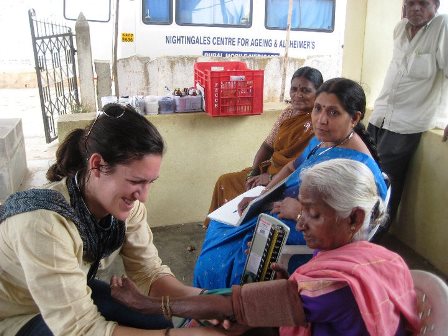
Robin Reister with seniors in Mumbai

But when talking to the locals about what is changing, especially from the elderly generation, you hear about the huge social changes taking place. The breakdown of the Indian family model, which used to be comprised of a large household with all generations, is now becoming nuclear and leaving many from the silver generation without a home.

My rotation focussed on the health and social issues of the elderly population in India. I worked with a multi-faceted medical NGO in Bangalore, the Nightingale Trust, whose realm includes home medical care, an inpatient dementia care unit, adult day care, and rural medical visits amongst other things.  I also worked with a newer NGO in Mumbai known as Silver Inning Foundation which uses social networking and media to help address multiple human rights issues and needs of the elderly. My goals in this rotation were to learn about the health and human rights issues involving the elderly in India and compare them to the USA’s, share my knowledge and ideas with the Indian people I work with, and use my connections and what I learned in the future in some way to help address these and similar problems.

Before leaving, I had some grasp on the issues affecting the elderly. I had heard that there were rising amounts of elderly people due to increasing life expectancy, and little infrastructure to support them. Also I knew rates of diabetes were on the rise. I wanted to explore the issues from a medical and human rights perspective, as are my interests. On arriving, I found that these things were true, and more. Again and again I heard the stories of children abandoning their parents, or moving away to the US. There was no Government support to help them finance their daily life. Rates of depression have increased in the elderly as an outcome of the changing family structure too.

The NGOs I worked with were helping to address these issues. I was a part of these NGOs as an observer and short-term worker. I think my presence benefitted the people I interacted with by sharing my knowledge of how the elderly are treated in America and by showing my support of the activities and the people in need.

Tomorrow: ‘Do not complain about health issues’ is the Indian’s mantra.

Robin Reister visited India in 2011. Today, she is a practicing doctor in a hospital in New York. ‘Grey Space’ is a weekly column on senior citizen issues. If you have an anecdote or leagl information, or anything you feel is useful to senior citizens, caregives and the society at large, feel free to get it published in this space. Write to editor@themetrognome.in or on Facebook at www.facebook.com/Themetrognome.in and we will publish your account.

(Pictures courtesy Robin Reister and Silver Innings Foundation)

Categories
Kharcha paani

5 ways to ‘read’ your employees

You’ll know what your employees are like if you observe, communicate and listen constantly for information and read the signs.
by Reyna Mathur

Consider this situation: you are the leader of a team of young trainees, and you are entrusted with the job of finding out the strengths of each person and fit them to the correct role. How do you achieve this? Do you take one-on-one interviews and ask them point blank what role they would like to do? Or do you opt for a more creative approach to find the answers more effectively?

HR professional Mayank Shetty advises, “The best way is to get the team together for a tea session in the canteen, where we would all get to know each other’s names and break the ice. Then I would suggest a bonding activity like going for a film.” He suggests that putting a new group in a situation where they have to share information with each other and even possibly pay for travel, food and entertainment goes a long way in telling the leader about each person. “For instance, I would notice at once if somebody is unwilling to pay for food, or is not forthcoming with information when asked which film they want to see. I would also note if somebody takes more initiative and plans for the whole group.”

You might want to note these 5 potential ‘red flags’ in your employees:

1. Reserved, uncommunicative employees. There may be at least one person on the staff who is silent most of the times and prefers to be by himself even in a group. Many people suffer from shyness which is often mistaken for aloofness. Try and get the person to speak up more, but don’t get pushy. It is normal for new joinees to be quieter than the rest of the staff, but if the employee has been with the office for over six months and still does not have an office friend, it means that the person functions best when left alone and should not be forced to participate unless ready.

2. The ‘funny’ employee. Every group has at least one ‘office clown’ who can be relied on to keep the atmosphere light. This person will have a joke ready for every situation. However, observe the person’s interpersonal communication with others – does he or she make hurtful comments about the others under the guise of a joke? Does he or she make racist, sexist or obscene comments that may embarrass others? You should clearly indicate that any hurtful or vulgar conversation will not be tolerated in the office. On the other hand, if the employee is also seemingly popular with the staff on an individual level, it means he or she is a good listener and employs humour to make friends.

3. The backlog employee. Your staff will have one person who habitually carries today’s tasks over to the next working day. Observe this person’s working habits for a while to judge why this happens. It might be as simple as plain procrastination, or it may be that the person is so burdened with tasks that he or she runs out of time to complete them. Speak to them if you find that he or she doesn’t finish the work out of laziness. If you need to reassign duties to this employee, do it at the earliest before the backlog increases. If necessary, team up this person with another team member who is finicky about finishing all tasks on deadline.

4. The give-me-everybody’s-work employee. Some members of the staff like to assist others on their projects, but very soon find themselves in a situation where they are doing all the work. This sort of employee is unable to say ‘no’ and hence, gets taken advantage of by the others. Clamp down on this situation at once, and take the employee aside to know why they are doing work outside their own ambit of duties. At this point, they should be able to communicate their problem areas clearly with you, provided you create a non-threatening discussion environment. If they still cannot speak up after gently probing, it simply means that they lack the gumption to defend themselves. You should think twice before putting this person in charge of a team or a project.

5. The ‘It’s not my problem’ employee. This kind of employee cannot be a team player, because he or she does not believe in rolling up their sleeves and getting down to completing the job. Their overall outlook is that they will do only as much as they are paid to do, and will categorically refuse to assist another team member or own up responsibility for an issue. This employee will also refuse to work beyond the stipulated working hours and make excuses to skip all-nighters. The best way to get this person to be productive is to put him or her in charge of a project and convey that the team’s progress will reflect in his KRAs.

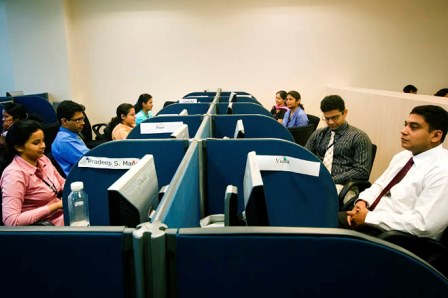
(Picture courtesy www.wsj.com. Image is used for representational purpose only)

Categories
Learn

Mumbai gets country’s first digital training centre for the disabled

Helen Keller Institute and NASSCOM join hands for country’s first NDLM centre to impart digital literacy training to the disabled.
by The Editors | editor@themetrognome.in

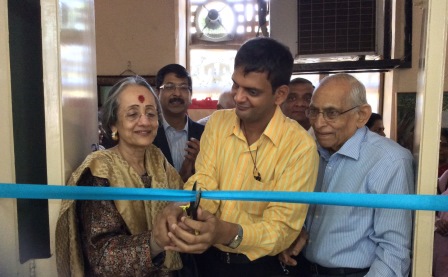
The Helen Keller Institute for Deaf and Deaf-blind (HKIDB) and NASSCOM Foundation yesterday jointly opened India’s first ever NDLM centre dedicated to training Persons with Disabilities in Digital Literacy. This will also be the first NDLM centre based out of Mumbai.

HKIDB will facilitate the training infrastructure and the trainers at the centre. Special care has been taken to make sure that it remains accessible to Persons with Disabilities. The computers inside the centre have been loaded with the latest accessibility hardware and software like Job Access with Speech (JAWS), speakers, mics, power braillers – braille keyboards and braille embosser (braille printer) etc. The course material has been fully tested for W3C level 2 accessibility level.

The centre will have beneficiaries trained on all digital devices, specifically, computers and mobile phones. Once trained, the beneficiaries will be able to send emails, connect on social media, buy from e-commerce websites, and even use the Internet to avail various Government services such as registering for Aadhar cards, ration cards, PAN cards, and others.

On the occasion, Yogesh Desai, CEO, HKIDB said, “Our aim is to develop the Deaf & Deaf-blind into self-sufficient human beings and integrate them into the regular stream of society to perform to the best of their abilities. The NDLM centre will address digital literacy needs of persons with other disabilities also. WE believe that no one is incapable of being taught and no one can do without education.”

Shrikant Sinha, CEO, NASSCOM Foundation said, “Inclusion of Persons with Disabilities has been one of the top priorities for NASSCOM Foundation. We are attempting to close the digital divide by helping Persons with Disability to harness the power of computers and mobiles and develop necessary skills to start using them with confidence.”

Categories
Deal with it

Worship, immerse and protect the seas

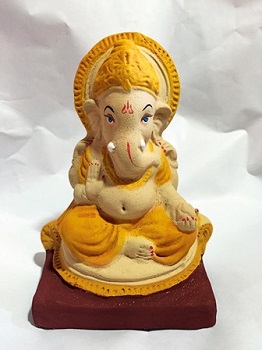
City based environmentalist Anand Pendharkar’s Ganesh idols stuffed with vegetable fish food are finding many takers in the State and country, too.
by Ravi Shet

Ganesh Chaturthi is one of the largest festivals celebrated in our city. But the festival creates havoc in our seas – the post visarjan (immersion) of Ganesh idols made of Plaster of Paris (POP) pollute the water significantly and also impact the marine environment badly. Nothing changes year after year – huge Ganesh POP idols are immersed in the seas, jeopardising the marine life at an alarming rate.

The answer, then, is to make eco-friendly idols. Thus, the Sprouts Environmental Trust and the good folks at Ogilvy and Mather (O&M) came together to create Ganesh idols made from corn and vegetable powder. These can be consumed by fish and other marine organisms. Anand Pendharkar, founder of Sprouts, has completed his M. Sc in Wildlife Science from Dehradun, and tells us that he has been cleaning the beaches in Mumbai post-Ganesh visarjan for the past 12 years. “Girgaon chowpatty has been on our radar, since huge idols mostly come there. People also flock to Juhu beach because celebrities come there,” he says.

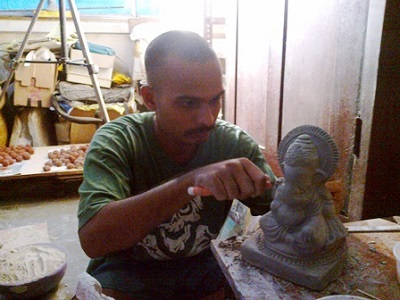
The corn and vegetable Ganesh idol

For the past 6 years, Sprouts has been preparing Ganesh idols from clay and papier mache as a healthy alternative to the usual POP idols. However, when O&M’s team (comprising Elizabeth Dias, Srreram Athray, Calvin Austin, Kunal Dangarwala and Farid Bawa) joined hands with Anand, the concept of stuffing vegetarian fish food along with clay for preparation of Ganesh idols was discussed. “The idols dissolve in water within 4 to 5 hours. The journey was full of learning and we went through a lot of research and testing,” Anand says.

The team created a standard size of 9-inch Ganesh idols priced at Rs 900, which are coloured using natural materials such as Fuller’s Earth, geru, kumkum and turmeric. It takes around 3 days to complete an idol and their target is to prepare 200 idols for this year. As of now, 8 artisans on a part-time basis are working in Mumbai with Anand, while some more are working in Nagpur.

Anand recently conducted a workshop for Margam (a programme of NGO Vidya), a self-help group for women in Powai, and taught them how to make this unique Ganesh idol. He says, “People who normally get Ganesh home or in pandals every years have purchased our 9-inch idol this year.” He further adds that his family has been a huge support for his journey.

(Pics by Anand Pendharkar and Ravi Shet)

Categories
Trends

Mumbai drivers do not let ambulances pass

Nanavati Hospital’s recently conducted mock ambulance drive finds continued apathy from the city’s road traffic towards ambulances rushing patients to hospitals.
by The Editors | editor@themetrognome.in

The chances of a patient’s survival after a traumatic injury is directly related to how fast (s)he receives emergency care, called as ‘Golden Hour’ in medical parlance. Aimed at providing quality emergency care, Vile-Parle based Nanavati Super Specialty Hospital recently conducted a mock ambulance drive awareness campaign, named as ‘Mujhe Rasta Do’.

The drive was aimed to measure the responsiveness of Mumbai’s drivers in giving way to ambulances in traffic, while also creating awareness about giving way to ambulances so that lives may be saved. 10 ambulances drove to Nanavati Hospital from different locations; the aim was to reach in the shortest possible time.

Said Dr Rajendra Patankar, COO, Nanavati Super Speciality Hospital, “It is well established that the patient’s chances of survival are greatest if they receive care within a short period of time after a severe injury. In emergency medicine, the Golden Hour is the time period following traumatic injury – a very small duration but with a high possibility of saving a life on providing prompt medical treatment.”

The drill included 10 different ambulances travelling from different locations across the city to reach Nanavati Hospital within the shortest time span. The initiative commenced from 11 am with all ambulances travelling from different locations without patients, but with the siren on. “Other vehicles did not make way for the ambulance to pass by, despite hearing the siren. This creates immense pressure on us to help the patient reach the hospital on time.

“Many times, the ambulance gets blocked in huge traffic creating delay to get the patient admitted in the emergency care unit. People also tried to drive right behind the ambulance thinking that if they followed it, they would also reach faster. This creates further blocks and difficulties,” said one of the ambulance drivers.

Said Maharashtra Health Minister Dr Deepak Sawant, “The State of Maharashtra has recently created a green corridor for a heart transplant. A green corridor between the hospital in Pune to the airport and another one from Mumbai’s Santacruz airport to Mulund was created at a moment’s notice. There is an urgent need to create an ambulance freeway to address the emergency medical care needs within the shortest period of time. The State Health Ministry will definitely work towards such initiatives with the State Road Transport Department.”

(Picture courtesy www.youtube.com)

Exit mobile version