Categories
Film

‘Tracing Phalke’ to celebrate 100 years of cinema

NFDC releases coffee table book on life of Dadasaheb Phalke; the book contains rare details of the cine genius’ life.
by The Editors | editor@themetrognome.in

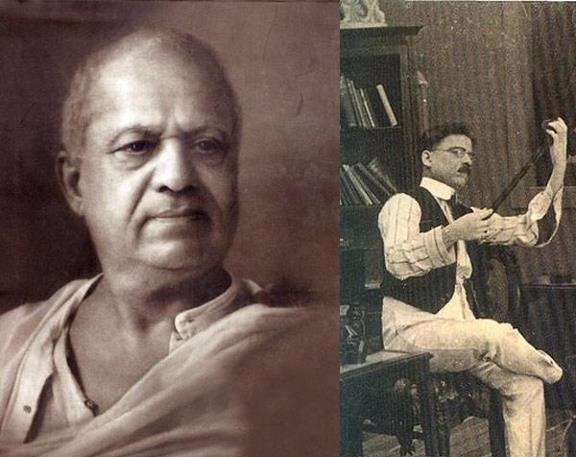
What better way to celebrate 100 glorious years of Indian cinema than to celebrate the life of the father of Indian cinema? Carrying this idea forward is Tracing Phalke, a book that chronicles the life of Dadasaheb Phalke.

“Celebrating the completion of an action-packed cinematic century of Indian cinema and the genius of Dadasaheb, NFDC (National Film Development Corporation) is pleased to announce the release of the limited edition of Tracing Phalke – researched, written and compiled by Kamal Swaroop, a film, television and radio director and screenwriter, more popularly known for his masterwork Om-Dar-B-Dar (1988),” a release from NFDC said.

The book is a “text-based visual treat that lends a magnified view into Dadasaheb’s life, the iconic coffee table book is an eponymous compilation tracing the life span of the Father of Indian Cinema, with rare details right through his schooling, places he visited, people he met and experiences that lent value to his innate genius and imagination that eventually lead to the birth of Indian Cinema.”

Speaking on the occasion of the release of the book, Swaroop, said, “I am happy that Tracing Phalke will be re-released this year just around the date of Indian Cinema completing a glorious century. And considering that NFDC is a harbinger in fostering and promoting Indian Cinema, associating with them couldn’t have been more apt for this initiative.”

Tracing Phalke is a very insightful compilation of Dadasaheb Phalke’s life by Kamal Swaroop and we are delighted to present this visual treat for film aficionados and the fraternity in this centenary year of Indian Cinema,” said Vikramjit Roy, General Manager- National Film Development Corporation.

(Pictures courtesy facebook.com, NFDC)

Categories
Beauty

Nail this

Put your best foot forward with our step-by-step guide on the perfect home pedicure – get your peep-toes out, women!
by Beverley Lewis

Your toenails are a mess and you really can’t wait to book an appointment at the salon. But you can’t always make the time to get a pedicure at the parlour. So what do you do? You follow our seven-step tutorial on giving yourself a pedicure a home, that’s what you do.

You will need: nail polish, cotton balls, polish remover/acetone, hydrogen peroxide (if you have stained nails), nail cutter, nail file, bath salts, cup of milk (for calloused feet), cuticle stick, scrub and foot mask (see recipe below).

Step 1: Out with the old. Get rid of old nail polish with a large cotton ball that has been liberally doused with acetone or polish remover. If your old polish has stained your toe nails or your nails have a yellowish tint, soak a cotton ball with hydrogen peroxide and apply it on your nails. Leave this on for a few minutes and then wipe off. This should take care of the stains.

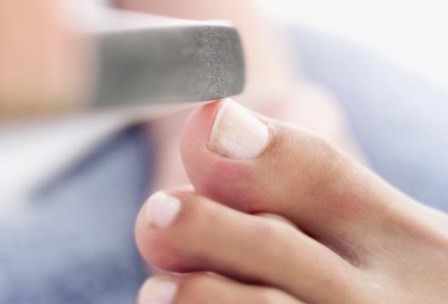
Step 2: Give it a trim. Use a nail cutter or a clipper and cut your nails straight across. To get a soft square shape, file your nails in one direction with an emory board (see pic below). Don’t clip the sides of nails, as this leads to ingrown toenails.

Step 3: Get soaked. Fill a large bowl with warm water and put in some of your favourite bath salts and aromatherapy oils. Soak your feet for a minimum of 10 minutes. The more cracked and calloused your feet, the longer you will need to soak them. If you want to get rid of dead skin, add a cup of milk to the mixture as milk is known to loosen dead skin.

Step 4: Cuticle care. After soaking your feet, your cuticles will be nice and soft. Then, using an orange stick, gently push back the cuticle. If necessary, use a cuticle remover lotion to help push back your cuticles. If you have excess skin on the sides of your nails that needs trimming, you can trim it with a cuticle trimmer.

Step 5: Scrub-a-dub. Next, give yourself a refreshing foot scrub to help remove dead skin and calluses from your feet. If you have access to beach sand, you can rub it into your skin as it makes a wonderful scrub. Alternatively, you can also use a body scrub or a homemade scrub made from sugar and olive oil.

Step 6: The mask. Instead of spending money on buying a foot mask, you can make one at home for half the cost. All you need is a tablespoon of fresh cream, 1 tablespoon of olive oil and a tablespoon of honey. Mix all these ingredients together and massage them into your feet. You can then wrap your feet in saran wrap or plastic bags. Leave this on for 20 minutes and then wash it off with warm water and a mild soap.

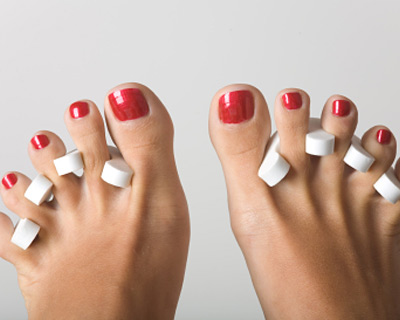
Step 7: A splash of colour. Use a cotton ball to remove any excess oils that may remain from your foot mask . Nail polish does not adhere well to oily nails. Use cotton balls to separate toes when painting your nails. First, apply a base coat. After it has dried, apply a coat of nail polish. Wait until this dries before applying the final coat. If you decide not to apply colour, simply apply another base coat and you are good to go.

Use these tips and tricks to give yourself a pedicure at home and you can save money and have gorgeous-looking feet all summer.

Beverley Lewis writes for beauty magazines and has amazing tips to share. Do you have a nail issue that needs sorting out? Write to Beverley in the comments section below.

(Pictures courtesy www.zenredsalonbangkok.com, perksandstyle.wordpress.com, www.webmd.com) 

Categories
Learn

“In Mumbai Region, 40% of us are living in ‘Campa Cola'”

Ramesh Prabhu, Chairman of the Maharashtra Societies Welfare Association, writes to the Maharashtra Government on the Campa Cola building society demolition issue.

“As Mumbai awaits with bated breath for some kind of miraculous intervention to save the 94 families of Campa Cola Compound from being dis-housed, these middle-class families are like the administration’s scapegoats. They represent all of us. As they wait for the raised axe to fall on their necks, my heart goes out to them with sympathy, and I am filled with worry with what will befall the rest of us. I am not competent to comment on the legality or the judicial wisdom of this decision; surely, the Supreme Court knows best. But I would like to ask some questions to no one in particular.

Why only Campa Cola Compound? What about the rest of Mumbai, where over 40 per cent of occupied residential buildings don’t have BMC’s mandatory Occupation Certificates? It is reckoned that at least  6,000 buildings are paying double for municipal water, which means they are not authorised. Many unauthorised structures are routinely regularised on payment of penalties… but there are many more that are not yet regularised for various reasons. Will this axe fall on them also?

And why only Mumbai? What about Thane, Mumbra, Ulhasnagar etc. where thousands of unauthorised (and often unsafe) structures are standing — a disaster waiting to happen?

In all these places, builders have have sold the flats, made off with the life savings of crores of families, worth several thousand crore rupees. Dozens of MPs, MLAs and Corporators from all political parties are routinely the accomplices of these builders, as are the bureaucrats.

As it happened with the three builders of the seven buildings of Campa Cola Compound, developers perpetrate the crime and usually go scot-free. Thousands of architects and contractors who mastermind such unauthorised buildings will also never be caught.

The municipal officials, State Government bureaucrats and police officials who turned a blind eye to the goings on are unlikely to be punished.

Needless to say, no one may point a finger at the judiciary, which willy-nilly allowed cases to drag on for decades and created a perfect window of opportunity for all the illegalities to build up.

When the time comes to for buildings to be demolished, it will be you and me — the common man — who will be running helplessly from pillar to post like the residents of Campa Cola Compound are doing today.

I have no easy solutions to offer. Major surgery is required in the entire MMR region, and that will not be a bloodless and painless process.

But may I humbly urge the State Government and Legislature to frame a humane policy to deal with unsafe buildings first, before demolishing sound structures like the Campa Cola buildings? May I humbly urge Maharashtra Government to avoid shirking its responsibility, and letting municipalities take their own decisions?

If a comprehensive and humane “demolition policy” is not framed, a humanitarian crisis looms large before at least 40 per cent of us in the years to come. Until such a policy is framed, I cannot help feeling that we all are Campa Cola building residents, waiting for our houses to be demolished for one reason or another.

Yours sincerely,
Ramesh Prabhu
Chairman
Maharashtra Societies Welfare Association

The Supreme Court today stayed the demolition notice and gave the affected building residents five months to vacate the premises. The threat of demolition still looms, however.

(Pictures courtesy chandivali.com, mid-day.com)

Categories
Trends

Your office could be checking you out

Companies have started verifying employees’ credentials in the wake of several crimes –  existing employees are included in the checks.
by The Editors | editor@themetrognome.in

The recent spurt of crimes, both economic offenses or otherwise, is spurring several companies to quietly check out the antecedents of those in their employment. And it’s not just the ones that companies are hoping to employ that are being given the once-over, a lot of companies are conducting background checks on those working for them already.

Details such as education, residence and personal information are being cross-verified to see if employees have given wrong data on any of these counts. Any misinformation is a potential red flag – companies then probe if the person has a past criminal record.

Employee verification is a routine practice among corporations in the West. Our country has only recently woken up to the threat that a ‘wrong’ employee can pose to the company, in the wake of several crimes being committed by supposedly ‘suitable’ individuals.

A recent survey by the Associated Chamber of Commerce (ASSOCHAM) found that nearly 52 per cent corporates in Mumbai, Delhi-NCR, Kolkata, Chennai, Bangalore, Ahmedabad, Pune, Dehradun and Hyderabad have been verifying their current and prospective employees at all levels. The verification was conducted by the Human Resource departments of small, medium and large businesses, the survey found. “Companies are fast realising the benefit of doing background checks of prospective employees or risk hurting their brand image in a fraud case. Screening of job candidates at all levels, and even vendors and contract staff is preferred. Previous employment details, academic and professional certificates, identity, criminal records, and credit risk, among other information, are checked thoroughly for authenticity and veracity,” the survey says.

Corporates are certainly becoming more careful and cautious when they are recruiting for the junior, middle and senior level positions, highlights the ASSOCHAM survey. “Many companies hadn’t done any background checks before hiring an employee, mainly at junior levels. The horrendous rape case in Delhi has certainly led to the need for carrying out a comprehensive scrutiny of employees at all levels.”

The survey majorly focused on broad sectors such as BPO, IT/ITes sector, financial and other services, construction, real estate, hospitality, tourism, FMCG and infrastructure, media and advertising, manufacturing and textiles, logistics, transport operators etc. Those companies that cannot conduct checks on their own are outsourcing the work – nearly 25 per cent of the companies surveyed had outsourced the verification work to specialised third party agencies. Under the most intense scanner were jobs that entailed working with children, or in healthcare.

(Picture courtesy www.eharmony.co.uk)

Categories
Tech

Review: BlackBerry Z10

Our tech reviewer tests the new and interesting BlackBerry Z10, and explains some of the fuss behind Blackberry’s newest offering.
by Manik Kakra

BlackBerry has been in a lot of trouble for the last two years or so. Their loyal customers have shifted to iOS and Android, and their financial statement doesn’t look impressive, either.
In an effort to overhaul its whole mobile business, BlackBerry has come up with its new operating system, built again from the ground up, BlackBerry Z10. BlackBerry Z10 is the veritable messiah to take this OS into the market. We take a look at this device and the new OS, and how it differs from the existing players in the market.

What it looks like: The BlackBerry Z10 sports a 4.2-inch (1280×768) screen, and has a rubberised back. The phone feels like a premium piece as soon as you hold it, and fits in your hand very nicely. There are no cheap materials or colours on its body.

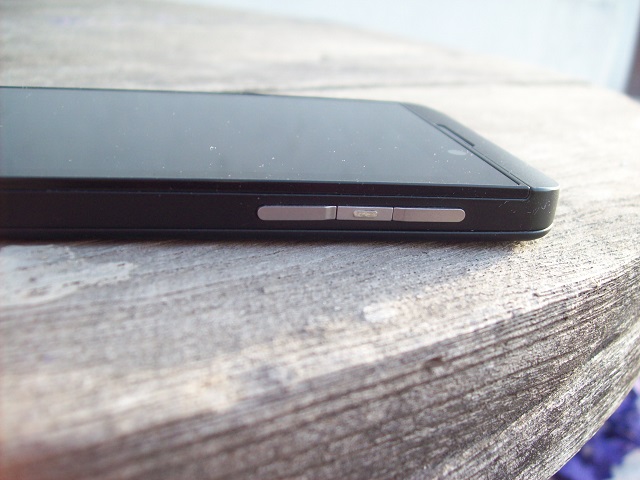
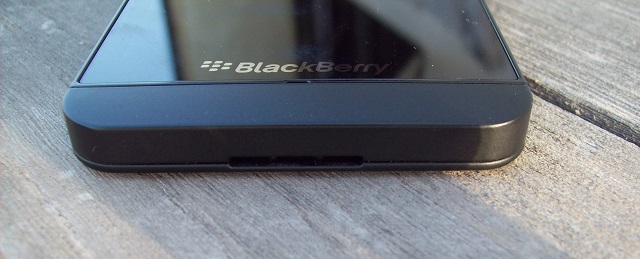
On the right, there are volume rockers and a voice control button in between (see pic on left); the left side has an HDMI port and microUSB port. The front is dominated by that screen. On top of the screen, there’s a 2 MP front-facing camera, LED light and speaker + sensor. On the bottom of the screen, you get a bold BlackBerry branding and primary mic. On the back, there is an 8 MP camera with an LED flash, and BB logo in the middle. On the phone’s top, there is a 3.5 mm headset jack, Power/ Lock key, and secondary mic. The bottom side has just a loudspeaker.

There are no physical buttons on the front, making it a full-touch device like the Nokia N9.

Screen test: The phone’s screen is quite bright and colours look very vibrant on it. There is not much chance you would see any pixels, and usually videos look impressive on it. The buttons on the side are also of high quality – you get a good feedback on pressing them. BlackBerry has done well in the construction of the phone as there are no rough edges. The call quality and network reception on the device we tested were top notch.

Camera quality: The 8 MP camera isn’t something extraordinary. It performs well in daylight conditions but the images aren’t the best from among the high-end smartphones out there. Although the lowlight images were really bad, most of the images in natural light should satisfy an average smartphone user. The focus works quite well, too. You can either tap on the screen to take a picture, or press the volume up button.

The camera UI is quite interesting. BlackBerry has overhauled it and made it quite convenient for the user to change settings within camera like TimeShift (burst mode), and frames.
Hear this: The audio quality on the phone through loudspeakers was disappointing. You get distorted sound even when playing on 70 per cent volume, and the loudspeakers, at the bottom, may get muffled while using the phone. Having said that, the in-ear sound was noticeably better. It was loud, clear, and the basic earphones, though no match for dedicated audio earphones, seem good.

Battery life: Battery life on the phone was average. I was able to get 16 hours on a single charge with regular usage.

Software brouhaha: Let’s now talk about the software – BlackBerry Z10. The software is nothing what we have seen from the company earlier. The BB10 OS is based on full-touch interface. The outlay is quite interesting. As soon as you switch on the phone, you get to see the Menu (or App tray). By swiping left from the first menu screen, you go to Hub, and swiping right takes you to other Menu screens.

Hub, as the name suggests, is one-stop umbrella for all your messages – Email, Twitter mentions, BBM, and SMS. You get all of them neatly placed in the Hub. Whenever there’s a new message, the LED notification light starts blinking, just like in the older BB devices. When you go into an app from the Menu, you have to swipe up from the bottom of the screen (ahem, webOS) to come out of the screen, and you will get to see multitasking view, showing you all the opened apps. All these preview panes have a small close ‘X’ button in order to close as well as remove the app from the multitasking page.

At the end of it all: The phone performs really well, and the UI is very fluid and quite intuitive to use. With its 1.5 GHz dual-core S4 Pro processor, and 2 GB of RAM, the phone almost never lagged and performed smoothly. The app switching works brilliantly and there were no app crashes.

Talking of apps, the BB AppWorld is seriously a downside to the OS. Though there are nearly 1 lakh apps available, there are too less good quality, important apps. BlackBerry has tried to give several native apps – Twitter, Facebook, FourSquare, Dropbox – but most seem half-baked. Take Twitter for instance; there’s no way to change font size, you cannot remain on your timeline position, and so on.

Email, which has been a strong point for BlackBerry, remains a solid point. The Email experience is one of the best you could get. That, along with the keyboard, are the best things about this OS. The keyboard is quite different from what we have seen on touchscreens, but once you start using it, you realise how nicely it works and how the prediction gets better. The Web browser is also very nice, and loads pages without showing too many weak links.
The OS doesn’t bring something new to the table for users which iOS or Android don’t already have. Yes, the gesture-based UI is good, but it could mean a new user has to learn how to use his new BlackBerry phone.

It is clear that BlackBerry has made a serious effort in the past one year. The BB Z10 is a really nice phone, but it may well be a little too less for users who are already used to iOS, Android, or Windows Phones. Having said that, if BlackBerry keeps providing updates and brings the Q10 to the market quickly, it could mean better time for BlackBerry in the Indian market.

Categories
Wellness

Exercises for the summer

An expert creates the ideal exercise plan for the summer. Crunches, dips, planks and squats feature on the to-do list.
by Ritesh Shaiwal, fitness manager, Fitness First India

Just as it is important to eat a balanced and largely cooling diet for the summer, it is also vital to exercise despite the heat. In fact, exercising in the summer is a great way to combat the many ups and downs that the weather causes in the system.

Additionally, we prefer to wear light clothing, and bring out the skirts, shorts, tank tops and sleeveless blouses in this season. If you want to show off your body to the best advantage and keep fit while doing so, I recommend these simple exercises:

Early morning outdoor jogs: Jogging is the best way to start your day in the summer, as it is relatively cooler in the morning. It is also a good way to keep fit across all ages.

Oblique crunches: If you haven’t already tried these, ask your trainer show you how to do oblique crunches. They are the best exercise if you want a tight mid-section. Do these if you want tight abs.

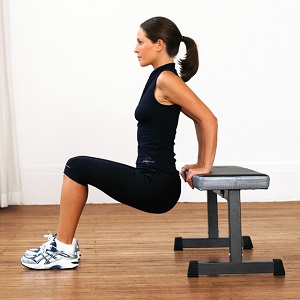
Tricep dips: Tricep dips (in pic on left) are your best bet against jiggly arms. Want to wear sleeveless blouses or tank tops? Do at least one sets of tricep dips to begin with, then gradually increase if you are able to manage more.

Pushups: Pushups are a popular warm up. It is simple yet continues to be a staple for strength training. It is excellent exercise for the arms and shoulders.

Squats: It is a strength training exercise which strengthens the lower body. However, you must get the form right while doing it. A tip to see if you’re doing it right: when you squat, your buttocks should push out (as if you are about to sit on a chair) and your knees must not go beyond the line of your toes.

Burpees: Burpee is an ultimate full body strength exercise. It is also called the squat thrust exercise. It is famous for its conditioning benefits when performed in quick succession. Do ask your trainer to show you how it’s done.

Side planks: Side plank is a form of strength exercise in a static form. It helps in strengthening the abdominals, back and shoulders.                                       

Superman raises in plank position: The same as the side plank, but with the arm outstretched and touching the toe. (See picture on right for reference.)

Walking lunges: It is a lower body exercise which helps in strengthening the lower body muscles. However, attempt static lunges before you try these. Once you get the form right, you can move on to walking lunges.

(Pictures courtesy Fitness First India, www.mensfitness.co.uk, supermamafitness.com, fitbie.msn.com)

Exit mobile version