Categories
Overdose

You are a terrorist

Terrorism doesn’t start with the picking up of a gun. It begins with mentally slotting people on various small fronts.
by Jatin Sharma

It might shock you to hear this, but it’s true. You are a terrorist. You have been contributing to terrorism in one or more ways knowingly or unknowingly.

It seems to me I am meeting a lot of terrorists these days.

What really is terrorism? It is an act of creating terror and feeding people’s mind with fear.

And you are contributing to it in many ways. The first step of supporting terrorism is when we, as individuals, try deciphering a person’s origin the moment we get to know his last name. It is the favourite pastime of an average Indian.

“Oh, your name is Mark Wesley. You are a Catholic?” you might say.

“No, I am a Protestant,” he may answer.

The moment we hear a person’s name, we get all excited. Like a person is a puzzle presented to us, and that must be solved. And as if we are not foolish enough to divide people in terms of Muslims, Sindhis, Sikhs and Parsis, we go a step further and say East Indian, Goan, Dalit and what not.

Let alone this sport of naming and categorising everyone in sight, we even throw out silly taunts when we celebrate festivals or watch matches. Have you ever gone up to a Muslim friend and asked him if he is supporting Pakistan when the cricket match is on?

Aren’t we helping terrorists – the bomb-weilding kind – become more powerful, for these kinds of statements make it easier to brainwash people later?

We are basically supporting terrorism as long as we keep dividing our people. We get amazed and make it a big story when a Muslim hosts a Ganesh at his place during the Ganpati festival. If you are a mediaperson who prints such stories to show that India is a land of ‘Unity in diversity’, you are a terrorist. Why does it shock you if someone wants to believe in a God without calling that God Allah or Ganpati?

The irony of the matter is that God has become a divisive name in today’s world. Even if you think you are the most reluctant fundamentalist, think again. If you have ever gone out to show the world that your celebration of a particular festival is better than any other religion’s celebration, then you have reiterated the divisive mindset.

If you still disagree, listen to this. The moment you go, “Patil is Marathi, Shah is Gujarati, Kapoor is Punjabi, Motwani is Sindhi, Batliwala is Parsi, Sheikh is Muslim, D’Souza is Catholic,” you are supporting terrorism, for you are segregating people in your mind. You are giving them an association that might not actually be true. Your mind is that of a terrorist, that automatically relates one person to be a part of a larger group, and you believe that group to be representative of a certain kind of behaviour.

More examples of daily terrorism? Sitting at a table and acccusing someone of being a miser as he is a Marwari, or calling a loud mouth at work a Bengali, or a show-off neighbour, a Punjabi.

When was the last time a person’s name was just a name to you? Or the last time you came across an unusual last name and didn’t waste your and his time asking which part of the country that person belonged to?

Jatin Sharma is a media professional who doesn’t want to grow up, because if he grows up, he will be like everybody else.

(Pictures courtesy o.canada.com, indiadeific.blogspot.com)
Categories
Enough said

Saluting a mother on Mother’s Day

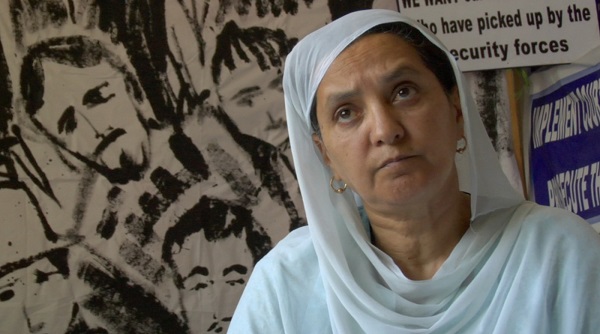
Parveena Ahangar’s son was picked up for ‘questioning’ by Kashmir police in 1990. She’s still waiting for him to return.
by Humra Quraishi

In between several scams being unearthed in this country daily, the more unfortunate among us have already geared up for Mother’s Day. Oh yes, it’s a big day to tell your mother how you feel! No matter how contrived this entire exercise might sound, there are several givers and takers for this day.

This Day brings to mind several unsettling questions. Where are those chiddren who are missing from their homes? Where are our young boys, who were picked up various security agencies for ‘interrogation’, never to return? What is the fate that befell their mothers? What kind of days do these mothers lead?

During my journalistic journeys to various parts of the country, I have met families who have had horrifying stories to recount of how their young children went missing, or were picked up for interrogation and either detained, or who have had time behind bars choke the life out of their fragile forms. There are children missing for these reasons in every part of this land, but the Government still does not seem to care enough to find them.

This is an ongoing reality in the Kashmir Valley – of teenaged boys being picked up for interrogation by various security agencies, never to return. They are declared missing, and their story seemingly ends there.

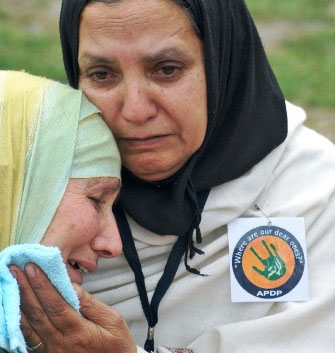
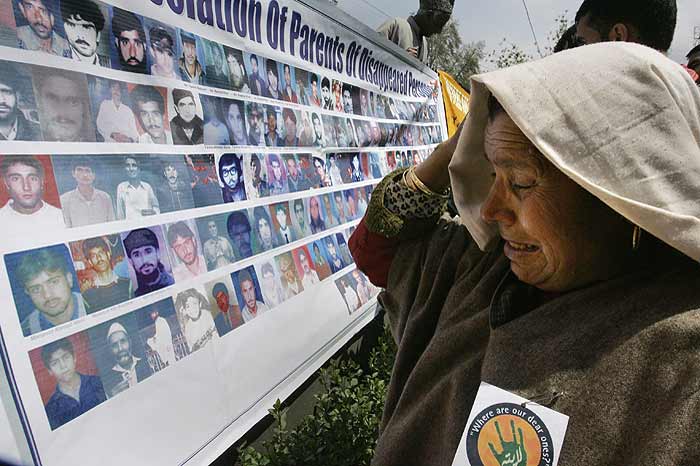
When I first met Parveena Ahangar (see pic on left and feature image), the Srinagar-based woman who heads APDP (Association of Parents of Disappeared Persons), she told me about her young ‘missing’ son, Javed. Listening to her, I felt emotionally drained, wondering at the extent of the brutality of today’s governance, where the State does not even stop at snatching away our young. It has been an ongoing fight since 1990 for this now middle-aged Kashmiri mother; it was in 1990 that her school-going son was picked up from their home in Srinagar’s Batmaloo locality and taken away for interrogation. Javed never returned and there has been no official news of his whereabouts at all.

“My son, Javed, was picked by security agencies in 1990. Security men came to our home to pick him up, saying they were taking him for interrogation. We pleaded with them, saying he couldn’t have done anything wrong, that he had just passed his matriculation. But they didn’t listen and took him to the interrogation centre at Pari Mahal. We never saw him again,” Parveena recounts.

That incident shattered the life of the entire family. Ahangar’s husband fell ill because of the trauma, and gave up working. He remains in poor health to this day. The other three children in the family were too young to realise the implications of their brother’s disappearance at that point, but the ongoing trauma has left its impact on them, too.

Today, Parveena heads the APDP, the longest ongoing non-violent movement of parents whose children have been taken for interrogation and never come home. Hundreds of families have been ruined by their loss as they try to cope with the trauma, but Ahangar is one of the steely few who will not give up the search. She says, “All these years we have been living in sorrow. I keep very unwell. We have exhausted all our resources trying to locate Javed in the various jails of this country, appealed to every possible government authority, to politicians across party lines…but there have only been disappointments.

I’m not giving up, and I will fight for as long as I’m alive. Ours is a peaceful, non- violent struggle, but the State and these politicians don’t bother. I am determined to carry on with the struggle.”

But not many mothers have her grit. Many have already given up hope. Their words echo in my ears: “To bury your dead son is one thing, but to go travelling from jail to jail and from police station to police station, looking for your son, is another sorrow.”

Meenakshi Ganguly, South Asia Director at Human Rights Watch, who has authored Everyone Lives in Fear, a report on the human rights situation in Jammu and Kashmir, said to me in  an earlier interview on the missing young men of the Kashmir Valley, “The family members of those that ‘disappeared’ have been campaigning for years. Parents have died waiting for a lost son to come home. Wives live with the label of a half-widow. These disappearances are a lasting wound inKashmir, and we hope that families will finally have some answers and receive justice.

“Disappearances are among the most heinous of human rights violations because families are left without answers, caught between hope and despair. I have met numerous families that are still waiting for news of their loved ones. Some keep hoping for a magical reunion. Others say that they want at least to be able to weep at the grave of their lost one.”

Noted academic Uma Chakravarti, who formed a support group for APDP in Delhi, had told me during an earlier interview, “We need a judicial commission to probe J&K disappearances. No one wants to address the Armed Forces Special Powers Act and the immunity it gives to the security forces, and that rapes, custodial killings and forced disappearances that will continue unless there is legal redress for violations of people’s rights. The easiest thing seems to be to not react or to pick up an item for a little while and then drop it.  The Government keeps talking about dialogue and confidence-building measures but has done little in terms of action.

The first thing it should do is to set up an independent judicial commission into disappearances so that the average Kashmiri and the individual families that have been pursuing the cases of the disappeared can have a sense of closure. This has been done in Sri Lanka to investigate the large number of disappearances in the 1980s. It will be the first step in pursuing State accountability. It will have a tremendous impact in Kashmir. It will demonstrate the Government’s commitment to a rule of law.”

(Pictures courtesy inshallahkashmir.com, githahariharan.com, freepresskashmir.com)

Categories
Guest writer

Loving Mumbai in Chennai

A true-blue Mumbaikar was faced with hostility in Chennai – thus making him prouder of the city of his birth.
by Aditya Kshirsagar

Never did I realise the pride of being a Maharashtrian until I came to Madras aka Chennai. I grew up in Bombay (now Mumbai). I always shared a love and hate relationship with the city of my birth, but even a month away from it is torturous. There are many things that I hate about Mumbai, but what I truly love is the respect that we have for all cultures. I might claim to be a Maharashtrian (a native speaker of Marathi) but like so many others, even my kin migrated here.

Growing up in Mumbai, you are invariably (even if you live under a rock) exposed to so many languages, and by default, end up being bilingual (at least). Personally, I am very terrible at learning languages. Even with that handicap, I speak Hindi, Marathi, English and can manage Gujarati, Bhojpuri and Bengali. South Indian languages are managed with the odd English words. Let me clarify something here, my maternal family is a mix of Southerners. My aaji (grandmother) tried in vain to teach me Kannada. All I learnt was ila (no).

In Mumbai, we speak a specific dialect of Hindi which is called Bambaiya Hindi. The requirements of this language are  simple. Everything we say starts and ends with bhen***d or saala or kya baat kar raha hai bey. This is the language that the city speaks.  What I miss the most here in Chennai is the fact that you cannot start speaking in English, jump to Hindi, start speaking in your mother tongue, revert back in another language, and yet find the entire process fluid. The conversation is never abrupt, but a flow, and we won’t realise it until someone deliberately points it out.

I moved to Chennai on August 4, 2012. Two weeks here and I knew this was to be my Kala Pani. Language is a major hindrance. There is a definite hatred towards Hindi. Over here, for the first time, I was referred to as North Indian. I’ve no issues called that but the arrogance with which I encountered these words was hurtful. I related to every bhaiyya in Mumbai. Being part of the minority is not fun. Wanting my voice to be heard, I introduced everyone who was willing to listen to the existence of the West Coast of India and the Deccan Plateau.

After moving here, I’ve started avoiding talking in Hindi due to the constant fear of being ostracised if you speak that language. I restrict my conversations to English or in broken Tamil or in the worst case scenario, to sighs and grunts. I’ve received scathing looks when I’d initially, like a naive Indian, enquired if they knew Hindi.

Let me clarify, I’ve made some excellent friends in Chennai. Thankfully, they have understood my plight and they converse around me in a neutral language. Moreover, they have made an effort to speak Hindi while I try to cope with Tamil.

This aforementioned breed, though, is very rare here. Others that I’ve met during my stay here are quite anal about their love and pride of the Tamil language. That is the most absurd sentence that they utter and do so on a pretty regular basis. Taking pride or loving your language does not mean that you choose only that language as your mode of communication. There have been several times in the University of Madras and in my department that my esteemed classmates only wish to talk in Tamil citing comfort issues and the fact that they studied in that language. Guest lecturers would also conduct classes in Tamil. It was quite irritating at first, but now I tend to block the language out or avoid the lectures altogether.

I don’t even dislike Tamil as a language. I try to learn the language because, as a journalist, it is important for me to be able to connect to locals. I might not completely succeed but I will try. Because that is what Mumbai has taught me, try to accommodate.

In my mind, it seems to be that Tamilians are just plain paranoid about their language and its status. Yes, I have read the history of Dravidian movements and the language issue. But, that does not mean that they need to alienate themselves. As I have observed here, most of the youth who are pursuing higher studies can barely clobber together a proper sentence in English. I just hope that this does not show on their employability. I can go on about all of this but it is  just paltya ghadya var paani (water over a turtled utensil).

I am revisiting my language, its culture and the people. Oh, the people. I’ve plenty of friends in Mumbai. There are Tamilians, Mallus, Muslim, Bihari, Bhaiyya (UPite), Christians, Sardars, Punjabi, Gujarati, Marwadi, Jain, Parsi, egad, you name any region and I ought to know someone. And nearly all of them either understand or talk or are fluent in Marathi. I don’t think anyone coerced them into learning the language nor is the Thackeray family that influential in Mumbai.

But, this stubborn behavior as displayed in Chennai made me realise one thing: ‘I need to do more for the Marathi language and help it flourish.’ That does not mean I will become a bigot who keeps shouting, ‘Son of Soil.’ But, I will genuinely try to help this beautiful language and its people in an entity that stands out.

Aditya Kshirsagar is in Chennai for a media course.

(Picture courtesy www.internations.org)

Categories
Beauty

Six home remedies for puffy eyes

Wake up looking like you spent the night in a pub? Take our six-step home cure to treat your peepers.
by Beverley Lewis

Swollen eyes can not only alter your looks, but also cause others to misinterpret your lifestyle. A little insight, however, can help determine the cause for marshmallow eyes, and the six home remedies outlined here, can make them very simple to treat.

Bag ’em: Teabags can help soothe puffy and irritated eyes as they not only contain powerful antioxidants, but they also contain anti-irritant properties. To get rid of the puffiness, place moist tea bags over your eyes.

For this, first soak the teabags in hot water for a few minutes and then take them out. Allow them to cool down to a warm temperature. Then, lie down on your couch or bed and place the tea bags over your eyelids (as shown in cover pic) and cover them with a soft cloth. Leave on for about 20 minutes, after which you will notice that the swelling around the eyes has reduced a bit. Do this every day and watch the puffiness disappear.

Grab some H2O: The easiest way to get rid of puffy eyes is to drink enough water. Try and drink at least eight to ten glasses of water each day. When the body is well hydrated, there is less chance of water retention, which can cause your eyelids and other parts of your body to swell. Water will also help flush out toxins from the body. Along with increasing your intake of water, also try and reduce the amount of salt you eat and avoid sodas and coffee, as they cause dehydration. Coconut water is also a great for curing puffy eyes, as it keeps the body well hydrated and flushes out the kidneys.

Be cool: Chilled cucumber slices are perfect for treating puffy eyes. The enzymes and the astringent properties present in cucumber help reduce inflammation. Chill slices of cucumber in the refrigerator for about 10 minutes. Then, place the cold cucumber slices on closed eyes for around 10 minutes or until the cucumber becomes warm. Repeat the process several times a day. This remedy will also help you get rid of wrinkles around your eyes.

Mrs Potato head: Grate a mid-sized potato and place it in a clean cheesecloth and tie it up. Now place this makeshift eye pack on your eyelids and leave it on for 15 minutes. Do this several times a week and you will notice a marked difference.

Get egged: Egg whites have got skin-tightening properties that can help reduce puffiness. They are also good for preventing wrinkles. Place two egg whites in a bowl and whip them until they get nice and stiff. Next, add a few drops of witch hazel to the mixture. Witch hazel is not only good for reducing puffiness, but it also acts as a natural skin-tightening astringent.

With the help of a brush – or you could use your fingertips – gently massage this mixture under the eyes and allow it to dry before washing it out. This remedy will not only tighten the skin around the eyes, but it will also make them look less puffy.

Spooning works: Take five to six metal spoons and place them in your refrigerator for 10 minutes. Next, take out a cold spoon and hold the rounded portion against your eye for a few minutes until the spoon becomes warm. Then, quickly replace it with another cold spoon from the refrigerator.

Keep repeating this procedure until you go through all the spoons in the refrigerator. This will not only help to tighten the skin around your eyes, but will also help relax the blood vessels in the eyes and decrease puffiness.

Beverley Lewis has written for beauty magazines and has amazing tips to share. If she’s missed a tip you’ve tried for puffy eyes, tell her about it in the comments section below.

(Pictures courtesy hudabeauty.com, www.healthyskinsolutions.com)

Categories
Eat

Diet ki dukaan

Why do we complicate our diet by bringing in dieticians? What’s wrong with home-cooked Indian food for our dietary needs?
by Anurita Gupta

Yeh chaar goli, teen teen ghante mein ek baar.” Remember this typical setup of a doctor’s clinic, with a compounder in the next room putting together a pink concoction for cough syrup and some tabs in a small white paper ki pudiya? These days, new-age diet consultants and nutritionists have replaced these doctors, with their ideas of eating small meals every two hours to lose weight.

My visit to a high profile diet consultant,who is not even a doctor in terms of having a degree, was like a flashback to such a doctor’s dawakhana. Just the way the doctor would pretty much hand over the same meds for everything from viral to tummy complaints, this nutritionist had her lines rehearsed: “The key is to eat, but not all at one go!” This instruction was not even given in person. A bunch of us were hustled to a tiny room with a TV by a rude receptionist, and made to watch a video presentation by this nutri-queen telling us about how eating healthy (read: wheat grass juice) would make all the difference.

It didn’t occur to me then, but in the name of personalised advice, this one was doling out tips wholesale.

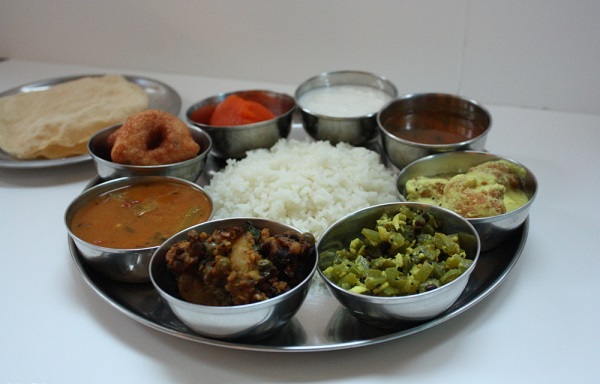
Dr Loveleena Nadir, renowned gynecologist and nutrition advisor with the Fortis chain of hospitals, says, “It’s quite simple, and yet people are not willing to accept that being fit can be as easy as eating regular home-made meals that are freshly prepared. They will try and figure various formulae, instead of having a typical Indian meal that is automatically filled with protein in the form of dal, complex carbohydrates in multigrain rotis and rice, and iron and other minerals and vitamins that are found in fresh and green leafy vegetables.”

The home connection
Cut to the 90’s when I was in my early teens and would find a trip to the sabzi mandi a great outing with my badi mamma. She was in her 60s then but more fit than many 30-year-olds. Her mantra? Khao sabb kuchh per kaddo vee (you must eat everything but burn it)! We would both walk more than two kilometres each way and carry back huge bags of sabzi and fruit.

Badi mamma would sweat but never be out of breath. Each of her chores required physical labour – no washing machines for her, and she would lug heavy buckets of hand-washed clothes to the roof to dry. The breakfasts she made were healthy – a grated apple, one bolied egg and two rotis with the sabzi of the day. She was her at her ideal weight of 56 kg with a height of 5ft 6in.

Work complicates matters
We have complicated our lives not just with work but with such little time to concentrate on our health that we pay money for someone to take us back to ‘ghar ka khana’. All our pre-packaged makhani dal and pulao for lunch and many dinner outings have made us ill. No wonder, then, that we are told to have healthy meals in small amounts, just like a medicine.

However the modern concept of ‘eating everything healthy’ in regular doses bears the hazard of completely unhealthy thoughts in our minds against a thali full of proper khana. With a dietician’s advice, we plan ahead and get ziplock bags of healthy, nutritious food. It doesn’t stop there. Many phone apps assist us in carefully calculating our calorie intake of the day.

Dr Nadir says, “It’s important in general to keep your salt intake balanced which, unfortunately, is our biggest problem, because all packaged and fast food is very high in sodium.”

So what’s healthy?

The humble dal chawal and bajre ka rotla were such favourites with gharelu aam ka achaar and mutthi maara pyaaz. I feel so deprived at times, because I don’t have the liberty of time to make or eat the food of my childhood.

Of course, our lives are different than before. Food is mostly a ‘comfort’ for us after a long battle with traffic and sometimes, a painful boss. So fatty, junk food becomes instant relief. With that, we drag our unhealthy selves not back to the kitchen to make a simple, healthy meal, but to knock on the doors of a ‘magic doctor’ who tells us to eat seven medium-sized rotis a day – something that our mothers told us ages ago, for free!

(Pictures courtesy www.myvistahealth.com, www.kidspot.com.au, www.spiceflair.com)

Categories
Event

Art Night Thursday is back

Visual Disobedience, a collective that makes art accessible to people, will let you hop along for an art gallery tour.
by Medha Kulkarni

It’s that time of the month again. Art Night Thursday is back, when some of Mumbai’s best art galleries throw open their doors (past closing time) to share,with art enthusiasts, works by some of the best/newest artists from India and abroad.

However, for most people, an art gallery tends to be an intimidating space. With artworks that spill out of the conventional art definitions and the general stream of heady chatter that seems only to be full of fancy words and concepts, most people tend to give art galleries a miss.

If you’re among those who really want to visit these galleries and have an interest in art but shy away due to lack of company, then the Visual Disobedience hop is for you.

Hop to it
Visual Disobedience is a collective formed by young,upcoming artists and other creative people who believe in breaking rules and essentially questioning the way society perceives art. The idea was born out of a simple desire to make art more accessible to the general public. Your guide for the hop will be Ramona D’Mello, who used to organise these gallery hops as part of Artinfo, but has now recently shifted to be a part of the Visual Disobedience.

“It’s all about making art accessible to everyone, irrespective of background, age or profession. We’re loosely-knit; there’s no upper limit on how many people can join us and no need to be absolutely punctual. If you can’t make it right from the start (of the hop), people can join us at different points during the art hop,” says Ramona.

The hop starts at Project 88 at 7.00 pm and winds its way from there through all the participating galleries. It’s free and open to all.

After a quick briefing, Ramona will take you through the different galleries. At every gallery, either the gallerist themselves or the curator give a short note about the works on display or the ongoing show.

“It might seem like an educational walk/talk, but it isn’t,” insists Ramona. “We usually have a lot of fun and make new friends this way.”

The hop happens today at 7.00 pm, and starts at Project 88, BMP Building, Ground Floor, Narayan A Sawant Road, Colaba, near Colaba Fire Brigade. Contact Ramona at 9892536558 or Kevin at 9769930240.

(Pictures courtesy Visual Disobedience) 

Exit mobile version