Categories
Bombay, bas

The Shahrukh Khan of Marine Drive

The city is home to several film ‘strugglers’ – while most simply fail, one became a star on the street.
by Nidhi Qazi

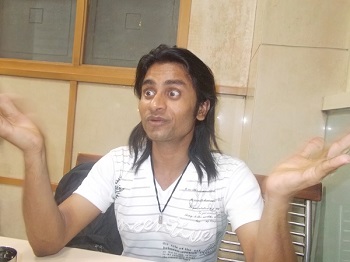
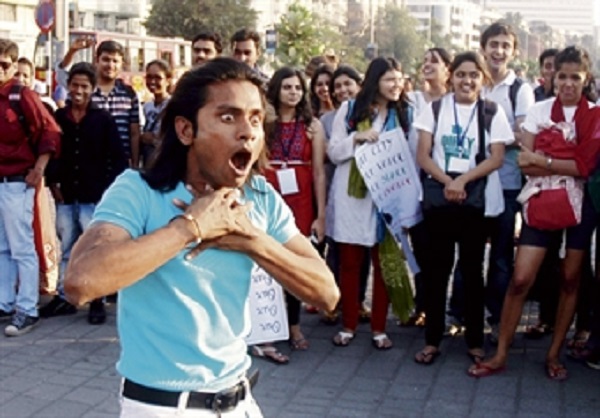
After a weekend well spent at the NCPA, spending time at Marine Drive seemed to be the obvious next choice. I couldn’t have gone there at a better time, for I saw a crowd of about 30 men huddled to watch someone perform. That someone was a man with long hair, lovingly called ‘Shahrukh’ by the crowd. He was enacting a Shahrukh Khan dialogue from the movie Mohabbatein, adding his bit of humour. “Woh mere ghar ke saamne se nikalti thi, thoda sharmati thi, lajaati thi. Kuch kehna tha usko magar keh nahi paati thi. Baad mein pata chala, woh gutka chabaati thi.” The audience applauded and whistled.

He started on another one from an Ajay Devgan movie – “Mujhe apno ne loota, gairon mein kahaan dum tha. Meri haddi vahaan tooti, jahan hospital band tha.” The crowd roared again.

Who is he? I wondered. Catching up with him later, I learnt that ‘Shahrukh’s’ real name was Gabbar Singh. Confused? Wait, let’s start this story from the beginning.

The star of Marine Drive

Gabbar Singh Chauhan (25) has been a star entertainer at Marine Drive for almost a decade now. The crowds simply love his acting of the famous movie scenes and stunts and dialogues with his touch of humour thrown in.

Gabbar Singh has been there, done that in Mumbai. Part of a dozen reality shows like India’s Got Talent and Entertainment Ke Liye Kuch Bhi Karega, he is a sought-after entertainer in family functions and a regular face at the endless auditions of the reality shows that have mushroomed in the electronic media. He carries a portfolio full of newspaper cuttings featuring him wherever he goes.

Watch a clip of Gabbar performing in Entertainment Ke Liye Kuch Bhi Karega:


He has long straight hair, inspired by Hrithik Roshan’s Krrish, a heart tattoo on the right arm and a petite frame, and comes across as another wannabe actor who is in this dream city for his big dream – Bollywood. But that is until you actually hear his story.

A têteàtête with Gabbar:

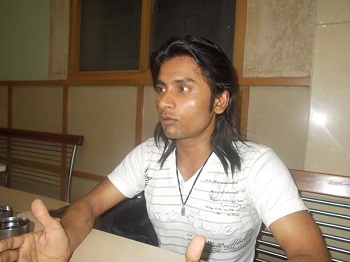
Gabbar Singh ChauhanI sat him down for tea at an eatery in Churchgate, and he proceeded to tell me his story. His conversation was liberally peppered with anecdotes illustrating how he is a people’s star. As if on cue, a waiter comes to the table and says, “Aap media se lagte ho. Yeh Gabbar Singh hain. Khayaal rakhiye inka. Yeh bahut achche actor hain. Maine inko Girgaon chowpatty mein dekha tha perform karte hue. Jamm ke likhiye inke baare mein (You must be from the media. This is Gabbar Singh. Take note of him, he’s a very good actor. I’d seen him perform at Girgaon chowpatty. Write a nice big piece on him.)”

The small display of his fan following aside, Gabbar proceeded with his story. An SSC passout, he is a resident of Mathura, UP and acting was not what he wanted to do. His parents named him Gabbar because he was “stubborn like Gabbar Singh”. He said, “I didn’t want to want to become an actor. Desh ki janta ne mujhe actor banaya hai (The people of the country made me an actor).” He added, “I saw a Shahrukh film on TV, then enacted the scene in front of a mirror and thought I was a very good actor.”

Mathura gave him a platform to perform at local events and his fan following increased. People started calling him ‘Mathura ka Shah Rukh’. Eventually, he got coverage in the local media and all this attention led him to come to Mumbai, only to get rejected.

“I came to Mumbai in 2002. People made fun of me when I asked them about Shahrukh’s and Amitabh Bachchan’s address. Nobody guided me. I didn’t know anyone in the film industry.” He then went back to Mathura. At that time, he was spotted by a director, and eventually got a role in Ravi Kissen starrer Dharam Shakti. Though the film did not release, it motivated Gabbar to chase his Bollywood dream and he came back in 2004.

Not a struggler

Speaking about his ‘public demand’, Gabbar says, “Aaj kal ke strugglers ki koi demand nahin hai. Main hoon asli zindagi ka hero. Public kehti ki aisa actor unhone zindagi mein pehli Gabbar Singh Chauhan baar dekha hai (No strugglers are in demand these days. I am a real-life actor. People say they have never seen an actor like me in their lives.”) But the passion with which he says this doesn’t really come across as boastful.
He then shows me a few mobile clippings featuring him. I see the judges laughing at him and point it out to him, but he says, “Judges hans rahein hain kyunki woh mujhe pasand karte hain, mujhe talented maante hain. Farah Khan ne toh mujhe apni film Happy New Year mein ek role bhi offer kiya hai (The judges are laughing because they like me, they think I’m talented. Farah Khan has even offered me a role in her film Happy New Year).”

In one clip, Anu Malik goes a few words further in his appreciation for Gabbar, “Gabbar Singh, tu filmi nahi hai; tu toh apne mein ek poori film hai (You are not just filmi, you are an entire film).” And he believes them all because, “Judges don’t lie.”

Gabbar’s source of income is the performances he gives at birthday parties, orchestras and the stage, and he makes about Rs.10,000 per month. As for Marine Drive, he performs on Thursdays, Saturdays and Sundays from 9 pm till about midnight.

Aiming for the stars
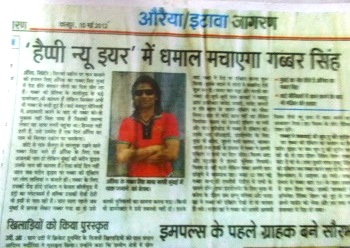
Gabbar in the newsAfter almost a decade of entertaining people by enacting famous scenes from films with his touch of humour, mimicking and performing several antics, what does he think he has achieved? “Name, popularity and respect,” he says. “Public ek star ko jitna pyaar deti hai, mujhe bhi utna deti hai. People ask me for autographs, photographs and wherever I go, people recognise me. Even media asks me for bytes on various incidents.”

Having “trained at Prithvi Theatre for three months”, Gabbar feels he doesn’t lack in talent but the only shortcoming is his improper Hindi and English diction. “Meri angrezi mein shehri touch nahi hai (My English is not very posh),” he rues.

With Bollywood as his “asli maksad”, doesn’t he feel his chances are reduced due to his non-filmy background? “Background doesn’t matter. Yes, the struggle is less but ultimately, public is the real judge. Take Sonu Sood, Shahrukh Khan, Mithun. None of them had a filmy background. Background ka achaar dalenge agar janta pasand nahi karegi!””

When fans follow
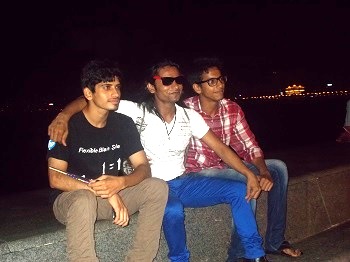
Gabbar Singh ChauhanAfter an hour of talking, we go back to Marine Drive, only to witness the much talked-about fan following. The first in line is a driver who calls out “Namaste, Shahrukhji.” Next, a couple of drivers say, “Kya haal Gabbar?” Two men on a motorbike at the signal shout across the road, “Hi, Gabbar!” Finally, at the stretch from Pizza by the Bay to the Air India building, chaiwallahas and local vendors greet Gabbar. There is a group of teenage boys who want to get a picture clicked with their Shahrukh.

We also chance upon the waiter who is done for the day and is relaxing by the seaside. He is Aditya, a huge fan of Gabbar. He says, “So many people like him, watch him. His acting style is fun but he should concentrate more on comedy.” He adds, “If big newspapers write about him, he would be instantly noticed by the industry bigwigs.”

Meanwhile, Gabbar Singh dials “Farah Khan’s number” only to find it “switched off”. And we call it a day.

(Pictures courtesy afternoondc.com and Nidhi Qazi) 

Categories
Event

Muslim mass rally on Friday

Leaders in city have called for a rally to pressurise Indian Government to petition UN on terror acts in Syria.
by The Editors | editor@themetrognome.in

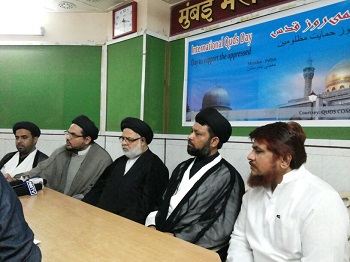
International al-Quds Day is an annual event on the last Friday of the holy month of Ramadan, expressing solidarity with the Palestinian people and the holy mosque Al-Aqsa, located in Jerusalem (Palestine). Today Muslim leaders in the city united under the banner of Quds Committee in order to condemn the terror acts taking place around the world, specifically in Iraq, Syria and Palestine. The speakers condemned the 17 serial blasts in Iraq which took place on Monday, and the ongoing terror activities happening since several years in Palestine and Syria. They said that Islam being a religion of peace, respects freedom for all countrymen and a secure life.

Press conference at Patrakar SanghA press conference to discuss the same was held today at Mumbai Marathi Patrakar Sangh, CST.

The leaders also condemned the Israeli and American activities in the land of Palestine, which has been colonised by the Israeli occupants for many years. Quoting Mahatma Gandhi, the leaders said, “Palestine belongs to the Arab, as France belongs to the French and Britain belongs to the British.” They asked the Government of India to send a petition to the UN and take some active steps in the international political scenario to make tge US stop funding and supporting the terror activities.

The committee has also decided to organise a mass rally on this Friday, August 2, from Khoja Masjid, Dongri, to get support from people and ask the Government to take strong steps soon.

The participating speakers were Maulana Hasnain Kararvi, Maulana Fayyaz Baqri, Sarfaraz Arzoo,  Maulana Husain Mehdi Husaini, Aliraza Namdar, Maulana Farman Sahab and Maulana Abulqasim.

(Picture courtesy www.latitudenews.com)

Categories
Become

Creating beauty from junk

Mumbai designer Arjun Rathi creates some beautiful products from scrap, and says that his quirky products are finding several buyers.
by Rachel Tseng

Walking through the numerous by-lanes of the crowded scrap markets in Mumbai can be very exhausting and cumbersome. But for someone like Arjun Rathi, it is a creativity inspired adventurous experience. A casual walk through Bharat Bazar in Mumbai 2011 was what introduced Arjun to the world of product designing using scrap and recycled products.

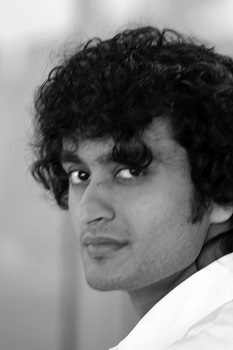
Arjun RathiArjun (26) is a professionally-trained architect and a product designer by passion. After graduating from Kamla Raheja College for Architecture, Mumbai in 2010, Arjun took up a summer course in Switzerland and worked with a Swiss firm specialising in industrial buildings. In India, Arjun has worked with Indiabulls Real Estate and has been a part of their Panvel Greens township project and their mall projects in Jodhpur and Kota.

We interviewed Arjun and this is what he had to share with us about his quirky passion and new-found profession.

What inspired you to design products out of scrap and recycled material?
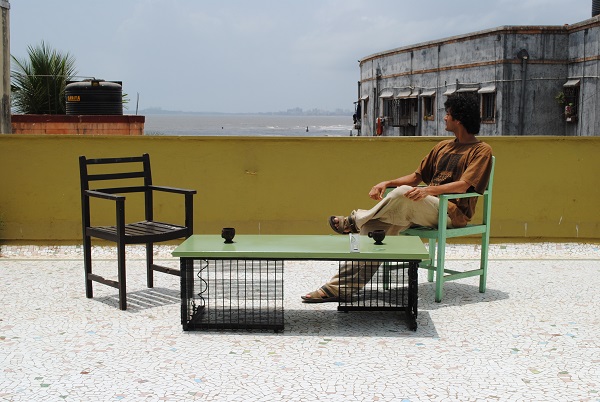
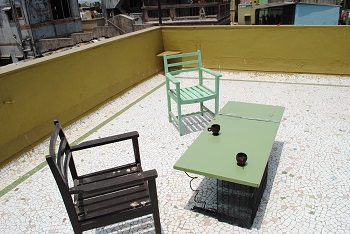
I was travelling around the scrap markets of Bharat Bazar in Mumbai and happened to stumble upon a retro Kelvinator refrigerator door. I immediately got an idea of converting it into a coffee table. Since then, re-using recycled materials for furniture design became a passion. The raw industrial look of recycled metal was very appealing to me.

Growing up as a child in the 1990’s, there are fond memories of a majority of the items we find in present day scrap yards. There is a lot of emotional connection to things like the Ambassador cars, retro fridges and the Walkman, as I have grown up with them. Re-using those items to give them functional purpose is great fun. Also, using scrap for functional design is a great way to recycle. Sustainable design doesn’t end with designing green buildings but zeroes down to micro-design of furniture as well.

How much money did you invest to begin work with?
I started experimenting with furniture and product design from my savings. More than the money, knowledge and good technical sense of what you’re doing is required. Furniture with recycled material is relatively cheap as your investment is in the core scrap product you want to design around. Negotiation is key at that point, if you’re purchasing them second hand or from scrap markets. The next step is either making the product yourself if you’re skilled enough, or getting it fabricated. Rates can vary from person to person.

How long did it take you to establish this business and make it functional?
As I lacked formal training in product design, I spent more than a year working hands-on with fabricators to understand the limitations of various materials like metals, plastics and glass. Knowing your material is key to designing a great product. It is also important to build multiple teams of different fabricators for orders of different scale and number. I am presently into my third year where I am professionally designing products, lighting and furniture.

Arjun Rathi Refrigerator TableWhat inspires you while developing/designing a product?
Usually by looking at the key recycled product you want to design around, one is able to give it a function. As a process it works in two simple ways – where you find an item and design something using it, or you look for specific items that fit your concept.

Most of the time when doing specific client work, it is important to understand the emotional and functional needs of the client before searching for the right materials or objects.

What is the approximate time frame to develop a product?
Designing a good product can sometimes take a lot of time. Working around a concept and finding the right recycled materials in the best condition is also a tedious task. Though once all the material is procured, we can generally assume two to five weeks for a project, depending on its size and complexity.

Apart from the Kelvinator fridge door converted to a coffee table (see featured image and pic on left), what are the other products that you have made using scrap or recycled material?

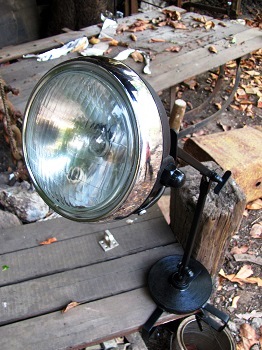
I have made desk lamps using Ambassador and Enfield motorcycle headlights. The natural casted form and raw industrial look of the headlights make for very interesting interior Arjun Rathi Enfield Lamp Product Design Desk Lampobjects, while the internal reflective surfaces of headlights are very functional for interior lighting.

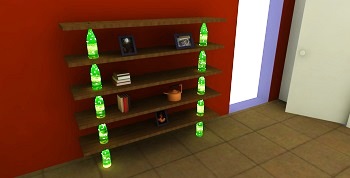
I have also designed a shelving system using champagne bottles as structural supports. Champagne bottles, unlike most wine bottles, are made of much thicker glass, hence can be used as structural supports for a shelf if executed properly.

Another light installation is presently under production using 24 Ambassador headlights and pipes to create a very industrial look for a private client’s space.

You make very unique and interesting products. Who do you consider as your competitors?
Design is a highly competitive and saturated field. The market is flooded with designer products targeted at all income groups. Most of the products I design are due to self-initiatives or constant urge to experiment with processes or materials. Most of the products are a result of my emotional response to them. I design products for myself and if someone wants to buy them, they are welcome to do so.

Is there a growing interest among people for decor of this kind?
The trend for customisation is rapidly picking up in India. The client is able to get a unique product designed for their space at a fairly lesser cost than purchasing an expensive branded design. Also the fact that their piece will never be replicated again. There has been a lot of interest for lighting products through recent clients. Luckily all clients I have dealt with are open to experimentation with design concepts and materials. They have a clear understanding of what they want as well. Most products require some appreciation space in the apartment; hence clients so far who have commissioned highly customised work have larger homes.

How do you pitch for clients?
Most products are designed due to my emotional connections with recycled scrap. I tend to design them for myself, then approach design stores and websites if they’re interested in selling them. Many clients also approach me directly for a specific piece to be customised for their space.

Where do you retail?
Some of my products are being retailed at the design store Chromakey, opposite the Warden Road Church and on the website www.homehero.in. You can also view my products on my blog and the studio can be directly contacted on email for product inquiries.

We also do a lot of niche design work for clients who need specific pieces or furniture or accessories. These are usually exclusive lighting design or furniture customised and designed specific to their space.

Arjun Rathi Champagne Bottle ShelvesWhat is the price range of your products?
Most of the products are limited edition or one-off pieces as the same fridge door/ headlight sample or recycled item cannot be procured at will. Every product is handmade by fabricators and a unique piece by itself. Also, there is minimal interest in the studio for mass production as it deviates from the larger scope of urban and architectural proposals.

Limited edition products generally start retailing from Rs. 14,000 upwards. All client-specific jobs depend on the design and scale of the project.

What has been the most satisfying part of your work?
The satisfaction after a successful execution of a concept is unparalleled. The process of exploring materials, design and meeting new people is great fun.

What message would you like to give people wanting to start a product line like yours?
Be open to learning. I’ve learned a lot hands-on through the process of trial and error. Some technical knowledge is essential or you might get taken for a ride by the fabricator. I remember when I was making the Refrigerator Coffee Table, I changed my fabricator twice because I was unhappy with their quality of work. It’s also good to know the general market rates for materials, as sound budgeting is important for any business.

(Pictures courtesy Arjun Rathi)

Categories
Cinema@100

When Partition broke up his life

Nida Fazli, Urdu poet and lyricist, speaks on why he made Bombay his home despite his family moving to Pakistan.
by Humra Quraishi

When I’m feeling utterly hopeless about life, I say these lines by poet Nida Fazli to myself –
‘Just keep on living /
Just keep on living like this /
Say nothing /

When you get up in the morning /
Take a head count of the family /
Slouch in the chair and read the paper /

There was a famine there /
And a war raged somewhere else /
Be thankful that you are safe/

Switch on the radio and listen to the new pop songs /
When you leave the house /
Paste a smile on your face/

Pack handshakes in your hands /
Keep a few meaningless phrases on your lips /
Be passed through different hands like a coin/

Say nothing /
A white -collar /
Social respect /

A few drinks everyday/
What else do you need /
Just keep on like this /
Say nothing …’

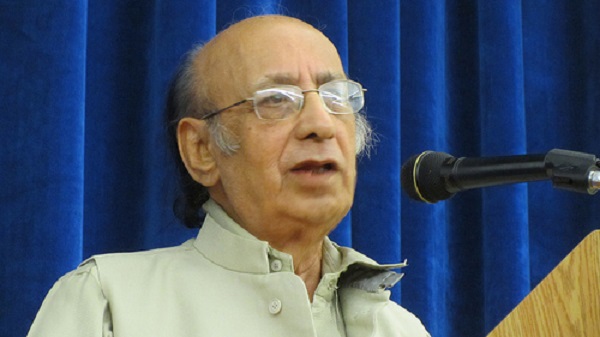
Nida Fazli And as I say these lines to myself, I recollect the two occasions I had the chance to meet the legendary poet and film lyricist in New Delhi. I had long conversations with him about his poetic journey to how he started writing lyrics for Hindi films.

I had had no idea that his journey had begun on a rather tragic note.

Around the time of the Partition of India and Pakistan, he had been engaged to be married. The Partition played havoc with this plan, when his own family and that of his fiancee migrated to the newly-carved country, Pakistan. “I did not move from Hindustan,” Nida told me. “I did not want to. So I was left back all alone.” He confessed to facing very trying times after this, having to brave several testing incidents for a long time. He moved to Bombay for work in 1964, and after an initial period of struggle, his talents as a poet began to be noticed in the film industry. His big break, however, came when filmmaker Kamal Amrohi hired him to finish the songs on his much-delayed magnum opus, Pakeezah. Fazli was brought in as a replacement for Jaan Nisar Akhtar, who had died before finishing two songs.

But Bombay brought the much-needed calm in his life. So how did he get from Uttar Pradesh to Bombay? “I was okay with moving to Bombay and I have always felt absolutely at home there,” he explaind. I found out, during the course of our conversation, that we came from the same qasba in UP, and as talk veered to our ancestral homes and the lives we used to live,

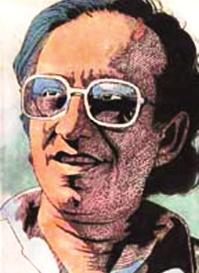
I was struck by how comfortable he was not speaking about films and the glitzy world of cinema, which had obviously not had enough of him yet – this year he was conferred the Padma nida fazli Shri by the Indian Government – despite him retaining his poet’s identity and not getting it mixed up with that of a film lyricist’s.

After a long chat, it was time to say khuda hafiz. But I still had one unanswered question. After his failed attempt at marriage, when his fiancee moved to another country, how did he settle in his personal life?

“Well, I found a companion in Bombay,” he smiled. “I married her and I have settled in this city for ever.”

“It is said that in Mumbai these days, even the big names in Bollywood who are Muslims are finding it difficult to buy or rent an apartment. Did you face any such situation?” I asked.

“No, I haven’t,” he said at once. “But this could be because my partner is a non-Muslim.”


Watch the ghazal ‘Hoshwalon ko khabar kya’ from Sarfarosh, penned by Nida Fazli:


(Pictures courtesy mishrasurya.blogspot.com, www.greaterkashmir.com)

Categories
Read

Do our youth need spirituality?

Three writers pen a tome, aimed at the youth, on the holy places of all religions and faiths across India.
by The Editors | editor@themetrognome.in

Everybody follows a religion. While religion is a deeply personal issue, and so is the visiting of holy places as per one’s faith, the undertaking of a pilgrimage is generally considered to be a task for old people. It is not an activity associated with most youngsters.

But, found three writers, the opposite is true.

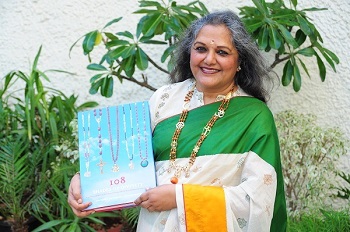
Anju PoddarIt was this line of thought that led the three writers – Anju Poddar, Sethu Vaidyanathan and Mukul Singhal – to explore India’s several religious faiths and the holy places associated with each. Their observations, made over a period of two years, were laid down in the stunning book 108 Shades of Divinity, which is a collection of the 108 holy places in India across nine faiths. We spoke to Mumbai resident Anju Poddar, whose brainchild the book was, about writing this particular book and discovering several interesting truths during the writing process.

Excerpts from the interview:

How did you hit upon the idea of this book?
Mukul Singhal (one of the authors) who is my friend Parul’s brother, had read my earlier books on Manasarovar and Traditions of India. I have written seven other books prior to this one. Mukul had visited the chaar dhams and the 12 Jyotirlingas as well. He contacted me about this project which was already in my mind. Then my daughter Avantika introduced me to Sethu Vaidyanathan (the third writer) who also had a passion about visiting places of worship. The three of us made a good team. Once we discussed the concept and the contents, we got started. We worked in total harmony, complementing each other.

Why do young people need to read this book?
For a while, I had been observing that a lot of youth were getting increasingly inclined towards visiting these holy places. The reasons could be that may be they suffered from too much stress in their lives, or may be they did it in a spirit of adventure. Or may be they did it just to connect with their roots?

When we were kids in the 1960s and 70s, my father KN Modi used to take us to all religious places when he could. Later on, we carried this tradition forward with our children also. So my daughter Pallavi once told me. ‘Maa, your grandkids have seen the three Disneylands in the US, Paris and Hongkong, but none of the Jyotirlingas. Why don’t you write about them and inspire the youth?’ That was how I got the idea for this book.

Why did you self-publish this book, instead of taking the traditional publishing route?
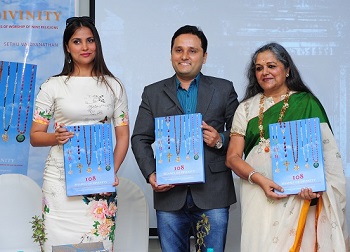
Self publication gives more freedom and flexibility in terms of content and choosing the top designer as per requirement. In our case, buying images was a mega cost which a From L- R. Lara dutta, Amish Tripathi, Anju Poddartraditional publisher would not have okayed, and the publisher also may have objected if we said we wanted to go to the best of printers and use expensive paper and hire a good editor. I say this from past experience.

All three of us pitched in (for the costs of production), we got the ISBN number and started work.

Despite it being a self-published work, the response to the book has been good so far. Apart from launching in Mumbai and Hyderabad, we launched in London on July 5 and we will launch it in Delhi on July 25.

Did you meet a lot of religious leaders/priests/imams in the writing of this book?
We had over 70 people helping us in the research and information gathering of this book, across religions. We had consulted Shankaracharayaji of Dwarkadheesh and Badri Ashram for the writeups on Hinduism. Likewise, for every other religion we went to various fathers, imams and priests, apart from experts for their inputs. After we wrote our articles, we sent them writeups to these people for their approval.

Why is the knowledge enshrined in 108 Shades of Divinity important in today’s times?
108 is an auspicious number, and this is known across our faiths. Even the beads in the jap maala are 108 in number. People should be aware of the location and significance of their holy places. My daughter Avantika suggested this name and we worked around it.

(Pictures courtesy Anju Poddar and www.alasr.info) 

Categories
Tech

Google could give your TV the smarts

Google’s latest event unveiled new devices and a device that, if it comes to India, could smarten up our TVs.
by Manik Kakra

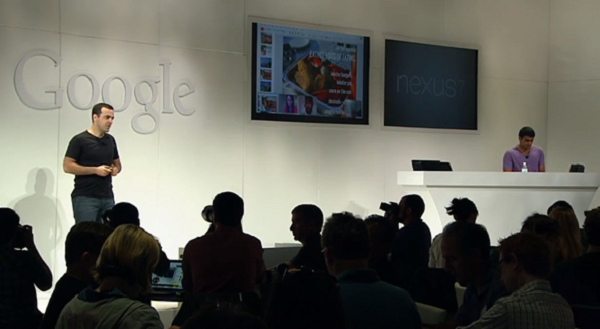
Google recently held an event centred around its Android operating system. The event was held under the name of Sundar Pichai, Android team head. Google showed not one but two new gizmos – new Nexus 7 and Chromecast. On the software side, it released the new Android version – Android 4.3 Jelly Bean.

New Nexus 7The tablet. Let’s first talk about the tablet. The new Nexus 7 (in pic on left) sports a 7-inch (1200 x 1920) screen, and runs on the latest Android 4.3 OS. It is powered by Qualcomm’s S4 Pro processor with Adreno 320 GPU, along with 2 GB of RAM. On the back, there is a 5 MP camera; and the front has got the same camera from its predecessor. The tablet comes in 16 GB, 32 GB and 64 GB options with WiFi-only and WiFi + 4G variants, starting from $229 (approx Rs 13,521) and going up to $349 (approx Rs 20,606). As of now, there is no official news on its Indian release or price.

The software. Coming to Android 4.3, Google has brought a lot to the platform with this update, but mainly all under-the-hood stuff. The OS has now got support for 4K videos, yes. Along with better graphics and responsive UI, the OS has also got a new games Play app, which is basically a competitor to Apple’s Game Center on iOS. Other highlights include improved Bluetooth support with lower power requirement; restricted profiles through which you can restrict apps and content consumed by other users using your tablet; tweaked camera app, and more. The OS update is already out for Nexus devices – Galaxy Nexus, Nexus 7, Nexus 10 and Nexus 4, and will be out for Google Play edition devices soon.

Chromecast. The Chromecast was more of a surprising announcement at this event. There were no prior leaks or rumours, and not many saw it coming. What is Chromecast? ChromecastChromecast is a dongle which allow you to play content from your PC, tablet or smartphone to your TV. Plug it in your connected TV, and you can watch your content on it. With this plugged in, you can access YouTube and Netflix, too. It costs $35 (approx Rs 1,4756), and is out of stock already. When we can get it in India, you ask? Well, not any time soon. And above that, there is not much hope that we would see any content for such devices even if they make it to India, in the near future. Having said that, Chromecast, and Apple TV, could well be the next buy for your living room just to make that idiot box a little smarter and more useful.

(Pictures courtesy www.redmondpie.com, gigaom.com, allthingsd.com)

Exit mobile version