Categories
Diaries

Nature in the midst of crowds: Maharashtra Nature Park

Lovely plants, awesome birds and seriously cool reptiles in close proximity to humans? It’s a jungle out there at Mahim!
by Adithi Muralidhar

Part 7 of the ‘Green Hangouts’ diaries
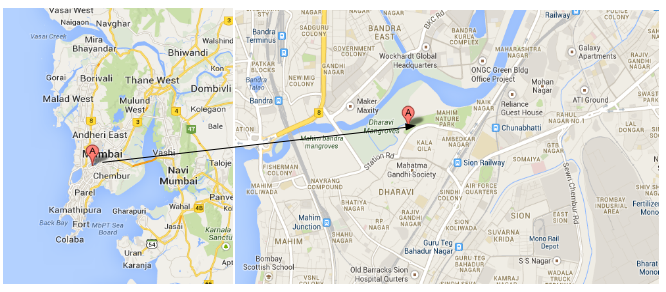
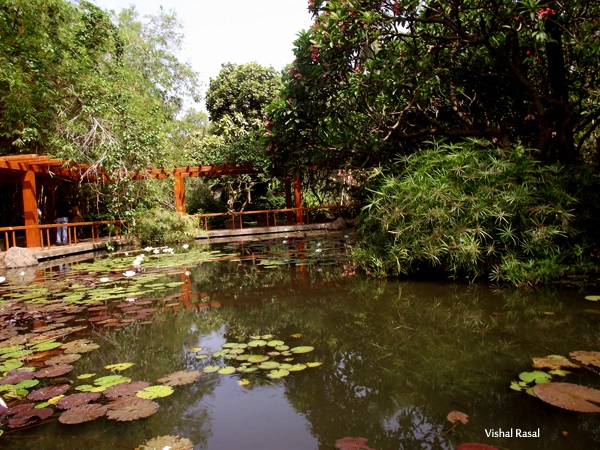
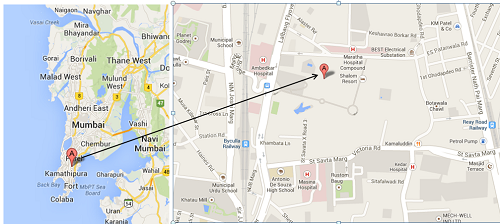
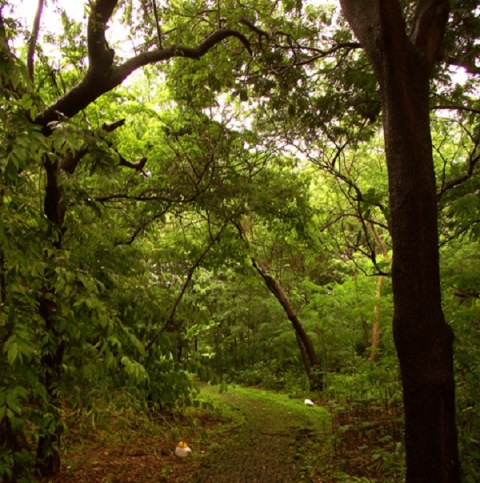
mnpLocated right in the middle of the city, the Maharashtra Nature Park (MNP), which was originally known as Mahim Nature Park, can be seen right behind the Dharavi Bus Depot. It is ironic that this park exists close to one of the most densely populated areas in the world!

What’s so special? The MNP has about 27 acres of functional area, most of which was a garbage dump earlier. The entire creek area behind the park was used as a dumping ground back in the 1970s. But by the 1980s, some of this area was declared as a bird sanctuary; soon enough, three decades later, MNP is one of the success stories of the city where nature has once again flourished!

The MNP has recorded close to 300 varieties of plants, 115 species of birds and quite a large number of insects. It is like a little green haven in the middle of the choked, polluted city. The forested area pretty much cuts down the vehicular sound that comes from the Bandra-Sion link road, right adjacent to one side of the park. You will find yourself in a tranquil state once you enter the park.

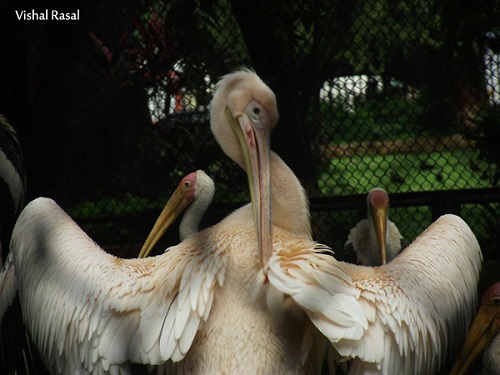
What to look for: If plants, birds or insects are not your thing, you can even sight some really cool reptiles here like the Common Cobra, Green Vine snake, Checkered Keelback, Rat snake, a few lizards and skinks, and an occasional rare sighting of the Indian Star Tortoise. Unfortunately, the serious habitat damage to the adjoining areas doesn’t support any mammal life. Apart from the intermittent sightings of the striped squirrel and a few species of bats, you are unlikely to come across any other mammal.

Currently the MNP also has an Education Centre, nursery, medicinal plant section and vermicomposting demonstration project, apart from the usual birding and butterfly trails. So if you are looking to get some information while you are the park, you can stop by these places! The park is often visited by loads of children who are part of various environment awareness groups.
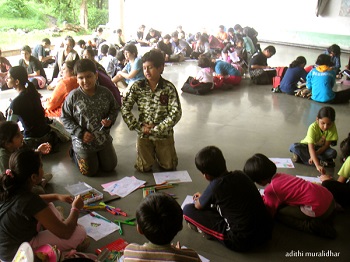
Whether you want to go for a nice walk in the forest or do a nature-trail or just relax, MNP is one of the best places to go to…it’s an immediate get-away from the polluted city and it is quite accessible by road and rail.

Getting there: The nearest railway station to MNP is Sion station (Central line), and the nearest bus stop is Dharavi bus depot. The Park is open on all days from 9 am to 5 pm (except on Government holidays).

—————-

This concludes our ‘Green Hangouts of Mumbai’ diaries. Apart from the seven places I mentioned earlier in the series, there are some more green spots to check out in and around the city. These are:

– Pherozshah Mehta Garden aka Kamla Nehru Park aka Hanging Gardens

– IIT Bombay campus, Powai

– Aarey milk colony, Goregaon

– Kharghar hills, Navi Mumbai (Note: It is better to go in large groups here, I hear it is a little unsafe, particularly for women)

– Bhandup petrol pump

– Palm Beach road mangrove stretch, Navi Mumbai (Note: Again, go in large groups.)

– Godrej Mangrove patch owned and maintained by Godrej and Soonabai Pirojsha Godrej marine ecology centre (SPGMEC) at Vikhroli. But here, you would need permission of the concerned authorities and plan a visit in advance.

– Wetlands of Uran

– Anushakti Nagar colony, where you can witness a small lake at the foothills (of Trombay hill chain) and where sightings of numerous birds and snakes is the norm. Usually, unless you are visiting someone who lives there, you are not likely to get entry into the colony as they have strict security set-ups in place.

– Karnala bird sanctuary, around 40 km from Panvel. One can hike/trek or go for nature trails here.

– Yeeor hills, ThaneTungareshwar, Virar

Adithi Muralidhar currently works in the field of science education research, in Mumbai. She is associated with Hypnale Research Station where she assists with various environment, wildlife conservation, education and community-related projects. She is a strong advocate of nature education.

This conclues ‘Green hangouts’, a series of stories celebrating Mumbai’s place in the green scheme of things, to coincide with Wildlife Week, which is celebrated from October 1 to 7 every year. 

(Pictures courtesy Vishal Rasal and Adithi Muralidhar. Reference: Sunjoy Monga (2005). Maharashtra Nature Park: Back to Nature. Naturecolours: Mumbai and MMRDA,  http://202.54.119.40/projects_mnp.htm)
Categories
Enough said

Revisiting Gandhi’s present-day legacy

Would our politics be any different if Mahatma Gandhi’s grandchildren had joined active politics? Or would things continue as before?
by Humra Quraishi

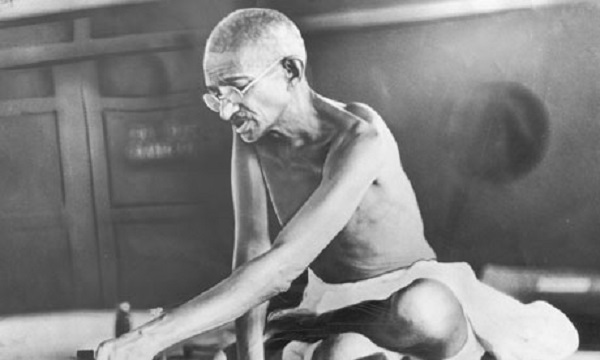
As I write this column a little after Gandhi jayanti this year, I have been recollecting several things about the Mahatma. The very crux of his philosophy was simplicity laced with truth. Nothing complicated or layered, just a subtle and direct way of communicating. Probably this is why we can so easily relate to the great man even today.

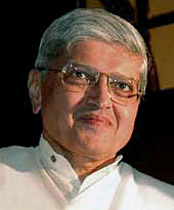
gopalkrishna gandhiEvery time I meet any of his four grandchildren, children of his son Devdas Gandhi, I get the sense the same sense of uncomplicated communication. Each time I’ve interviewed Ramchandra Gandhi, Rajmohan Gandhi, Gopalkrishna Gandhi (in pic on left) and Tara Gandhi Bhattacharjee, I’ve always got a sense of ‘genuineness’ in their words and views. Even when I visited Tara and Rajmohan’s homes, I was struck by the simplicity. In fact, the late Ramchandra Gandhi had never even owned a home and lived all his life in a rented annexe in very tight financial conditions.

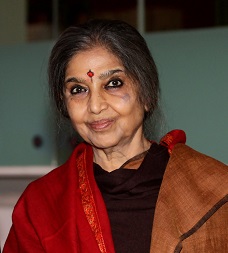
When I first visited Tara (in pic below) at her South Delhi home, I could see it was a very ‘different’ space. Huge hand-made dolls stood in the house, as did charkhas and khadi weaves. When I asked her about her grandfather, she’d said, “Bapu kept a very tight schedule so we couldn’t interact for hours at a stretch, though I’d spent most of my childhood with him and Ba. He spoke on ‘mulya’(values), taught us to value time, to focus on ‘buniyadi usul’(fundamental values). I never saw him angry or cranky. But very often he’d looked sad. In fact, whenever he was upset he’d stop talking and fast or tara gandhi bhattacharjeekeep a maun or roza and stop eating. When upset, he would sit at the charkha spinning for hours at a stretch.”

Rajmohan described his relationship with Gandhiji thus: “As his grandchildren, we didn’t have any special rights to his time. He belonged to the entire nation. At that time, I was a child so I couldn’t understand it, but I later realised that the family had to pay a heavy price to achieve freedom. Looking back, I think even then I had some inkling of why we, his grandchildren, couldn’t spend much time with him.

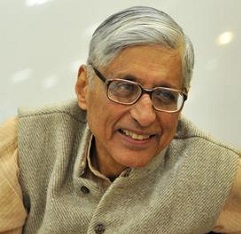
rajmohan gandhiHe recounted the values he inherited from his grandfather and father, “My father Devdas Gandhi brought us up on the same values – that money making was not to be the purpose of life, that service was to be part of life and that any service ought to be totally unconnected with personal advancement. He always stood for freedom of the Press and told us how important it was for the Press to be free.”

There is much to share on the subject of Bapu and the many anecdotes of his life and times, but I have to share this one thought: I wish Gandhi’s grandchildren had joined active politics. Who knows, the situation in the country could have been somewhat better with their presence? Rajmohan (in pic above), who had joined the Janata Dal briefly before leaving the party and politics after huge disillusionment, said, “Today, political parties have hardened their stance on questions of caste and religion. My inability to do that prevents me from finding a strong voice in any political party. As far as the Congress is concerned, the refusal of the party to fight out corruption keeps me away from it.

“The BJP is out of the question because of its ideology. I am too old to start a new party of movement. I would have done it years back but not now…today I find my skull too  fragile!”

Humra Quraishi is a senior journalist based in Gurgaon. She is the author of Kashmir: The Untold Story and co-author of Simply Khushwant.

(Pictures courtesy www.thehindu.com, www.zimbio.com, www.theguardian.com, www.hss.iitm.ac.in)

Categories
Diaries

The garden of our collective childhood: Rani baug

Most of us are familiar with this garden since our childhood. It still holds a special place in our hearts.
by Adithi Muralidhar

Part 6 of the ‘Green Hangouts’ diaries

I remember going to Victoria Gardens as part of one of my primary class school picnic destinations. All that we did was – go there in a bus, sit down under a large tree, eat our packed dabbas, and come back home! I remember the place being quite deserted, but quite green. During my more recent trips there, I realised the place was still green (phew!) but it was no longer deserted – I still don’t know whether it’s a good or a bad thing!

ranibaugOne of the main things that I vividly remember were the two huge baobab trees at the entrance of the garden. Often known as the Tree of Life, the Baobabs have origins in Africa and are trees that can live for almost 3,000 years. Those two trees might have witnessed the phenomenal changes that have taken place over the years in that area of Mumbai.

What’s so special? Often cited as the city’s largest ‘open-green-public’ space, the Rani Baug spreads over an area that is close to 50 acres (give or take a few). Since the time the park was open to the public in 1862, the Rani Baug has faced several pressures from the city’s ever increasing urbanisation. Negligence, poor maintenance, pending infrastructure projects, financial aspects and deforestation are some of the major challenges faced by the park even today. This fairly large garden is home to over 3,000 trees (276 species and around 500+ species of plants, shrubs and climbers) besides serving as the habitat for a large number of birds and insects. Some of the rare and endangered trees found here are the Pride of Burma, Alligator apple tree, Brazilian Ironwood and Colville’s Glory, to name a few.

One part of the garden was transformed into a zoo and efforts have been made to revamp the current status of the zoo infrastructure. But this has posed a serious threat to the existing ranibaug-2-vishalbotanical garden. In fact, to counter the multi-crore proposed project of BMC to revamp the zoo, an (all-Mumbaikar-woman) action committee ‘Save Rani Bagh Botanical Garden Action Committee’ was formed. They were successful in their efforts, as the Central Zoo Authority (CZA) overruled the civic body’s ambitious plan to revamp the Byculla zoo (See these articles for more information on the subject here)

Conferred with Grade II-B status in the Schedule of Heritage Regulations for Greater Bombay, 1995, Rani Baug is Mumbai’s one and only heritage botanical garden. This place is also a delight for students of architecture, as the garden layout is typical of the Renaissance axial planning. To most Mumbaikars, however, this is a garden that occupies a special place in our hearts, like childhood memories tend to do. That this space is green and rich in terms of nature and history also helps!

Getting there: The nearest railway station is Byculla station (Central line). The park is open six days a week from 10 am to 6 pm.

Adithi Muralidhar currently works in the field of science education research, in Mumbai. She is associated with Hypnale Research Station where she assists with various environment, wildlife conservation, education and community-related projects. She is a strong advocate of nature education.

‘Green hangouts’ is a series of stories celebrating Mumbai’s place in the green scheme of things, to coincide with Wildlife Week, which is celebrated from October 1 to 7 every year. 

(Pictures courtesy Vishal Rasal. For more reading on Rani Baug, see http://www.saveranibagh.org/frontlineArticle.php. References: Bombay Natural History Society (2012). Rani Baug 150 years: Veermata Jijabai Bhosale Udyan and Zoo, Oxford University Press)

Categories
Overdose

How to use Marathi in Mumbai

Using a few simple Marathi sentences in Mumbai can get your work done, even swing popular opinion in your favour.
Jatin Sharmaby Jatin Sharma

It is true that you really can’t get by without knowing Marathi in Mumbai.

Languages were created by man for the purposes of communication. But as time passed by, languages transformed and developed their own personalities and individual identities. Languages became more than just a thought translated into words.

Sadly, as languages evolved, they also devolved into something else – they became tools to stereotype, and also an instrument to measure superiority.

In Mumbai, we see a mix of languages, but the one language that is in the news on and off is Marathi. This language has been the cornerstone of great literature and theatre in the 1970s, it became the flashpoint during the Sanyukta Maharashtra movement in the 1960s, it eventually became the language of choice for the city’s trader class. In a cosmopolitan mix of communities – you name it, the community is present and thriving in Mumbai – Marathi somehow held a firm grip on the city.

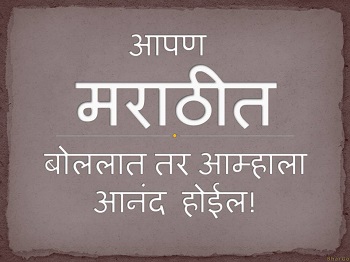
And today, knowing this language also gets the job done in Mumbai. It is no secret that knowing Marathi in Mumbai helps your files move Marathifaster in Government offices. If you break a traffic rule, your overall penalty can be reduced with the use of a smile and a Marathi line: “Saheb maaf kara, mala jau dya (Sir, forgive me, please let me go)”. This line will, more often than not, result in a change of heart of the traffic policeman who will let you go after a warning in Marathi. Speaking in Marathi is so useful in escaping punishment after flouting traffic rules, that I have started believing that the fine you pay to the Traffic Police is inversely proportional to how much Marathi you know.

The first task that is a must for anyone in Mumbai looking to get their official documentation done is to learn Marathi. Start by learning a few sentences like, “Saheb, lavkar kara na (Sir, please speed it up)”, “Saheb, kuthe jau? (Sir, where should I go?)”, “Saheb, hey form kuthe deu? (Sir, where should I submit these forms?)”. Trust me, these are magic lines that will get you a swift reply. It is astounding, contrasted with the many times I have gone to Government offices and asked a question a million times in Hindi, only to see the official I am speaking to continue to bury himself in his files. I used to wonder if their ear drums were soundproof; then I spoke in Marathi and the official always looked up and answered.

Marathi also comes in handy when you’re looking to quickly build support during a public fight on a Mumbai street. Whether you are travelling in the train or arm wrestling with each other in the bus, it’s Marathi to the rescue. Many times when I have found myself in the middle of a fight, and when I’ve sensed that my opponent has an edge, I’ve simply dropped in a few Marathi words and prayed to God that he does not speak Marathi, too. And as if by magic, the use of something like “Gardi aahe, kay karnar? (It’s crowded, what can one do?” has resulted in most of the onlookers turning in my favour.

Marathi BolaI’ve come to realise that using Marathi can be quite a lifesaving tactic in Mumbai. I employ the language at various places to get my work done faster. Believe it or not, Marathi even helps me get a vada pav faster than others at a stall.

It’s something to ponder on, this Marathi in Mumbai. The way it converts thoughts into words, they way it gets a faster response to a question, the way it makes me more acceptable to a crowd, the way it makes me look into myself and others, the way it gets me respect in the eyes of other Marathi speakers, and the way it sometimes tears me apart.

This is truly a language that helps us aam aadmis connect. And these days, it is helping me get my Aadhar card made.

Jatin Sharma is a media professional who does not want to grow up, because if he grows up, he will be like everybody else.

(Pictures courtesy www.xtimeline.com, www.123rf.com, ekmarathimanoos.blogspot.com)

Categories
Diaries

A haven for butterflies – Ovalekarwadi butterfly garden

Imagine a spot of green that has the most beautiful butterflies flitting in and out constantly – and in Mumbai!
by Adithi Muralidhar

Part 5 of the ‘Green Hangouts’ diaries

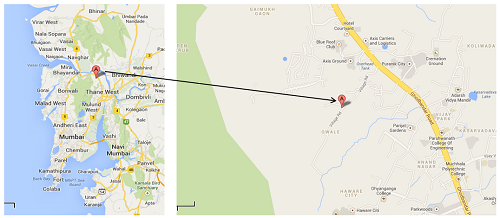
I had only heard of this place… and not very long ago, I was ‘invited’ to join the Fovalekarwadiacebook page of this unique garden (https://www.facebook.com/ovalekarwadi). Soon I could hear more discussions and praises for this garden and then I got curious! Obviously these were not just rumours… they were not the momentary excitement people have, that lasts as long as fizz in an open soda bottle. There was definitely something to the buzz about this mystery garden located off Ghodbunder road, a road known to be lined with skyscrapers and industries!

Why a butterfly garden? Ovalekarwadi butterfly garden was the brainchild of Rajendra Ovalekar, a physical education teacher by profession. Rajendra had a strong inclination for being close to nature. Particularly intrigued by butterflies, he decided to set up a garden that would exclusively be home to these fluttering beauties.

With help from friends and family, he created the Ovalekarwadi in his two-and-half-acre farmland located close to Owalagaon. Sheltering over 120 species of butterflies, the Ovalekarwadi has now become a famous hotspot for nature lovers from all over the city.

I had the opportunity to see Rajendra give a small presentation about his garden during a recent seminar held at CEC in Goregaon (September 2013). In his 15-minute interaction with all of us, his love and commitment to the garden really stood out. He explained how this garden came about and the effort it took for him to make this place “attractive and welcoming” to these 100 species of butterflies. Maintaining the place was not a simple task.

He explained how he uses old discarded fruit as a source of food for these butterflies – he stuffs the fruit pulp in small metallic cages (to keep away birds from feeding on it) and places these nectar houses all over the garden to attract the insects.

One can also learn more about the life-cycle of butterflies at the garden by direct observation. For example, you will come across all the stages of the butterfly’s life cycle here – the egg, pupa, cocoon and final adult. You can spend the whole day just watching, observing and recording butterfly behaviour. Photographers are another group of people who love to frequent this place. It is so difficult to capture these wavering beauties, it takes you hours to get a great shot. But at the Ovalekarwadi, you have better chances of photographing butterflies, because they are just all over the place!

Even though this cannot qualify as a complete weekend ‘get-away’ spot, it definitely is worth the visit!

Getting there: The nearest railway station to Ovalekarwadi is Thane station (Central line). The nearest bus stop is Owala village bus stop. The garden is open only on Sundays from 7.30 am to 1.30 pm.

Adithi Muralidhar currently works in the field of science education research, in Mumbai. She is associated with Hypnale Research Station where she assists with various environment, wildlife conservation, education and community-related projects. She is a strong advocate of nature education.

Green hangouts is a series of stories celebrating Mumbai’s place in the green scheme of things, to coincide with Wildlife Week, which is celebrated from October 1 to 7 every year. 

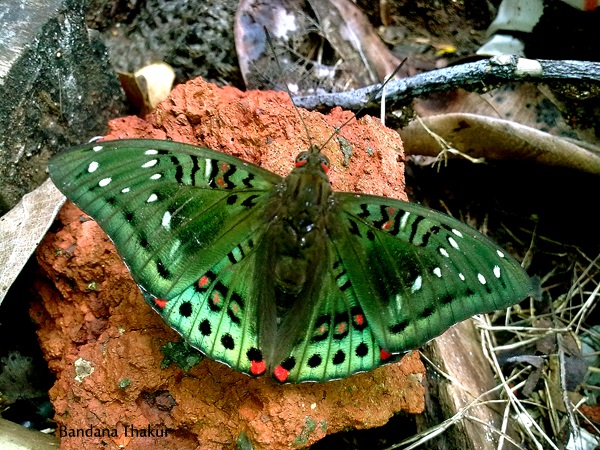
(Featured image by Bandana Thakur. Image shows a male Gaudy Baron butterfly)

Categories
Uncategorized

Get Navrarti ready!

Let’s get you and your man ready for the festival with some awesome tips on dressing right and looking great.
by Deepa Mistry

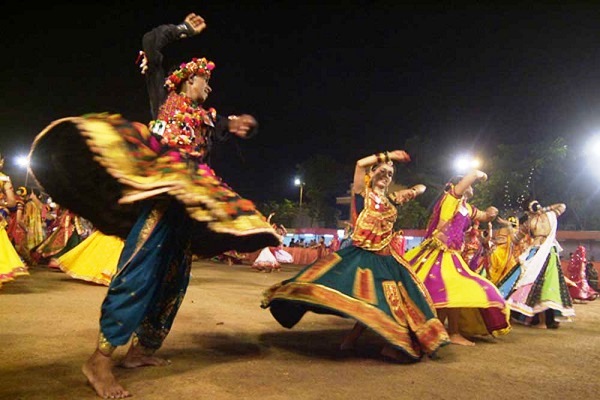
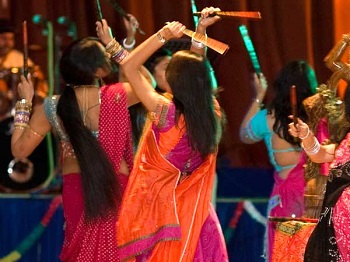
Navratri starts today and now’s the time to bring out the colourful chanya cholis, ethnic jewellery and accessories, apart from gorging on many tasty delicacies. But dressing right can get you all confused – but it’s not that difficult putting the ideal look together. Of course, both men and women should know the latest trends in fashion and colour to even get started.

So here’s how you can get your look together for Navratri:

Dress and jewellery:

neon is in– Neons are very much in this season! Every year we have changing trends in dresses and chanya cholis. Team up a neon-coloured ghagra (having a thick border) with a golden blouse and a net dupatta. You can opt for a neon green ghagra and a red or hot pink net dupatta or mix-n-match colours like green with yellow or purple. Orange goes well with pink.  A lot of neon chanya cholis are also available (see pic on left).

– TV serial-inspired outfits are in vogue this year. A three coloured combination is the newest craze among many. Pick a red ghagra, in cotton, velvet or net which has a little embroidery or a lace, along with a yellow blouse with sleeves till your elbow and a green net dupatta. Go for stylish cholis – backless or with fancy designs. You can mix and match with your own favourite colour combos.

– Go Indo-Western. Full length cotton skirts with sequins look great when teamed with a tank top or a singlet. Wear a stole around your neck and you’re ready for the night. Add a touch of glam with oxidised bangles or chunky traditional jewellery.

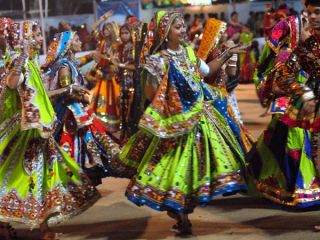
– Tailored chanya cholis are the best as per your own style, but nothing beats the beauty of a traditional outfit.chanya choli

– A traditional chanya choli never goes out of fashion. This year’s glamourous look is three-fourth length chanya cholis.

– Forever in trend are broad borders, rabari work, embroidery, multicolored panels, Kutchi print, traditional Leharia and Bandhani prints, beads and mirror work. Bright and beautiful colours with stones embellished will surely add elegance. Digital prints and colour blocking are very much in vogue this season.

– The trending jewellery this year is colourful wooden bangles or brass bangles, statement neck piece and simple tops. For a traditional look go for oxidized pieces of jewellery, which includes necklace, bracelets or kada, kamarband and nose rings. Kundan Navratri jewellery is also hot in this season.

– Men can opt for a traditional ‘Kedyu’, a typical Navratri outfit especially for men; they are available in a variety of colours. Or go for a nice kurta with jeans or chudidar.


Hair and accessories:

Braids are the best! While dancing, only braids will stay intact, so you could try a fishtail braid (see pic on right), top knot braids, side braids, four strand braids, rope braids etc. as they give comfort andfishtail braid fresh look.

– Opt for accessories which give an ethnic touch, like a maang tikka, earrings with loops to be pinned in the hair etc. But don’t overdo it, as chances are they may fall off while dancing.

– A traditional headband or Navratri cap with embroidered and mirror work goes well with the traditional chanya choli outfit. The caps are available for both men and women.

– Waist belts and arm bangles look exceptionally pretty with a typical outfit.


jootiesFootwear:

– The best footwear is flats. Avoid heels.

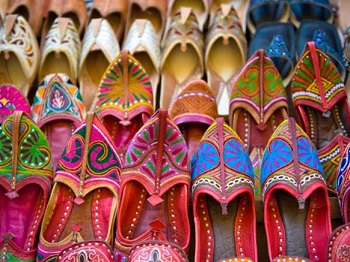
– Wear fancy Kolhapuris or mojris as they are available in various patterns and colours.


Grooming:

– Since cholis are mostly backless or have a low-cut back, try back polishing; it is a safe treatment also recommended by many doctors.

– For glowing skin, a lot of spas and beauty parlours offer special facials and other treatments for this season. Head and body massages are quite a rage not only among women but men also. You could book a couple package with your better half.

– Tattoos on the arm, back and ankle are the raging trend but only go for it if you are 100 per cent sure that you want it. Make sure you get it from a reputed tattoo studio. Temporary tattoos are good as well.

– Don’t go overboard with make-up. Pop tints, reds and glitter are in this season.nail art

– This is a good time to get a manicure and pedicure. A huge variety of nail art options are also available. Go funky this year.

– Men can try funky and cool haircuts, hair highlights or full colour, hair gels etc.

– Waxing and threading, face clean-ups and facials are no longer restricted only to women. Even men are opting for these treatments to look good during the festive season.

We wish you a Happy Navratri! So put on your dancing shoes and enjoy the nine days of this colourful festival to the fullest.

Do you have a Navratri dressing up or beauty tip to share? Tell us in the comments section below.

(Pictures courtesy Manoj Sunstar, en.wikipedia.org, zeenews.india.com, www.bellasugar.com, idiva.com)

Exit mobile version