Categories
Tech

Review: Coolpad Note 3

This new phone looks good on paper and performs well too. It is a great device, save for some glitches.
by Manik Kakra | @Manik_K on Twitter

The Chinese company that started its smartphone journey here with the Dazen1 and Dazen X7 is now out with the Coolpad Note 3. While the Dazen1 certainly provided a bang for the buck, we were a little disappointed with the DazenX7. Let’s check out if the Coolpad Note 3 performs enough to take on this already-heated price segment of under Rs 10,000.

The looks. There are two White bands above the 5.5-inch HD screen that sport LED notification, sensors, ear-speaker grille, 5 MP camera at the top; and three capacitive touch buttons – Recent Apps list, Home, and Back (from left to right) – at the bottom. The phone is quite large but doesn’t feel awkward to hold given its sheer screen size and curved sides on the back. At the back, it accommodates the bio-metric fingerprint scanner around the centre, and the slightly-protruding 13 MP camera, which is surrounded by LED flash and secondary mic. The loudspeaker is located near the bottom.

On the left is your volume rocker, which is all plastic and feels just okay in terms of tactical feedback; while the Power/ Lock key is on the right and isn’t difficult to reach. The 3.5mm headset jack is on the top, and the bottom part hosts the microUSB port.

Screen. The phone sports a 5.5-inch (1280 x 720) IPS panel. The screen is great for outdoor usage under sunlight and does a good job of colour reproduction. HD videos look quite nice on it, and I didn’t spot any shortcomings while viewing videos, though high-resolution images may appear a little washed out to some coming from a high-end screen.

Coolpad Note 3Camera. The Note 3 boasts a 13 MP (f/2.0) camera on the back. Here are a few sample images.

The camera does a good job at focus adjustment and capturing colours, but struggles with sharpness. It is decent at handling low-light shots, and the camera app, with a bunch of usual modes to pick from, works really well for taking shots in most situations.

Battery. The phone often lasted around 20 hours with heavy to moderate usage. With light use, it can last you a full day on a single charge. This includes brightness at 20%, some Leo’s Fortune, Twitter, WhatsApp, and EMail (Gmail app) with a single SIM card inserted. The phone takes a little over 2 hours to get its 3,000 mAh battery unit fully charged, and while it supports quick charging you will need another higher capacity charger as the default charger you get in the box doesn’t support it.

Audio. The phone’s loudspeaker at the back is pretty much average and its placement doesn’t help either. It’s fine for ringing and notification alert, but don’t expect good sound for videos and games. The phone has good call quality on both sides, but I did notice a bit of performance deterioration in terms of network reception compared to other smartphones on the same network and in the same areas. The Note 3 supports 4G LTE on of the SIM slots (both require microSIM cards) and usual 3G and 2G on the other slot.

Software and performance. The Coolpad Note is powered by the MediaTek MT6753 chipset (1.3 GHz octa-core processor, Mali T720 MP2 GPU) along with 3 GB of RAM. It runs on CoolUI 6.0 that’s based on Android 5.1. The fingerprint scanner on the back is nicely mushed below the surface and works really well, about 8 out of 10 times. While some might find its back placement a bit odd, it’s not that strange after a few days of use, plus it unlocks your screen quickly.

Long-pressing the Home key brings up Google Now. You can now lock a particular app in the recent apps list, so that it doesn’t get cleared when you clear all apps from the list. The OS seems to have fixed push notifications issue with messaging apps. Performance-wise, the phone seems quite smooth and hardly lagged during use. The OS still looks and feels quite immature, like icons, default sound tracks, etc, and the theme center hardly has any options to choose from. Its basic style of having all your apps shortcuts and widgets on various Home screens is still there, though you can now switch to “traditional style” and have a separate app launcher in addition to your Home screens.

All in all, the phone that seems compelling on paper also performs pretty well to make it a good phone at this price point. It has a good screen, above average battery life, but while it struggles with sound quality and how CoolUI looks, the OS performed pretty well and a fingerprint scanner that doesn’t disappoint for daily use making it a worthy contender, with the likes of the Honor 4X, RedMi 2 Prime, Karbonn MachOne Titanium and a few others, for those looking for buy a smartphone under Rs. 9,000 or so.

(Pictures courtesy Manik Kakra)
Categories
Hum log

Empowering women through paper

Shalini Datta quit a high-flying corporate job to train impoverished women in Malad the power of self-sustenance through paper products.
by Ravi Shet

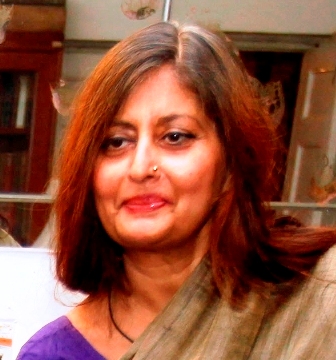
It takes a lot of courage to give up a full time salaried job to start an organisation that helps underprivileged women through the sale of handmade paper products. But that is precisely what Shalini Datta did. After working for almost nine years in top IT organisations in India, Shalini started AfterTaste in September 2012, a self-sustaining organisation in Malad, Mumbai. AfterTaste not only trains underprivileged women from Ambujwadi slum in Malad to become artisans, but also boosts their confidence to earn money and support their children’s education.

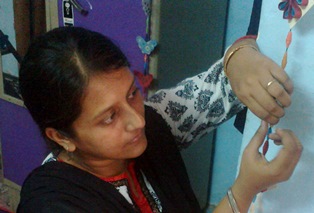
Shalini DattaShalini’s journey is an interesting one. After completing her chemical engineering from Pune, she got job with a top IT company and in a few years, she switched to another one in Kolkata. “I took part in the company’s CSR activities, which included teaching children every Saturday. These children lived near heaps of garbage and were extremely poor,” she remembers. “Soon, I developed a strong desire to bring about a social change, but I didn’t have time from my Monday to Friday job. So I quit my job to do what I really wanted to do,” she smiles.

The Teach for India fellowship followed soon and brought her closer to the impoverished section of society – it gave her the chance to experience their pain and struggle firsthand. “I was given Class 2 to teach from around 80 students in a municipal school in Malad. I would keep them engaged through various art and craft activities. The fellowship was a turning point in my life, where I would teach the children and also interact with their mothers. These women struggled for basic needs, but they wanted to give their children a shot at education,” Shalini says.

“I found two enterprising women and started AfterTaste,” she adds. “My interest in art and craft helped me and I trained these two women in developing paper bags from newspapers. My engineering background helped me experiment with product design and my teaching experience helped me communicate to these women in a simple way,” she says.

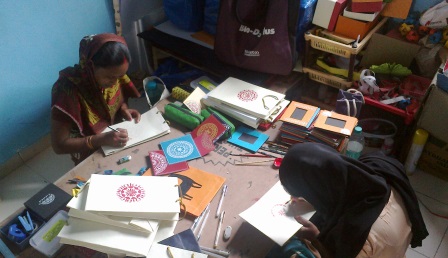
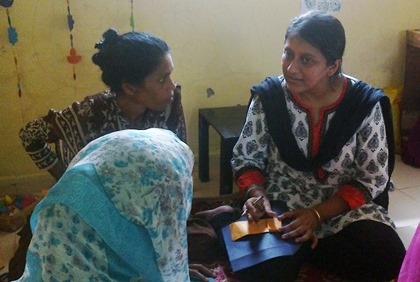
AfterTaste started operations from a small space in a chawl occupied by one of the women who worked with Shalini, AfterTaste_Women working on productbut in May 2015 they moved to a new space with 15 women currently working on 20 different handmade paper products such as folders, mobile stands, lamps, and photo frames. AfterTaste had its first exhibition in Godrej, Vikhroli in October 2012 and from there they have come a long way and it’s still a self-sustainable organisation. Along the way, it has inspired unskilled women to become more confident about running their homes and sending their children to school.

Shalini says, “Each of our products has a personal touch. Everything here is made using paper and is customised by women through decoration in their own distinctive way.”

Kamrunnisa, a mother of three daughters and a son, was confined within the community; however AfterTaste completely changed her life. She says that Shalini’s encouragement helped her step out of her home for work. “I am thankful to Shalini didi for her support and training. I can now support my family, pay school fees and also ensure that my daughters get the same education as my son,” she grins. “I never thought that I would go outside Mumbai and teach underprivileged women in Gujarat how to make handmade paper products. The respect I got from them was memorable for me.”

The women working with AfterTaste are taught teamwork and bonding so that there is no sense of rivalry against each other. Fatima Shaikh, who has been associated with AfterTaste since its inception says, “I now contribute to my family’s financial needs, which makes me feel good and also gives me a sense of confidence to face people. I now want to learn English and also want my children to have access to good education.”

Shalini adds, “Right from purchasing raw material to pitching ideas to clients and creating more sales avenues is a difficult job. But seeing the positive change in the lives of these women and their passion keeps me motivated to push my limits.” She says that she plans to reach 100 women by year 2019 through AfterTaste and empower them so that she can break their vicious cycle of poverty.

To volunteer at AfterTaste or to buy their products, Shalini Datta can be contacted at C/6, Malwani Panchsheel Cooperative Housing Society, Plot No. 62, Near Ambujwadi Rickshaw Stand, Malwani, Malad West. Call +91-9673992618.

Categories
Kharcha paani

How to make money as a self-employed person

Don’t let the pressures of being in business for yourself bog you down. Strategise carefully to manage your business finances.
by The Editors | editor@themetrognome.in

Nobody expects business to be an easy affair to handle, but some people make a difficult task impossible by reckless and foolish behaviour. You can’t predict when your next big contract will be signed or when you can announce that you are breaking even, but with the help of cautious spending and common sense habits, self-employed persons can make sufficient money out of their work to lead quite comfortable lives.

Make a list of all expenses. Since your business is going to pay for your household expenses, you need to have a clear idea of what your home expenses are every month, and the times they are likely to increase (like in the case of a family wedding coming up in a few months, or fees for a new course for your child). Once this list is made, preferably with a month-by-month projection, you will be in a better position to devote a minimum percentage of your income to the home. Keep this sum of money fixed till such time inflation or necessary expenses necessitate reallocating more money.

Minimise overheads and expenses. If you are finding the going tough on the business front, causing stress at home, you might consider scaling down your operations, at least for a little while. If you can make do with three full-time staff instead of five, relieve the extra staff and save on their salary. You might even cut down your own salary for a while. Also, make sure that there are no wasteful expenses taking place in the office – air conditioners being left on when nobody is there, printouts being taken repeatedly when only once will suffice, employees leaving computers on even after they leave office, etc. All of these unnecessary expenses can be easily done away with by careful monitoring.

Accept that there will not be fixed income. Being a self-employed professional, whether on a freelance or a business basis, means that your income will be different every month. Some months will be a financial windfall, while others will be very lean. For the times when money is low, anticipate the reduction in business much before you hit a troublesome patch, and set aside funds to help you keep the office running even when there is no business. Business or not, you still have to shell out money for salaries, overhead, water and electricity, etc. so be on the guard before trouble actually comes knocking.

Never make the home finance the business. A mistake that most businesses in the red make is to use up all their assets to keep the office running. They forget why they went into business in the first place – to give a comfortable life to themselves and their families. Hence, the ideal business model is one in which the money flow is one way: from office to home, and never the reverse. People make the mistake of selling off personal assets like jewellery or mortgaging their homes to raise money. Still others take heavy loans against property and insurance policies, hoping to replace all the sold or borrowed assets when money comes later. Your office and home and two separate entities, so you cannot use your home to fund your office.

Invest wisely. You will need to secure your and your family’s life by timely investment in suitable insurance policies, equity bonds, mutual funds, etc. However, don’t opt for the first savings instrument you come across. Take professional help in planning for your family and your business. Your accountant will tell you how much income you will lose by way of paying taxes based on a projection of your business, so make sure you set aside this sum months in advance. Also, your spending should be the same, irrespective of how much money your business gives you. Never be tempted to splurge recklessly when you have surplus funds on hand.

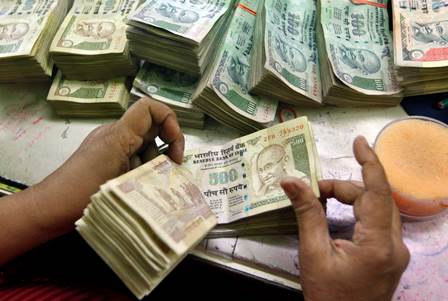
(Picture courtesy www.wordlypost.in. Image is used for representational purpose only)

Categories
grey space

The rights of senior citizens

Are you aware of your rights as a senior citizen in India? Read on to know what these rights are.
by Advocate Aileen S Marques

In 2014, India had about 10 crore people above 60 years of age, this number is expected to touch 32 crores by 2050. The 2014 report by a NGO- Helpage India highlights a very sad state of affairs in the lives of the “old in age-young at heart”. According to this survey more than 50% respondents faced some form of abuse and 41% of them chose to keep silent and bear the pain. It’s time that the hands that nurtured us reclaim their rights.

Similar to the theory of reverse mortgage, all those who will benefit from the property and assets of the senior citizens are legally bound to provide for their needs.

The document ‘UN Principles of Ageing’ (1982) is considered the basic guideline for promotion of the rights of senior citizens. The five principles enumerated therein are: Independence; Participation; Care; Self-Fulfilment and Dignity. The right to access adequate food, water, shelter, clothing and health care is basic to the lives of senior citizens. They should also have access to health care to help them maintain the best possible level of physical, mental and emotional well-being.

Older persons have a right to live in dignity in a safe environment, free from exploitation and mental, economic and physical abuse. The Indian laws provide for maintenance for parents who are ignored and neglected by their children. The section 125 of the Code of Criminal Procedure provides for the maintenance of parents who are unable to maintain themselves. The Protection of Women from Domestic Violence Act 2005 provides protection from violence, the right to residence and maintenances for women (even mothers) who face violence from their children.

The Maintenance and Welfare of Parents and Senior Citizens Act, 2007, is an Act that provides more effective provisions for the maintenance and welfare of parents and senior citizens guaranteed and recognised under the Indian Constitution. Parents and senior citizens have a right to be maintained by their children. Similar to the theory of reverse mortgage, all those who will benefit from the property and assets of the senior citizens are legally bound to provide for their needs.

So if the senior citizen has property which his/her children will inherit on his/her death, then according to 2007 Act, they are legally bound to maintain the senior citizen during their lifetime. Children have an obligation towards their parents. In an attempt to rejuvenate the lives of the senior citizens, the Government of India has introduced many policies and schemes. Senior citizens have to realise that they have rights, the most important being the right to life. It is important that they become aware of their rights and assert them rather than succumb to the pains and pressure of their victimising children. Life is a blessing of God, live it with grace and dignity.

‘Grey Space’ is a weekly column on senior citizen issues. If you have an anecdote or legal information, or anything you feel is useful to senior citizens, caregives and the society at large, feel free to get it published in this space. Write to editor@themetrognome.in or on Facebook at www.facebook.com/Themetrognome.in and we will publish your account.

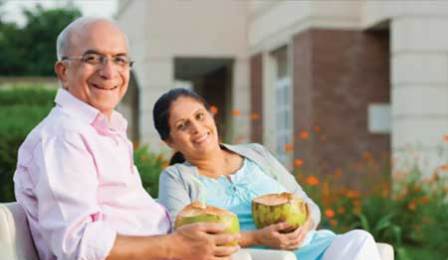
(Picture courtesy estatebulletin.in. Image is used for representational purpose only)

Categories
Film

Review: Rajwade and Sons

This week’s release is the story of generational conflict in one of Pune’s richest business families. Watch it with family.
by Ravi Shet

Rating: 3.5 out of 5

A film about business, interpersonal relationships and how succeeding generations view the world through a different prism, Rajwade and Sons is a story of familial obligations, stifling dreams and carrying on age-old traditions.

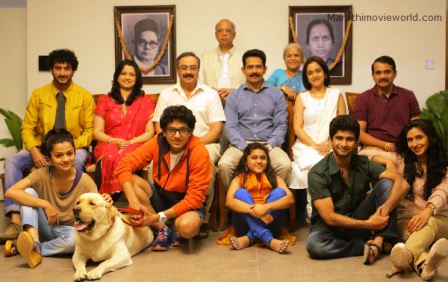
Adamant patriarch Rameshrao Rajwade (Satish Alekar) is the head of the Rajwade family and his children – Vidyadhar (Sachin Khedekar), Laxmi (Mrinal Kulkarni) and Shubhankar (Atul Kulkarni) obey their father’s decisions and orthodox values without questioning him.

Vidyadhar is prone to snooping on his children by checking their Facebook accounts and even discussing the same with his wife. Meanwhile, Anay is slightly self-centred with his love for shoes and his laptop, while Shweta is interested in working and travelling around the world.  Laxmi lives in her father’s place along with husband Vaibhav Joshi (Rahul Mehendale) and their kids – Annaya (Mrinmayee Godbole) and Virajas (Siddharth Menon). Virajas is shown working half-heartily in family business with Anay, while Annaya wants to pursue her career in modeling.


In this cast of characters is introduced Vikram (Amitriyaan Patil), Rameshrao’s estranged son who has left the family home years ago and not been in touch ever since. Anay, Annaya, Shweta and Virajas go to their old home and discover Vikram’s belongings and also take some of the things. Till one day, Vikram returns and everyone is excited and happy to see him, except for Rameshrao, Shubhankar and Vaibhav. They suspect that he has come for his share of the money and property. Vikram’s entry in the family energises the third generation of the Rajwade family to pursuing their dreams.

Sachin Kundalkar keeps the right amount of twists in the story, and realistically showcases how the older generation’s decisions are forced on the succeeding ones. There is a harsh glare shone on the infighting and the concept of the Indian joint family that restricts the younger generation from living their dreams. The pace of the film is well balanced in the second half with good camerawork by Arjun Sorte. Atul Kulkarni and Amitriyan Patil deliver good performances and they are very well supported by Alok Rajwade, Krutika Deo, Mrinmayee Godbole and Siddharth Menon. This one is a good watch with your family members – even the extended family ones.

(Picture courtesy marathimovieworld.com)

Categories
Enough said

The homeless in Kashmir may be homeless forever

A visit to the Kashmir valley shows disturbing truths of how an apathetic Government is disinterested in helping homeless residents.
Humra Quraishiby Humra Quraishi

I have been restless and upset by the goings-on in the country. I decided to escape the news of the maddening incidents in Dadri and elsewhere with a trip to Kashmir. Only…there is no escaping any grim reminder of the present-day Indian realities when one reaches the Valley. For the reminders come brutally fast and thick here. If anything, one is filled with more despair at the plight of marginalised Indians in the country.

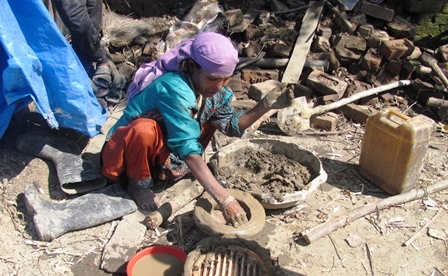
I travelled to Kashmir to report on flood victims and their survival in the backdrop of the fact that those rendered homeless by the ghastly floods are still homeless. Even after a year, as autumn paves way for another harsh winter, there has been no Government assistance to these people. Besides a sense of deep gloom, there is also simmering disgust at the PDP joining hands with the BJP. The latter is widely perceived as a dangerous communal force that will only bring ruin to the Valley.

Even as the BJP makes inroads in the region, I was taken aback at how bitter the average Kashmiri is about the state of his or her life in the State. From cab drivers to persons of the elite class, the opinion is unanimous: the PDP made a huge mistake by partnering with the BJP, and there is hope (even at this late hour) if the two were to part ways. The anger stems from the perception that the RSS is guiding the hands of the BJP in Kashmir (as in other places) and this can only lead to destruction of everything that Kashmiris hold dear.

A young gentleman I met there was vocal about the BJP and Modi. “How can Modi sarkar talk of a Common Civil Code while Muslims and Dalits and Christians are treated like third class citizens?” he wondered. “The Government hangs Yaqub Memon and Afzal Guru, but spares Hindu terrorists from Mumbai to Karnataka to Uttar Pradesh to Madhya Pradesh! Even if one does not want to equate terrorism with any religion, these lapses make one think along these lines. Why are Ministers like Mahesh Sharma allowed to speak whatever they please? Will ordinary citizens like myself be allowed to make provocative statements and not get arrested?”

I also write today about Engineer Rasheed, J&K’s only independent MLA, who I met on October 5, a couple of days after he hosted his infamous beef party. He told me he was a qualified engineer but decided to contest elections to save himself from police brutality – he has faced a lot of it in his younger days. “I wasn’t politically inclined, my basic idea in standing for elections was to save myself from police threats and torture.

“I have gone through hell all through my adult years. I have been wrongly imprisoned, tortured in lock-ups…” He is so wary of the police that he has declined police protection even as an MLA! “I am not comfortable with the police and I have declined all forms of security. I have declined escort vehicles, too.”

Such is the State of affairs, then, that even an MLA shies away from contact with the police. Can one imagine what the ordinary Kashmiri goes through?

Humra Quraishi is a senior political journalist based in Gurgaon. She is the author of several books, including Kashmir: The Untold Story and Dagars and Dhrupad, among others.

(Picture courtesy www.ipsnews.net. Image is used for representational purpose only)

Exit mobile version