Categories
Places

In the pursuit of the Buddha

An overnight train journey, the stunning beauty of the Ajanta and Ellora Caves, and some excellent company. What a trip!
by Salil Jayakar | @Salilicious on Twitter

The caves of Ajanta-Ellora in Aurangabad (Maharashtra), both World Heritage sites, have been on my must-visit list for some time now. With a long weekend in March this year, thanks to a pending casual leave (Friday) and the Gudi Padwa holiday (Monday), I finally made the trip.

Having already booked Mumbai-Aurangabad return tickets on the Devgiri Express early February, I was also excited to accomplish my first solo overnight train journey! The approximately seven-hour train ride was incident-free and I arrived weary and sleepy in Aurangabad at about 4 am. Thankfully, my hotel was just two minutes away and I was soon tucked in for a quick nap.

Early next morning, at about 8.30 am, I made my way to Aurangabad’s Central Bus Station from where buses leave for Ajanta at frequent intervals. While I was tempted to go on one of those AC Volvo buses, I eventually chose to take a seat on a Maharashtra State Transport (ST) bus – a Government-run inter-city bus service. And with that, came another first for me – my first ST bus ride! On the bus I met the delightful Debbie from Belgium, and we became travelling companions. On a month-long India holiday, she had decided to spend the last two days of her trip visiting Ajanta-Ellora.

The ST bus ride was not as bad as I had imagined. At some point at the beginning of the journey, the conductor asked me to sit in the driver’s cabin, which was fairly comfortable. The driver drove like he was in a Formula 1 race, the summer sun was hot (about 40 Degrees Celsius) but the wind in my face kept me quite cool. Since the Ajanta Caves are about 100 km from Aurangabad, it’s a good idea to leave for them as early as possible since it takes about three hours to get there. Let me add here that Ajanta and Ellora are two different cave sites, away from each other. You need two separate days to visit them.
Oh, Ajanta!

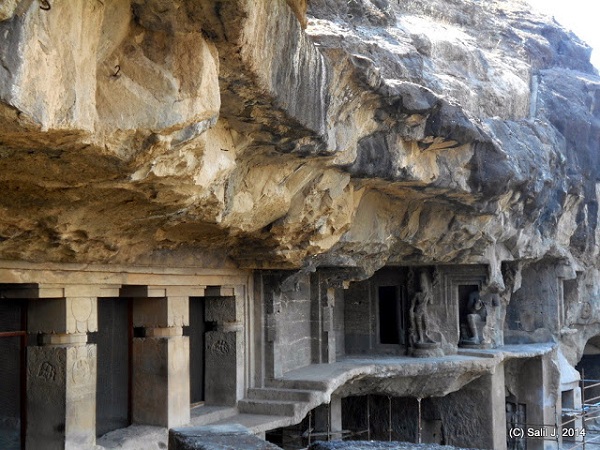
Forgotten by time for thousands of years, the Buddhist rock caves of Ajanta were discovered by accident in 1819. And what a discovery it was! It is hard to believe that these monastic sanctuaries – hand carved in sold rock – were created at a time when none of today’s modern tools were at the disposal of the creators.

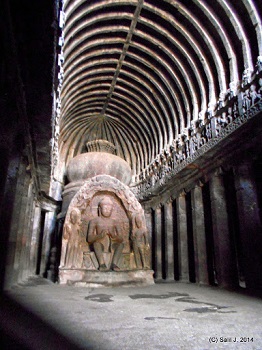
The architectural and sculptural beauty of these rock temples is surpassed, perhaps, by the addition of a third art form – painting – which has only added to Ajanta’s fame. Excavated between the 2nd century BC – the oldest cave dates back to pre-Christian times – and the 6th century AD, the nearly 30 Ajanta Caves were carved in an isolated ravine, which is almost horseshoe in shape. From a guide book I bought, I learnt that the central theme on the walls of these magnificent caves come under two heads – narrative scenes from the Buddha’s life and illustrations of the Jataka fables. Most of the caves have beautifully carved pillars, a large hall and a row of cells on the side, which was where the monks slept.

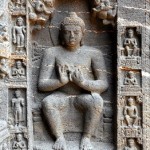
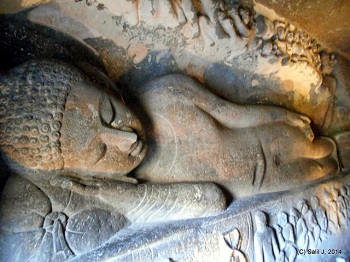
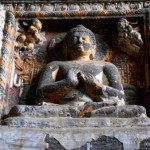
At the back, framed by a doorway beyond the ante-chamber and opposite the entrance is a huge Buddha. The walls and ceilings illustrate tales from the Buddha’s life. While most of the paint has peeled off, some of the panels have been well preserved and their beauty is there to see. The colours are still quite bright and the detailing is exquisite. Stunning, to say the least! For me, caves 19 and 26 were the most awe inspiring of the lot. Cave 19 has a beautiful and exquisitely carved façade and arched windows that add to its grandeur. The outside walls have several Buddha figures in various positions. Cave 26 has a large reclining Buddha that is nearly 25 feet long. I believe the reclining Buddha at Wat Pho in Bangkok has been inspired by the one at Ajanta, but I can’t verify this. All in all, walking in and out of the various caves at Ajanta is a journey of discovery.
On to Ellora

On day 2, Debbie and I met at 8.30 am at the bus station for breakfast and chai. Debbie enjoys Indian food and we happily tucked into kande pohe and a batata wada before we began our journey. The Ellora Caves are about 30 km from Aurangabad and it takes about an hour to get there. Unlike the Buddhist Ajanta Caves, the Ellora Caves are the product of three religious systems – Buddhism (caves 1-12), Brahmanism (caves 13-29) and Jainism (caves 30-34).

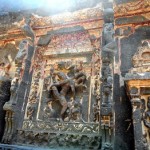
As you enter the Ellora Caves site, cave 16 is the first cave you see but it makes more sense to walk down to your right and start from cave 1. The Buddhist caves at Ellora are quite unlike the ones at Ajanta. Some of them are large, almost three storeys high, and have Buddha figures in the main shrine. Of the 16 Brahmanical caves, the most stunning is cave 16 or the Kailash Temple. Regarded as one of the greatest monolithic structures of the world, the Kailash Temple was cut top-down from a single rock! I think we spent half of our time at Ellora at the Kailash Temple – marvelling at its beauty and grandeur. At this juncture, I must tell you of my love for elephants – and I was fascinated by all the elephant sculptures here. Ganesh or Ganapati, my favourite elephant-headed God also makes an appearance. It also has a Shivaling.
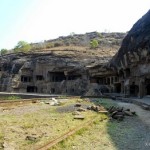
Cave 29 is also a must see. It is one of the largest caves and has three separate entrances with wide columns. On the left, as you enter is a huge Shiva with eight arms (in the form of Kali) killing a demon. On the right, is a huge intricately-carved scene of Shiva-Parvati sitting on top of Mount Kailash even as Ravan tries to lift it. Last, but not the least, are the Jain caves, which have to be accessed by road.

The most prominent ones are caves 30, 32 and 34, of which cave 30 is the chhota Kailash as it is considered to be a smaller version of the Kailash Temple. Cave 32 is known as the Indra Sabha, the assembly hall of Indra – the king of the Gods. It has a huge hall with pillars, each of which has a different design on it! I’d been told that the Ellora Caves can be seen in about two hours but I think we easily spent about four hours seeing all the important ones at length.

Since Debbie had to catch a flight back to Mumbai and then onward to Belgium, we decided to take a rickshaw back to the city (approximately INR 1,000). Our driver, Anees, was born in Ellora and was eager to show us some other sites on the way back. Our first stop was Aurangzeb’s tomb. Aurangzeb was the sixth Mughal Emperor and I expected his tomb to be grand, but the nondescript one I saw was disappointing. Next up was Bibi-ka-Maqbara, the mausoleum of Aurangzeb’s wife. Inspired by Agra’s Taj Mahal, it’s known as the Taj of the Deccan or the poor man’s Taj. If you’ve seen the original Taj, give it a skip. We also decided to give Daulatabad Fort a miss. Walking up 750 steps to reach its top in the scorching heat didn’t excite us!

My weekend trip to the Ajanta and Ellora Caves was more than I could have hoped for. I accomplished a couple of things along the way, saw magnificent works of architecture that are a symbol of what we humans are capable of, and had some friendly company along the way. What more can one ask for?

(Pictures courtesy Salil Jayakar)
Categories
Bombay, bas

Mumbai celebrates six festivals this week

What’s awesome about a cosmopolitan city is that there are several occasions to celebrate – this week, there are six!
by The Editors | editor@themetrognome.in

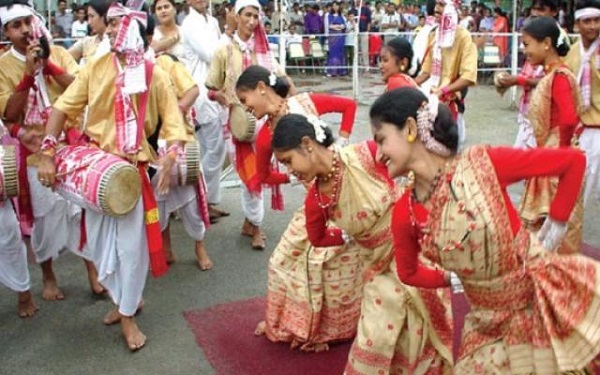
It’s safe to say that Mumbai has been in celebration mode since yesterday, Sunday, April 13. Or at least, Punjabis and Oriyas have started the celebrations – the harvest festival Baisakhi was celebrated yesterday, on Sunday, and the Oriyan New Year, Bishubh Sankranti, also began yesterday.

Other communities to celebrate the start of new years and harvest festivals are Bengalis, Malayalis, Tamilians, and Assamese.

The Bengali New Year, Poila Baisakh, falls on April 15 this year. Likewise, the Assamese will usher in their new year, Rongali Bihu, on the same day.

The Malayalis will usher in Vishu Kani on Tuesday, April 15. As per the Malayali calendar, the New Year starts on the first day of Chingam, but people in the Malabar area consider Vishu as the astrological New Year.  The term ‘Vishu Kani’ refers to the sighting of an auspicious item or symbol at dawn on Vishu day, thereby ensuring that the entire year is auspicious and peaceful. It is a day of much feasting, with food traditionally balanced between equal proportions of salty, sweet, sour and bitter items.

Meanwhile, Tamilians will celebrate Puthandu today, on April 14 this year. Puthandu is also celebrated in Malaysia, Sri Lanka, Singapore and Mauritius. Traditionally, a tray comprising a mirror, flowers, three fruits, betel leaves and jewellery is placed in a suitable corner of the home on Puthandu eve, and viewed first thing in the morning on the New Year day. This is said to set the tone for the rest of the year.

Enjoy the festivities, Mumbai!

(Picture courtesy www.hellotravel.com. Image used for representational purpose only)

Categories
Big story

“I was misquoted by the newspaper”: Abu Azmi

“The question of asking for punishment for rape victims does not arise,” SP leader says, blaming ‘misquote’ in Mid Day.
by The Editors | editor@themetrognome.in

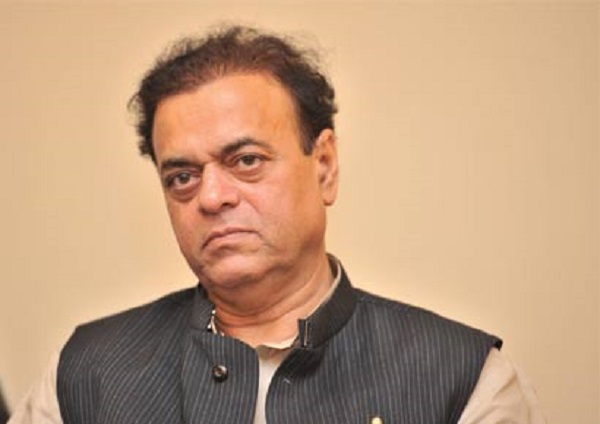
The furore over Samajwadi Party’s (SP) Maharashtra head Abu Azmi simply refuses to die down. A few days after the party and most notably, his son Farhan (contesting the Lok Sabha seat from Mumbai North Central) and daughter-in-law Ayesha Takia, were left embarrassed by Azmi’s controversial statements on women having consensual sex before marriage and that rape victims should be punished, the leader today tried to clear the air over the issue in a press conference in Mumbai.

“I didn’t say what I was quoted as saying in the Mid Day newspaper,” Azmi said, referring to the story that first appeared in the city tabloid. “The question of me or anyone else asking for punishment for rape victims does not arise…I regret [how my statement was twisted]. If a rape victim were to be punished [along with the rapist], it would be an act for the lowest of the low,” he said.

Explaining what he had actually said, Azmi added, “If the reporter (from Mid Day) chose to twist my words and print them, it is unfortunate. In fact, I was asked a question by another reporter, about Islam punishing sex before marriage for both men and women. To this, I had replied that yes, Islam did punish it and hence, it would be wrong to ask for severe punishment for a rapist in every such allegation. I said that if a woman has consensual sex and then resorts to blackmail and alleges rape, it may lead to a man being hanged.” He then added, “I did say that Islam punishes all rapists with death. But I also explained that such cases should be treated with caution, so that all parties receive justice. I had been speaking to the Mid Day reporter over the phone, and I did not know that the conversation was being recorded. What I had said off the record was also published as is, which is a wrong practice.”

Azmi further said that because of the news, his supporters and admirers had been “very hurt”. At the conference, he also read out the entire transcript of the conversation he had had with the Mid Day reporter, stressing that not once had he mentioned anything about punishing a rape victim.

What are your thoughts on Abu Azmi’s statements and his rebuttal? Let us know in the comments section below.

(Picture courtesy www.dnaindia.com)

Categories
Trends

More Indian women in the driver’s seat

A survey finds that with financial independence, more women are driving cars in India and stating their specific personal preferences.
by Nielsen India

The following is excerpted from a survey conducted recently by Nielsen.com (India), which tracked the numbers of women on Indian roads, their choices in the cars they drive and whether they are decision-makers in the car-buying process.

How Women Decision-Makers Are Influencing Car Purchases

– Women have become more involved in decision-making when buying a car.

– For women, safety features more important than price.

– Automatic transmission, abs and run-flat tyres key factors for women car buyers.

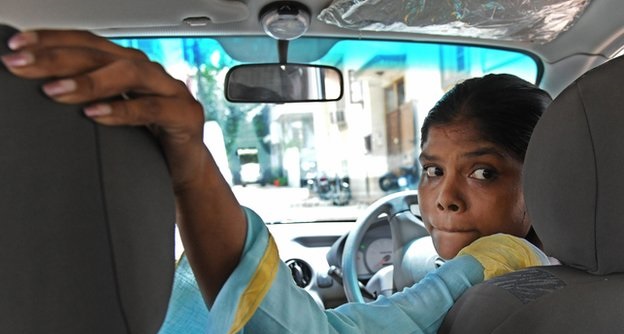
The gender gap on Indian roads is rapidly decreasing. As with other roles, women in India are taking the wheel in larger numbers—a shift that can be attributed to several factors, including rising education levels and increased career opportunities.

In Patna, for example, 3,228 driver licences were issued to women in 2010- 2011, up 37 percent from the previous year. Moreover, between 2008 and 2011, the percentage of cars registered by women in the city has doubled.

This growth spurt in women drivers has prompted car makers to innovate and design vehicles to suit women’s preferences. A Nielsen study into the subject of gender-based auto needs found that women today play an important role when choosing, and in some cases, even buying the family car.

Who’s making the decisions? 

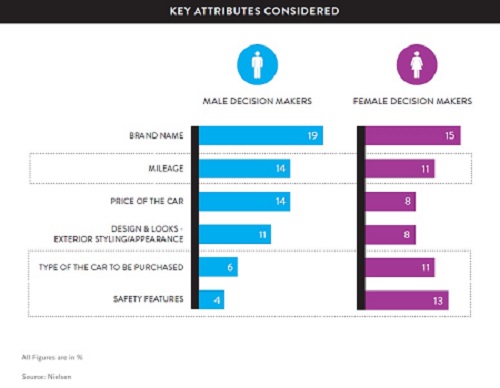
Almost half of all women respondents in the survey were the key decision-makers during car purchases. One in every four women said she was a joint decision-maker on important car features, including the manufacturer and type.

Based on the survey, women not only influence decisions about which car to buy, but on occasions, are also the sole decision-makers on crucial vehicle features. Around 75 percent of women decision-makers said they were the only ones deciding a car’s key elements during a purchase.

Nielsen’s findings also revealed that income plays a role in women’s involvement in the purchase process. Women who earn more than 75,000 rupees a month and are in control of the household budget are the key decision-makers while purchasing a car. Moreover, families with higher incomes have more women decision-makers. According to the survey, older women from more affluent families are also likely to be highly influential at the time of car purchases.

Consider the graphic below (click to magnify):

women and cars


(Featured image courtesy www.bbc.co.uk)

Categories
Enough said

Same same, but different

These elections have the potential to be a turning point in our country’s history, but what if nothing changes later?
Humra Quraishiby Humra Quraishi

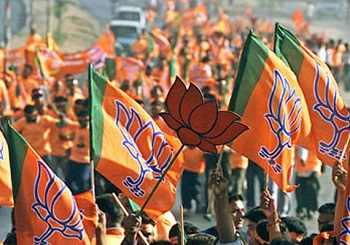
These elections and their results could well prove to be the proverbial turning point in the history of our country. Of course, it’s far too early to predict if the so-called ‘Modi wave’ will actually bring the BJP to power, or if it’s just a lot of hype. But one thing is clear – we are doomed if we are to be ruled by the likes of Narendra Modi and his aide, Amit Shah.

Modi has become quite restrained in his utterances, but Amit Shah is going all out, especially with his latest hate speech in Muzaffarnagar. Was his speech a hint of things to come – are we to expect more killings, more displacements of hapless innocents from their homes?

Just last evening, I had a heated argument with some others, when I said that under Modi, we cannot expect even a semblance of stability. Who is to say that tremendous upheavals will not take place under his stewardship?

No, this is not a question of the welfare of majority communities, or the safety of minorities. Have you ever wondered that with the BJPBJP, the RSS will follow? There is little need for me to elaborate on the kind of functioning of the RSS, which has often been intolerant of ‘others’. The turbulence I speak of started with LK Advani’s rath yatra, which started a series of events that led to the eventual destruction of the Babri Masjid, on December 6, 1992. Ever since that day, the poison of communalism has been steadily seeping into our psyche.

That is not to say that the Congress or Samajwadi Party can fare any better – if they had done what responsible political parties should do, then we wouldn’t have a situation like the one in Muzaffarnagar. The Congress had completely betrayed people’s expectations, and have been insensitive and unfair.

And in this bleak scenario, one is maybe forced to put its faith in AAP, which at least debuted in a stunning fashion this year. I have been interacting with several citizens during the campaigning phase, and here in Delhi, a high percentage of the population seems supportive of AAP. These citizens include people who are daily wagers and those from the lower middle class segments, and all of them are fed up of the ‘uselessness’ of the Congress and the BJP. Several told me that they would rather see the topi show its prowess this time around.

And while we are seemingly obsessed with the negatives of the AAP and Arvind Kejriwal, we are failing to see that the AAP has actually managed to rattle two biggies – the Congress and the BJP – and is being spoken of as the Number 3 option this election. That’s a huge achievement for a party so young.

Humra Quraishi is a senior political journalist based in Gurgaon. She is the author of Kashmir: The Untold Story and co-author of Simply Khushwant.

(Pictures courtesy www.indiatvnews.com, www.ndtv.com)

Categories
Do

Attend: A storytelling festival for children

Enroll your child in this 10-day storytelling workshop that ends with a finale performance in front of a live audience.
by The Editors | editor@themetrognome.in

We ply our children with a variety of ‘activities’ to keep them ‘busy’ during the long summer vacations. How about keeping them occupied in an activity that will help them explore their innate creativity and become imaginative storytellers?

‘Story Nest’ is back with the second edition of its storytelling summer festival for young children from Apri 14 to 24. Conceptualised by professional storyteller Sherin Mathews, who has been grooming children for the last 11 years, Story Nest will, through a 10-day camp, present the Big Fat Indian Wedding adaptation of the classic story, ‘The beauty and the beast’. The workshop will also work towards staging the inspired version of the Blue Umbrella.

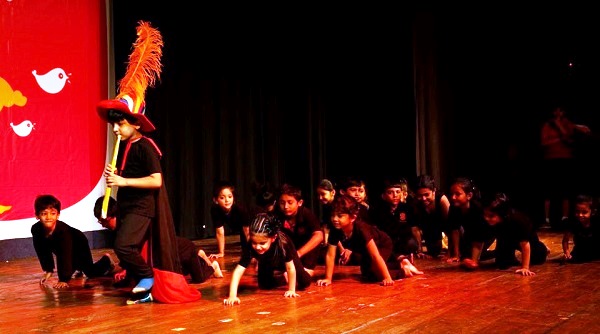
“Through Story Nest, we help children aged four to 16 years use the tools of storytelling in performing arts, storytelling techniques, public speaking, drama, music and dance. As a culmination of the unique storytelling festival, Story nest will stage a public performance of its young storytellers,” explains Sherin (in pic on left, during one of her performances with the children).

She adds, “Stories engage, enchant, touch, delight, inspire, motivate, challenge, entertain and transform the listener into a new way of being. Stories go right into the heart and soul of people. The power of storytelling on our lives can only be experienced. Listening to a storyteller can create lasting personal connections, promote innovative problem solving, and foster a shared understanding regarding future ambitions. The listener can then activate knowledge and imagine new possibilities. Together a storyteller and listener can seek best practices and invent new solutions because stories often have multiple layers of meanings.”

A few details about the workshop:

– The ‘Story Nest’ workshop will take place from April 14 to 24, 2014. These will be practice sessions, and will take place between 9 to 11 am and 6 pm to 8 pm.

– The finale will take place on April 26, 2014 at Prabodhankar Thackeray Auditorium, Borivali, from 10 am to 1 pm.

– The registration fees per child will be Rs 5,000. Each participant will be trained to narrate a story in one or more narrative forms.

– Call Sherin Mathews for more details on +91-9004748616.

(Pictures courtesy Sherin Mathews)

Exit mobile version