Categories
Event

Walk of art

Artist Renu Mital is showing her work at The Trident, Nariman Point, starting from today. Do check out her interpretation of ‘Survival’.

Too often, we complain of the city not hosting enough art events every week. For a city teeming with talent, and teeming even more with people wanting to see the work of young artists.

Since 1996, The Trident, Nariman Point, claims to have recognised these needs, and put up the Trident Art Walk for lovers of art in the city. The Art Walk claims to showcase “talents evolved by the magical triplet of brush, paint and canvas,” and takes place every fortnight in The Oberoi Shopping Arcade.

Starting today, artist Renu Mital is showing her work at The Art Walk, till April 14. Titled ‘Art Treasures’, Renu’s work deals with the theme of survival, through oil on canvas. Check out her work below.


Categories
Tech

Book your next holiday at a kiosk

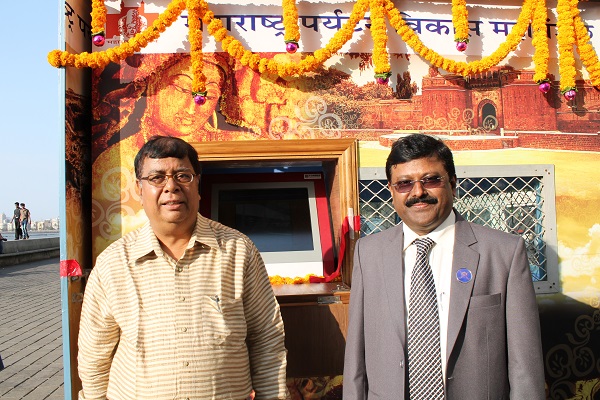
MTDC to install touch screen kiosks to help users book holidays at MTDC resorts; first one installed at Marine Drive.

It is summer time and everyone’s heading for a holiday. To make the process of booking accomodation for your holiday easier, the Maharashtra Tourism Development Corporation (MTDC) has hit upon the idea of installing touch screen kiosks at various spots in Mumbai and the State.

To this end, the first such kiosk was installed a couple of days ago at Mumbai’s Marine Drive. The kiosk and others like it will enable users to get information about tourist destinations in Maharashtra, in both Marathi and English. Plus, once you browse the information and make a destination choice, you can book your stay at an MTDC resort in that destination, as well as book train tickets to get there.

As per a release from MTDC, the plan is to “set up 300 such kiosks at various tourist destinations in Maharashtra, at Government offices, railway stations and airports. Within Mumbai, the kiosks will be put at CST, Dadar, domestic and international airports, Sanjay Gandhi National Park etc.”

(Picture courtesy MTDC. Image shows Jayant Kumar Banthia. Chief Secretary, Government of Maharashtra and Dr Jagdish Patil, Managing Director, MTDC, inaugurating the kiosk at Marine Drive)

Categories
Do

A rubber stamp existence

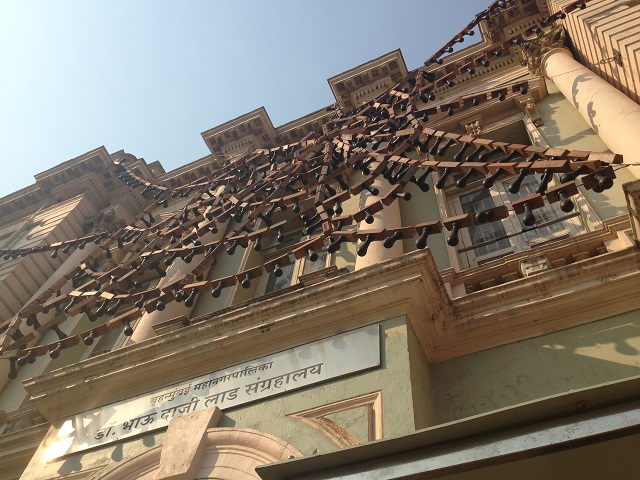
Reena Kallat’s ongoing exhibition at the Bhau Daji Lad museum has literally stamped its authority all over the building’s façade.
by Medha Kulkarni

An off-the-beaten-track thing to do this Sunday – if you haven’t already planned a movie/outing with family and friends/a booze party/ all of these would be to head to a museum. Not just any museum; specifically, the Bhau Daji Lad Museum, Byculla.

Why? Because it’s hosting a stunning exhibition by artist Reena Kallat. Titled ‘Untitled (Cobwebs/Crossings)’, the exhibition is a part of ZegnArt Public/India, an international project created by Ermenegildo Zeg

What it’s about

‘Untitled’ is an impressive work that captures the attention of the viewer with its sheer presence. Several rows of rubber stamps are strung together to create a cobweb that covers the entire façade of the museum (see featured pic). The work seeks to invoke ideas of bureaucracy and the passage of time; thus each rubber stamp actually has the name of a street (in the city) that has since been renamed.

According to Kallat, the work is “a visual representation of the cobwebs of the past and of memories that clutter our spaces and will eventually fade away with time.” The project was chosen out of a group of seven artist proposals (by artists like Gigi Scaria, Sakshi Gupta, etc.) by the museum and ZegnArt Public. A separate gallery space is devoted to the other artists’ ideas and works, for the benefit of the viewer.

ZegnArt Public believes that the public space can be inhabited in several ways to facilitate negotiation and exchange and encourage critical thinking and dialogue and thus aims to explore this possibility within diverse contexts. India has been selected as the first country for this intervention and thus ZegnArt has partnered with the museum to put to test this notion of public space vis-à-vis the urban fabric of India’s most dynamic city,Mumbai.

On view till April 14, the museum also organises curated walks every Sunday that seek to create a dialogue between art and the viewer. Kallat has referenced old street names and forgotten histories as nodal points in her exhibition, and these are used as a starting point for the walk. The walk covers the length and breadth of the exhibition and then continues on through the Museum’s permanent collections that highlight the faded memories and the constantly changing identity of the city.

The best part about the walk is it is organised in English and Hindi/Marathi and the price is included in the Museum entry fee. Walk timings are 11.30 am for the English walk, and 30 minutes past noon for the Hindi/ Marathi one.

(Picture courtesy blog.saffronart.com)

Categories
Tech

Google starts rental movie service for India

You can buy and rent movies, TV shows from Google’s Play Store. But the Hindi film collection isn’t too exciting.
by Manik Kakra

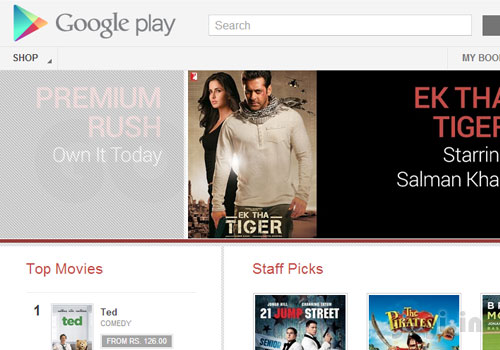
Here’s some good news for you Android users out there. Google has started its movie rental service on the Play Store. Users in India can now buy and rent movies and TV shows from Google’s Play Store.

To start off, you have to download the Google Play Movies and TV app on your Android device. Then, search for the required movie, and hit buy or rent.

Use it: If you rent a movie, you can watch it within a month, and for the next 48 hours once you start watching it. If you download a movie or a TV show, you can enjoy it on five devices, but rented movies can only be watched on a single device.

Pay for it: If you are not aware of the payment system, this is how it works: a user has to add his credit or debit card information on Google Wallet, in order to buy apps, games, e-books, movies, and more from the Google Play Store.

What we didn’t like: The movie collection right now isn’t too extensive. Hindi movie lovers won’t have a very good time browsing through the new catalogue. Movies start Rs 50 onwards, and go up to Rs 590, available in SD and HD options. Some of the Hindi titles available as of now are Ta Ra Rum Pum, Ek Tha Tiger, etc., but a lot of good films are missing. Meanwhile, the English collection looks much better, with The Hobbit, 21 Jump Street, Seven Pounds, and so on included.

A few days ago, Google started selling the Nexus 7 (16 GB WiFi) on its Play Store for Indian users, priced at Rs 15,999. A few weeks back, Google introduced e-books for Indian users. Back in December, Apple opened its iTunes store for India. Looking at these developments, it is sure that Google and Apple are becoming serious about the Indian market, especially on the content side. Though we have services like hungama.com and saavn.com for music and movies, brands like Google and Apple can really work the magic to bring better content to India, quality and quantity-wise.

I hope Google and Apple start bringing their devices quicker to Indian shores. We have a lot of users here, waiting for the devices and content, while their US and Europe friends enjoy it way before. Here’s hoping this start doesn’t disappoint, and companies have many more goodies in store for its users.

(Picture courtesy gogi.in)

Categories
Watch

Strictly a Monday evening affair

Tonight, Vikalp@Prithvi showcases two powerful documentary films about women who challenge the norm, and women trapped in a barbaric tradition.
by Medha Kulkarni

On every last Monday of the month, Vikalp@Prithvi organises free film screenings at Prithvi House. Vikalp@Prithvi is a collaboration between Prithvi theatre and Vikalp, which conceptualised and started ‘Films for Freedom’ six years ago in 2007 and has since screened several award-winning documentaries and brilliant short films.

What’s more, these films are made accessible to the general public for free.

The initiative is run by documentary filmmaker Anand Patwardhan and Chandni Parekh, psychologist and creator of online initiatives Chandni.org and Fund-A-Cause.

An assault on freedom of expression is an assault on democracy – this idea gave birth to Vikalp. What started off as a small festival has now morphed into a full-fledged movement. Vikalp insists that it is not an institution or a copyrighted idea, but is simply an inspiration, one that strives to ensure that voices of dissent will not be quashed or silenced.

Thus, the screenings that take place in various cities across the country are not necessarily in the name of Vilkap, although they do embrace its ideology. In Mumbai, there are specifically three venues that are said to be associated with this idea, namely the Tata Institute of Social Sciences (TISS) in Deonar; Alliance Francaise in Marine Lines, and of course, Prithvi Theatre in Juhu.

“All our shows are packed,” says Chandni. “Right from students, NGO professionals and filmmakers to bankers…the crowd is diverse and the post-screening discussions are enriching.”

Chandni says that the most memorable moment for Vikalp@Prithvi was in 2010, when they showed Deepa Bhatia’s film on farmer suicides, Nero’s Guests. “Many audience members voluntarily contributed to the donation box that we passed around to most of them at the end of the screening. We donated the entire amount of Rs 9,500 to Deepa to support the farmers in Maharashtra, whom she and journalist P Sainath have been helping,” Chandni says.

If you’re planning to catch a film today, you could consider these two powerful films at Vikalp@Prithvi:

Izzatnagari Ki Asabhya Betiyaan (The Immoral Daughters in the Land of Honour):

A documentary film about women who take on the powerful (and deeply misogunistic) khap panchayat is a powerful film that addresses the issues of ‘honour’ crimes, injustice and social boycotts. Directed by Nakul Singh Sawhney, the 93-minute long film chronicles the lives and stories of five young Jat women who rallied against the Khap Panchayts in their quest for freedom, justice and equality. The stories of these women are juxtaposed  with those of the Khaps. This poignant film exposes the double standards and violence that are conveniently kept out of sight and yet happen even today in a so-called modern India. The trailer of the film is here:


A Pinch of Skin:

This film talks about the hushed-up but rampant evil about the practice of female genital mutilation. The award-winning film exposes the brutal betrayal of innocent young girls, perprutated by a society that appears modern and yet retains the mindset of a cruel medieval one. In the guise of keeping a check on female sexuality, young pre-adolescent girls who have no control over what is being to them are the victims who have live with the burden of this life-long trauma. The narrative explores the voice of dissent (which sees this as politics of a sexual kind) intercut with those that insist that this heinous practice should be kept alive invoking the name of tradition. It is directed by film maker Priya Goswami who will be present for a Q & A session after the screening.

Screening Details: Head to Prithvi House, opposite Prithvi Theatre, Janki Kutir, Juhu Church Road, at 7 pm today, March 25. Entry is free, on a first-come-first-seated basis.

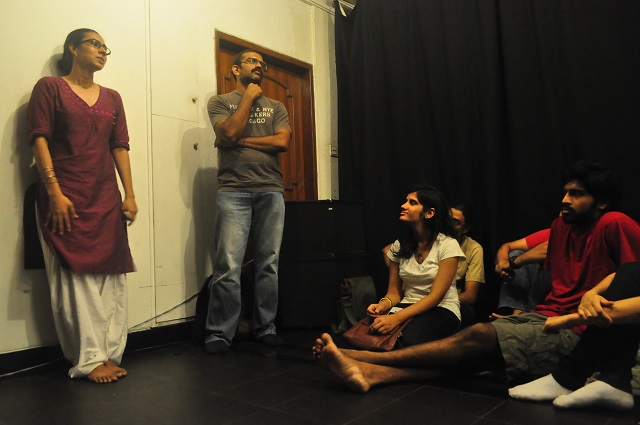
(Picture courtesy Chandni Parekh. Image is a file pic showing a post-screening discussion.)

Categories
Watch

A great idea takes Root

The Root Reel, an initiative to bring good documentary films and discourses on them to the public, turns one today.
by Medha Kulkarni

It started off as a simple idea born out of sheer love for good documentary films and after 12 months, incredible documentaries, critical engagements, passionate debates and discussions, The Root Reel celebrates its first anniversary today.

Part of The Root, which was conceived as a platform to facilitate discourses and expression on social and environmental issues through workshops, music, film (whether animation, documentary or short film), and other cultural avenues, The Root Reel deals specifically with films. In the course of the last year, The Root has set up various forums that saw the exchange of ideas and thoughts and encouraged a critical engagement with the issue at hand.

The Root Reel has been organising documentary film screenings once a week at the Alliance Francaise Auditorium, either in collaboration with another organisation or by themselves. This weekend’s film screening is extra special as it marks a milestone in the life of The Root Reel and has been organised in conjunction with the Indian Documentary Foundation (IDF). The film being showcased is Whores’ Glory and it is being shown on a first-come-first-seated basis.

Prior to this, The Root Reel has showcased such films as Megacities, Between The Lines, NEXT: A Primer On Urban Painting and Blood In The Mobile.

Those of you that can get out of work by 6 pm today, head to the Alliance Francaise Auditorium, Theosophy Hall, near Nirmala Niketan, Churchgate, to watch this film and stay back for a bit and participate in the discussion thereafter. The film is directed by Michael Glawogger and is 90 minutes long. Entry is free.

About Whores’ Glory:

Whores’ Glory is a cinematic triptych on prostitution: three locations, three languages, three religions. Paradise, the world and the hereafter merge in prostitution to create an image of the relationship between men and women. In Thailand, women wait for men behind glass panes, staring at reflections of themselves. In Bangladesh, men go to a ghetto of love to satisfy their unfulfilled desires on trapped girls. And in Mexico, women pray to a female death so as not to see and feel their own reality. Where the most intimate becomes a commodity, the product is expensive and fiercely contested.

Look for more details on The Root and their events here.

Exit mobile version