Categories
Tech

Review: Coolpad Note 3

This new phone looks good on paper and performs well too. It is a great device, save for some glitches.
by Manik Kakra | @Manik_K on Twitter

The Chinese company that started its smartphone journey here with the Dazen1 and Dazen X7 is now out with the Coolpad Note 3. While the Dazen1 certainly provided a bang for the buck, we were a little disappointed with the DazenX7. Let’s check out if the Coolpad Note 3 performs enough to take on this already-heated price segment of under Rs 10,000.

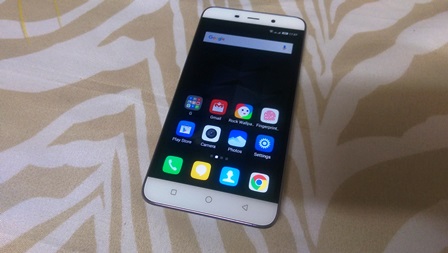
The looks. There are two White bands above the 5.5-inch HD screen that sport LED notification, sensors, ear-speaker grille, 5 MP camera at the top; and three capacitive touch buttons – Recent Apps list, Home, and Back (from left to right) – at the bottom. The phone is quite large but doesn’t feel awkward to hold given its sheer screen size and curved sides on the back. At the back, it accommodates the bio-metric fingerprint scanner around the centre, and the slightly-protruding 13 MP camera, which is surrounded by LED flash and secondary mic. The loudspeaker is located near the bottom.

On the left is your volume rocker, which is all plastic and feels just okay in terms of tactical feedback; while the Power/ Lock key is on the right and isn’t difficult to reach. The 3.5mm headset jack is on the top, and the bottom part hosts the microUSB port.

Screen. The phone sports a 5.5-inch (1280 x 720) IPS panel. The screen is great for outdoor usage under sunlight and does a good job of colour reproduction. HD videos look quite nice on it, and I didn’t spot any shortcomings while viewing videos, though high-resolution images may appear a little washed out to some coming from a high-end screen.

Coolpad Note 3Camera. The Note 3 boasts a 13 MP (f/2.0) camera on the back. Here are a few sample images.

The camera does a good job at focus adjustment and capturing colours, but struggles with sharpness. It is decent at handling low-light shots, and the camera app, with a bunch of usual modes to pick from, works really well for taking shots in most situations.

Battery. The phone often lasted around 20 hours with heavy to moderate usage. With light use, it can last you a full day on a single charge. This includes brightness at 20%, some Leo’s Fortune, Twitter, WhatsApp, and EMail (Gmail app) with a single SIM card inserted. The phone takes a little over 2 hours to get its 3,000 mAh battery unit fully charged, and while it supports quick charging you will need another higher capacity charger as the default charger you get in the box doesn’t support it.

Audio. The phone’s loudspeaker at the back is pretty much average and its placement doesn’t help either. It’s fine for ringing and notification alert, but don’t expect good sound for videos and games. The phone has good call quality on both sides, but I did notice a bit of performance deterioration in terms of network reception compared to other smartphones on the same network and in the same areas. The Note 3 supports 4G LTE on of the SIM slots (both require microSIM cards) and usual 3G and 2G on the other slot.

Software and performance. The Coolpad Note is powered by the MediaTek MT6753 chipset (1.3 GHz octa-core processor, Mali T720 MP2 GPU) along with 3 GB of RAM. It runs on CoolUI 6.0 that’s based on Android 5.1. The fingerprint scanner on the back is nicely mushed below the surface and works really well, about 8 out of 10 times. While some might find its back placement a bit odd, it’s not that strange after a few days of use, plus it unlocks your screen quickly.

Long-pressing the Home key brings up Google Now. You can now lock a particular app in the recent apps list, so that it doesn’t get cleared when you clear all apps from the list. The OS seems to have fixed push notifications issue with messaging apps. Performance-wise, the phone seems quite smooth and hardly lagged during use. The OS still looks and feels quite immature, like icons, default sound tracks, etc, and the theme center hardly has any options to choose from. Its basic style of having all your apps shortcuts and widgets on various Home screens is still there, though you can now switch to “traditional style” and have a separate app launcher in addition to your Home screens.

All in all, the phone that seems compelling on paper also performs pretty well to make it a good phone at this price point. It has a good screen, above average battery life, but while it struggles with sound quality and how CoolUI looks, the OS performed pretty well and a fingerprint scanner that doesn’t disappoint for daily use making it a worthy contender, with the likes of the Honor 4X, RedMi 2 Prime, Karbonn MachOne Titanium and a few others, for those looking for buy a smartphone under Rs. 9,000 or so.

(Pictures courtesy Manik Kakra)
Categories
Film

Review: Rajwade and Sons

This week’s release is the story of generational conflict in one of Pune’s richest business families. Watch it with family.
by Ravi Shet

Rating: 3.5 out of 5

A film about business, interpersonal relationships and how succeeding generations view the world through a different prism, Rajwade and Sons is a story of familial obligations, stifling dreams and carrying on age-old traditions.

Adamant patriarch Rameshrao Rajwade (Satish Alekar) is the head of the Rajwade family and his children – Vidyadhar (Sachin Khedekar), Laxmi (Mrinal Kulkarni) and Shubhankar (Atul Kulkarni) obey their father’s decisions and orthodox values without questioning him.

Vidyadhar is prone to snooping on his children by checking their Facebook accounts and even discussing the same with his wife. Meanwhile, Anay is slightly self-centred with his love for shoes and his laptop, while Shweta is interested in working and travelling around the world.  Laxmi lives in her father’s place along with husband Vaibhav Joshi (Rahul Mehendale) and their kids – Annaya (Mrinmayee Godbole) and Virajas (Siddharth Menon). Virajas is shown working half-heartily in family business with Anay, while Annaya wants to pursue her career in modeling.


In this cast of characters is introduced Vikram (Amitriyaan Patil), Rameshrao’s estranged son who has left the family home years ago and not been in touch ever since. Anay, Annaya, Shweta and Virajas go to their old home and discover Vikram’s belongings and also take some of the things. Till one day, Vikram returns and everyone is excited and happy to see him, except for Rameshrao, Shubhankar and Vaibhav. They suspect that he has come for his share of the money and property. Vikram’s entry in the family energises the third generation of the Rajwade family to pursuing their dreams.

Sachin Kundalkar keeps the right amount of twists in the story, and realistically showcases how the older generation’s decisions are forced on the succeeding ones. There is a harsh glare shone on the infighting and the concept of the Indian joint family that restricts the younger generation from living their dreams. The pace of the film is well balanced in the second half with good camerawork by Arjun Sorte. Atul Kulkarni and Amitriyan Patil deliver good performances and they are very well supported by Alok Rajwade, Krutika Deo, Mrinmayee Godbole and Siddharth Menon. This one is a good watch with your family members – even the extended family ones.

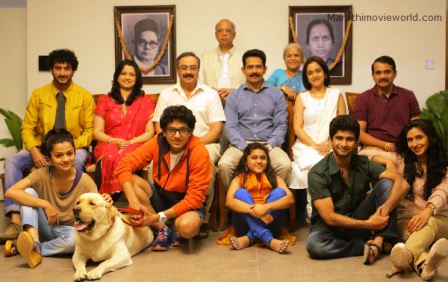
(Picture courtesy marathimovieworld.com)

Categories
Film

Review: Sicario

A fast-paced thriller that explores morality and humanity in interactions with criminals, this one’s a one-time watch for action fans.
by Ravi Shet
Rating: 3.5 out of 5

Sicario is directed by Denis Villeneuve, and it is a story that deals with the drug trade and how US agencies sometimes bend the rules to dismantle this business and the people associated with them.

The film features FBI Special Weapons and Tactics Teams agent Kate Macer (Emily Blunt), agent Reggie Wayne (Daniel Kaluuya) and their team on their way to raid a house in Chandler, Arizona. To their shock, the FBI team discovers an array of dead bodies embedded in the walls of house, while two FBI officers are killed by an explosion in the backyard.

Dave Jennings (Victor Garber), Kate’s boss, Matt Graver (Josh Brolin), Department of Defense advisor and others include Kate and her elite team of agents in a plan to look for the person responsible for the incident, which includes cartel boss Manuel Diaz (Bernardo Saracino). Kate and Matt leave for their mission via plane to El Paso, where Alejandro Gillick (Benico Del Toro) joins them. Kate soon discovers many disturbing facts – the plan is going to Juarez, Mexico instead of El Paso, Texas to extract a prisoner named Guillermo, Manuel’s henchman. Then, Matt’s methods are highly questionable when extracting the criminals, with no concern for civilian safety and civil laws.


Soon, Guillermo is badly tortured by Matt and Alejandro to know the whereabouts of Manuel. Matt and Alejandro succeed in getting the exact location of the tunnel that the cartel uses to get drugs into the US through the help of Mexican migrants. Kate and Reggie feel that Matt keeps them in the dark about many details and do not answer their doubts convincingly. This back intrigue sets the stage for many twists in the story.

The pace of the film is well maintained. Roger Deakins’s camerawork is superlative, especially in the scenes shot through underground tunnels on different types of night-vision equipments. Emily portrays Kate with the right balance of strength and empathy, while Josh Brolin and Benico Del Toro support the film with solid performances. This one’s a must-watch for thriller and action fans.

(Picture courtesy www.sbs.com.au)

Categories
Listen

Jazz fever hits Mumbai

Famed jazz musician Igor Butman kicks off Mumbai tour with a spellbinding stage performance with talented visually challenged Mumbai students.
by Ravi Shet

Noted Russian Jazz maestro Igor Butman, after giving a magical performance in Goa on October 4, 2015 reached Mumbai yesterday with his quartet comprising Saxophone, Drums, Double Bass and Piano. Jus’ Jazz 2015, an annual jazz fest series is initiated by Jazz Addicts, a group of jazz enthusiasts.

Igor needs no introduction, especially to people who understand and love jazz music throughout the globe. It was in the year 2003 that Igor first came to India as a part of India Russia Cultural Programme and this is the fourth time Igor (who has been associated with Jazz Addicts) has come to India. This time, he will enthrall audiences with a unique presentation.

His quartet features an exceptionally talented pianist, vocalist and the visually challenged Oleg Akkuratov from a small Russian town, Armavir. Oleg has won numerous awards and hearts through his incomparable talent. Igor met Oleg three years ago in a competition and was impressed by him. Drummer Eduard Zizak and Sergei Korchagin, double bass player, a new member of the Quartet, completes this magical band.

In an interactive workshop yesterday between Igor Butman Quartet and the students from National Association of Blind (NAB) at Little Theatre, NCPA, Mumbai, every moment was a touching one and the auditorium was spellbound by jazz fever. The NAB students and Igor Butman Quartet had an excellent Jam session and also one of the NAB students, Bhagwan and Oleg sang ‘Mera Joota Hai Japani’ which was an excellent performance of the evening.

Igor Butman Quartet will perform today at Tata Theatre, NCPA. Igor says with his infectious smile, “I love coming to India since people over here respect and appreciates jazz music and also the food, especially chicken dishes are really good. Jazz music motivates me to perform and improvise my own composition every time.” He says that music runs in his family, his grandfather was a pianist who used to perform for Russian band. “I enjoyed watching my father performing on the stage and that made me follow in his footsteps. Also my mother and grandfather encouraged me lot in my music journey.”

Jazz music lovers, get ready to be mesmerised this evening by Igor Butman Quartet.

This event is at Tata Theatre, NCPA, 7 pm today, Tuesday, October 6, 2015. Tickets are priced from Rs 300 to Rs 1,668.

Categories
Film

Review: Dagadi Chawl

Excellent performances and slick camera work make this film stand out, though the story and plot follow a predictable graph.
by Ravi Shet

Rating: 3 out of 5

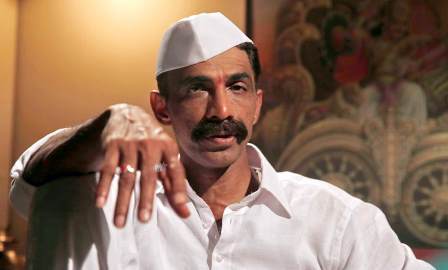
Dagadi Chawl directed by debutant director Chandrakant Kanse not only focuses on gangster-turned-politician Arun Gawli (known as ‘Daddy’) but also highlights the story of a common man caught in the deadly world of crime and the era of gang wars in late 90s.

The film, based in Mumbai in 1996, starts with Daddy (played by Makrand Deshpande) performing a puja at Dagadi Chawl, while his trusted henchman, Chandu Mama (Sanjay Khapre) attacks a local politician who is set to contest elections against Gawli.

Suryakant Sadashiv Shinde aka Surya (Ankush Chaudhari) who works for Daddy collects extortion money from a builder named Desai. On getting a complaint from Desai, encounter specialist Inspector Kale (Kamlesh Sawant) picks up Surya and plans to bump him off to complete a half century of encounters. However, DCP Ashfaq Khan interrupts Kale’s vehicle and demands that Surya be transferred to him.

On interrogation, Surya reveals the story of how he chanced upon a life of crime: when a group of goons harasses his girlfriend, he gets into an altercation that ends with him beating many of them up. This lands him squarely in Daddy’s crosshairs, because the goons are his boys.

This film will remind you of the gritty Satya and Vaastav, since the backdrop of the plot is quite similar. Here too, an innocent man falls prey to an unforeseen situation and ends up in the murky world of crime. Some of the scenes in the movie are predictable; however some slick camera work clubbed with a good background score and sharp editing are the positives of the film.

Ankush Chaudhari as Surya justifies his role perfectly; however Makrand Deshpande as Daddy impresses the audiences a lot more through his body language and dialogue delivery. Sanjay Khapre and Yatin Karyekar play good supporting roles. Many in the audience will also love the ‘Morya’ song played during the Ganesh Visarjan scene.

(Picture courtesy marathistars.com)

Categories
Tech

Review: OnePlus 2

We review the newest OnePlus phone and find that it has some good features while it lags behind on some others.
by Manik Kakra | @Manik_K on Twitter

OnePlus has been among the most talked-about phone manufacturers in the last one year or so – whether for a good reason or a bad one is debatable. The OnePlus One helped usher in this new era of affordable smartphones that give bang for the buck when it comes to overall performance. Does the OnePlus 2 justify itself? Let’s find out.

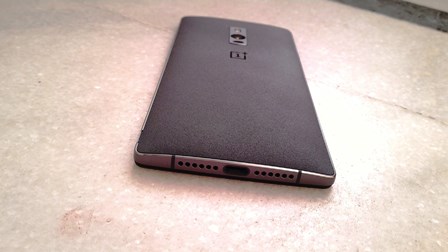
The looks. OnePlus 2 (A2003) follows a similar form factor, but is noticeably narrower and denser. Its Sandstone rear panel is still there, and you get unique rear cover options like Kevlar, Rosewood to add if you like. This time, the company has also added a silent/notification switch on the left side, so that you can switch between silent and alarm (as per Android Lollipop’s changed notification system) where you can choose what alerts you and what doesn’t without having to turn the screen on.

On the right, you have volume rockers and Power/Lock key. Another change is the new USB type C port (more on it later) at the bottom around the mic and loudspeaker grill at the bottom. On the back, an annoying thing, at least for me, is the metal case around the infrared laser focus, camera and dual flash. The metal ring isn’t flush with the surface, and you keep hitting it with your finger.

The aluminium chassis around the phone and thinner bezel are definitely welcome changes. The phone feels a lot more solid in hand. It isn’t a small phone by any means, but that curved back, Sandstone back cover and rounded edges help in gripping a bit more comfortably.

Screen. The OnePlus 2 boasts a 5.5-inch full HD LCD with Gorilla Glass on top. I found the screen a little brighter than the OnePlus One, and has good viewing angles and decent colour reproduction, but some might spot washed out colours coming from a better panel. Visibility under sunlight is okay and full HD videos and high quality images look pretty good on it. It isn’t the best LCD on a phone today, but certainly not bad either.

Sound. The loudspeakers at the bottom are just about okay for videos and games, but not as punchy as the best out there. It has modes like time lapse for video, HDR and Panorama for images.

Camera. On the back, there is a 13 MP (OmniVision sensor) camera with dual LED flash and an infrared laser focus. Here are a few sample images.

The camera can take good detailed shots. It struggles in low-light conditions (improved with last two updates), giving grainy shots, but performs well enough in decent lighting condition. The camera app was a little sluggish to use and had some shutter lag in the beginning, but has improved with the last update, too.

Battery. The phone is equipped with a 3,300 mAh battery unit that is not user replaceable. I found its battery life to be decent – quite a few times it lasted me almost a day for light to moderate usage; while requiring to be charged in about after 20 hours (4 hours of screen on time) with quite heavy usage (single SIM card). It isn’t as good as the OnePlus One, but not below the average Android flagship today.

The phone has a USB type C port, meaning no more juggling which side of the USB cable goes up. On the contrary, there is no quick charging, which a lot of people will miss having seen or used it on many Android phones launched earlier this year. The phone takes almost two and a half hours to charge from 0 to full.

Software and performance. The device runs on Android OxygenOS 2.1 that’s based on Android 5.1.1. If you’re familiar with stock Android (mainly seen on Nexus and Android One devices, as well as Motorola phones), you should be at home while using this phone for the first time.

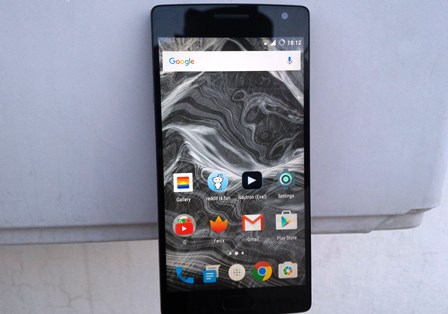
There is something called Shelf on the left-most Home screen that shows weather, your most used apps and contacts and you can also all widgets on it, not of much utility at this time. You can now change the phone’s screen colour temperature (added in the latest update). Customisations options include the option to change what LED colour for a particular type of alert; using any icon pack from the Play Store in the default launcher, which is same as the Google Now launcher in most ways. You can also decide between physical touch buttons or on-screen keys, and later assign which key does what function.

Under the hood, there is a Snapdragon 810 SoC (1.8 GHz octa-core processor, Adreno 430 GPU) along with 4 GB of RAM (that’s for the 64 GB storage option; 3 GB for 32 GB storage). I found the OS to be quite smooth and stutter-free. Leo’s Fortune, a popular game, runs smoothly on it and doesn’t drop frames. Having said that, I found strange issues like the default dialer lagging, or Home button not recognising a single tap, quite a few times. Though the fingerprint scanner itself works really quickly and about 8 out of ten times. Oh, and it certainly gets a bit hot around edges and camera module after a bit of gaming and watching HD videos.

All in all, the OnePlus 2 seems like a great device under Rs 25,000, but doesn’t leave a great impression that its predecessor once did. It has a good screen, decent battery life, one of the best cameras in this price budget, but lags behind a little due to its software issues. And while you might want to buy a OnePlus 2, you still need an invite to purchase one from Amazon.

(Pictures courtesy Manik Kakra)

Exit mobile version